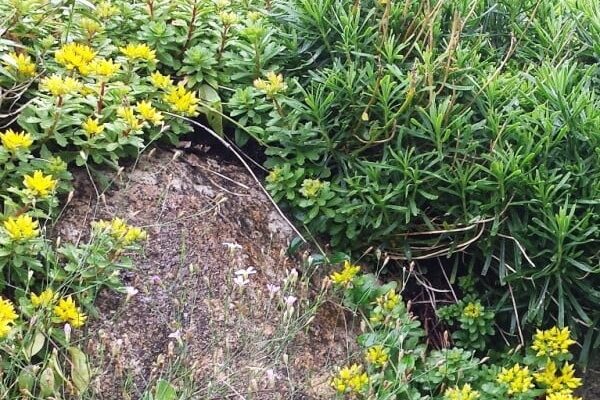
It’s said like this rock garden stonesjust like plants, they must be planted, not placed. Obviously there are some principles that apply to how to place stones and how to combine them with plants so that the final image is harmonious and beautiful. We asked the landscape architect Linas Puodžiūtėwho conducts seminars on rock gardens and other uses of stones in the garden, what rules would you recommend following?
The rocks in the rock garden have the same origin
Compositions of stones and plants must unite everything into a single image, so the more different details in this combination, the more difficult it is to avoid chaos. And vice versa: as much as possible identical objectsthe easier it will be to create a harmonious whole. This is an eternal law that applies not only to the design of rock gardens, but also to the design of the entire construction site.
With stones this law is clearly visible. Therefore, the specialist suggests do not mix stones of different origins. If you have already chosen sandstone boulders, just use them. If you have selected granite slab
This does not mean that all stones will be the same – they will differ in shades, patterns and sizes.
USE STONES OF DIFFERENT SIZES
If you are looking for stones to buy, ask immediately if the suppliers have them in different sizes. Too many small stones will not create any effect. There should be at least some stones significantly larger for others.
Lithuanians are used to seeing strange stone compositions, called rock gardens, dominated by small rubble. However, it has little in common with the real Alps, so it cannot be said that such rock gardens imitate nature. Many people attach great importance to stones, but their smallness does not create an effect, but becomes a background. So we no longer understand who plays the main violin in a Lithuanian rock garden: gravel or plants?
Pay attention to the works of foreign designers. In order for rock garden stones to play, they must look good. Therefore don’t be afraid to use large stones.
Buy them in different sizes: from large ones, which will be accents, to completely small ones, which will fill the spaces between the other stones.
Immediately choose whether the stones will be broken or stretched and do not mix with each other. So everyone, from small to large, must be like this or like that.
GROUP THE STONES
We already have the stones, but how to arrange them? Group them. Some large stones lost in a sea of very fine rubble: no drawing, no image.
If you doubt your intuition, use the laws of classical design: group an odd number of stones: by 3, by 5, by 7, etc. In one group, let there be several larger stones, a little further away – several more large stones, further – another group of stones. An odd number will help to avoid regularity, which is not characteristic of nature, but at the same time it will allow you to maintain a neat and harmonious image.
Fill the spaces between large groups of rocks in the rock garden with fine gravel or plants.
GROUP and PLANTS
Do not disperse the plants in any way, but also group them together. In no case do not plant several varieties of plants one at a time, as it will be very difficult to create a balance. Remember what it looks like mountain areas in nature – after all, they are dominated by only a few types of plants, which are repeated in several places. Use the same principle: fewer species, more units.
If in doubt about the choice of plants, limit the color palette of flowers. During the seminar L. Puodžiūtė provides advice on color matching and recommends specific plant varieties suitable for growing next to stones. However, if you look deeper, you will definitely find the right flowers for you, just remember to plant them in repeating groups.
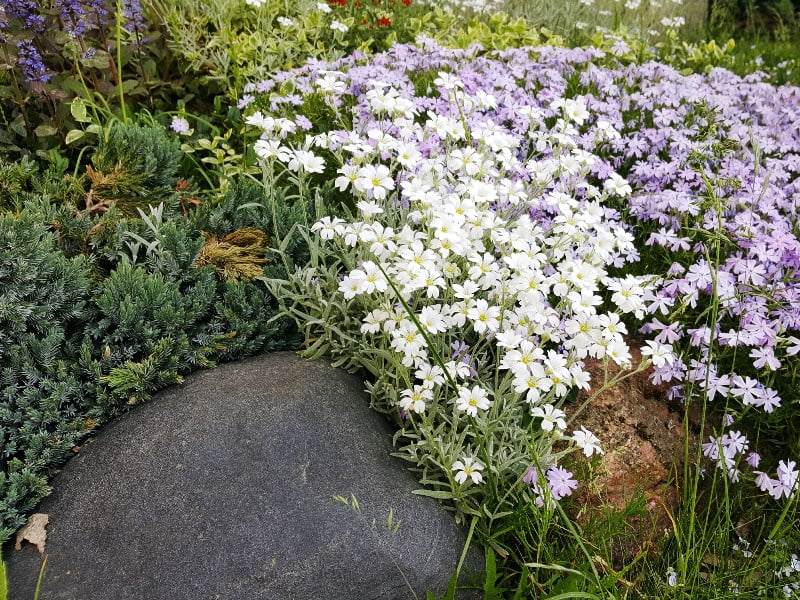
Look for plants that like dry conditions and don’t need a lot of humidity. When in doubt, it is often there as a sign leaves of a gray shade, which are still covered with fluff. The flowers are usually small, the stems are thin, the leaves are narrow. All these signs show that the plant is trying to retain moisture as long as possible and let it evaporate as little as possible. In Lithuania you will find a really wide choice of suitable plants, so the biggest problem will not be finding the right one, but rejecting it so that there are not too many.
DO NOT REGRET AND DO NOT BURY THE STONES
In order for the composition to look natural, the stones should not be vertical or transverse, but lying flat. We’re talking just like people! In short, the stones must be as if they fell naturally or were pushed out from the depths of the earth.
This means that at least a third of the rock mass must be underground, and better if even two thirds underground. The stone will look as if it has been here for years and will blend in beautifully with the surroundings.
Understandably it’s a shame to have a stone that costs a lot of money practically buried in a mountain. However, if you want a beautiful and natural image, don’t hesitate bury part of the stone.
Additional tip: large stones that end up on a slope, dig a littlecreating a sort of terrace. This is done so that rainwater does not flow from the stone composition to the sides, and at least part of it is directed into the inside of the composition, where plants grow. Since the plants are planted in easily drained soil, there will be no waterlogging anyway, but due to the planting angle of the stones, the plants will receive more moisture during rain.
And don’t forget it Rock garden stones, like plants, are part of nature. Therefore, you can immediately break all the rules if you see that the image is harmonious and natural-looking. The most important thing is that the entire composition of stones and plants is not bright and sparkling with colors and novelty, but beautiful in its simplicity and eternity.
latest posts published
Tired of working in the garden? What can be done to reduce maintenance
How to successfully transplant a Christmas tree
Landscaping a new plot: where to start?
What grows in clay: This is what worked on Juste’s farm

Organic seeds: are they worth paying more for?

Preventive spraying of tomatoes with homemade remedies –
Environmental management: how to renovate a bored plot?
Designers answer what are the 3 best plants for the garden
Fruit trees online: how I ordered them and how I planted them