It all begins like this.
One fine day you calmly approach your plant, ready to give it a little water to continue its happy – and hydrated – existence and as you tilt your wrist you let your gaze wander among the leaves.
How beautiful is the foliage? All colored, or perhaps an intense green.
But it is inevitable, as your eyes move to see if some new, small and adorable leaf has emerged at the base, you see HER.
The cursed one is white and furry, like a bunny that came out of the ground with the worst intentions.
You blink hoping for a strange reflection of the light coming from the window. But it’s 9pm in a cold February, it’s already a lot if the light bulbs in the house give off light, let alone the sun.
You sigh and stop giving water to that poor plant that is now swimming (the unwanted wad of evil does not drown, we warn you) and with a look of pity you ask yourself how much longer it has left to live, if a move is possible, or a surgical operation to remove the mold.
What can be said in these cases? We know that finding the words is not easy.
…Ah no wait. Of course it’s simple! Enough with the melodramas and let’s dive into this guide to the battle against mold, you might be surprised by the simplicity with which you can defeat such a problem 😉
White mold and plants
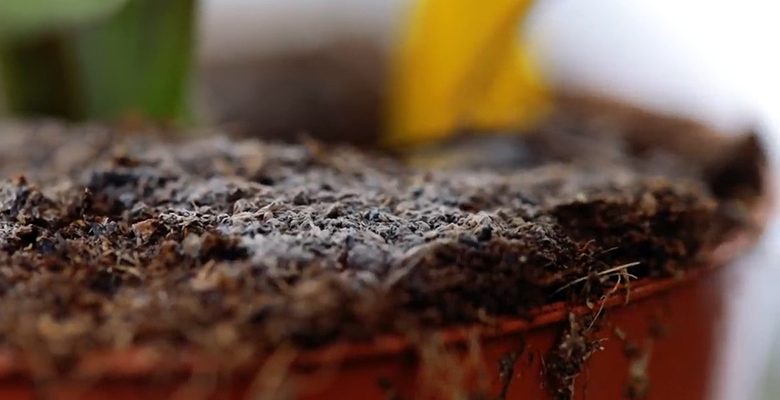
We often receive requests for help relating to the discovery of white mold on plant soil. In fact, it often happens that mold and/or whitish encrustations appear on the surface of the substrate even in cultivation pots carefully kept at home.
First of all, let’s start by reassuring you, in most cases, it is nothing that can affect the health of the plant.
Aesthetically, however, they represent an ugly detail, for this reason it is worth studying the topic further, discovering how this mold is created and how to eliminate it.
Causes of mold
White mold usually originates from two fairly canonical main causes:
- real mold caused by decomposition of organic elements (e.g. bark). Molds have a primary role in attacking the organic substance which must be mineralized, in these cases it is characterized by being hairy. To avoid -or limit- its formation it is necessary to pay attention to do not leave dead parts of the plant (such as fallen leaves) on the ground surface. At home therefore, maximum cleanliness of the plant! Other times these molds can arise from the presence of coarse material within the soil. This event usually occurs with poor quality soil but unfortunately even with the best of substrates you cannot be 100% certain that you will never see mould.
If you decide to use organic material to fertilize the plant (e.g. coffee grounds), remember that it is good practice to compost these materials first, in this way we do not risk that all this organic substance remains on the surface causing the now well-known problem. - the second hypothesis is not inherent to the presence of actual mold, but rather it is mineral deposits always whitish in colour. In these cases the surface of the soil acts as a filter and when the water evaporates, mineral residues, usually of calcareous origin, remain on the ground. In these cases the “mold” will not be hairy but will look more like a crust made up of many grains.

In both cases, the problems are usually triggered by an excess of water and a poor light exposure.
How to solve the problem
We have already clarified that white mold is not a real problem for the plant, we therefore underline that the solution is not repotting which would only cause stress to the plant.
In the first case, if we see that there are coarse elements on which mold is forming, we simply need to remove them and throw them away. Otherwise (both in the first and second case) it will be sufficient to remove the soil that shows signs of mold and replace it.
To prevent this phenomenon I recommend the use of excellent soil and the use of sub-irrigation, which never manages to wet the last centimeters of surface soil and causes neither the triggering of the decomposition processes which then cause mold nor the deposit of minerals.
latest posts published
Tired of working in the garden? What can be done to reduce maintenance
How to successfully transplant a Christmas tree
Landscaping a new plot: where to start?

What grows in clay: This is what worked on Juste’s farm

Organic seeds: are they worth paying more for?
Preventive spraying of tomatoes with homemade remedies –
Environmental management: how to renovate a bored plot?
Designers answer what are the 3 best plants for the garden
Fruit trees online: how I ordered them and how I planted them