Prophylactic spraying of tomatoes can significantly extend the yield of tomatoes. After all, tomato diseases are one of the most common reasons for ending the season early. It is possible to purchase special means for preventive spraying, but you can also do it from what you have at home:
After my tomatoes were attacked by a brown spot last year (you can read it here), I decided to prevent diseases instead of fighting their consequences. I will tell you why it is worth spraying tomatoes, when it is better to do it and, of course, with whom and how.
Spraying tomatoes: why it is necessary
The phrase “spraying tomatoes” does not mean that we are talking about chemical preparations. Spraying as a tool is the transfer of certain substances to the plant: only if we water, we give those substances through the roots, and if we spray, we give them through the leaves. Through the leaves the plant absorbs substances faster, so this is particularly important if we already notice a deficiency of certain substances or if we notice the first signs of diseases. The sooner the plant receives help, the better we will help it.
Tomatoes can be sprayed for two reasons:
- When tomatoes lack nutrients;
- When you want to protect tomatoes from diseases.
The means can be of chemical origin, but they can also be organic, organic – these are all kinds of homemade plant extracts or special organic means, ready-made and sold in garden shops.
This time I’ll go another way: I’ll use simple tools that I have in the medicine cabinet and refrigerator at home.
I’ll show you everything, but first let’s see what situation I see in our greenhouse.
The tomato flowers withered
In June I found dead tomato flowers in my greenhouse. This means that the flower has formed, but the fruit will not bloom. In other words, we have already lost part of the harvest. what happened The tomatoes lacked boron. This could have happened for several reasons:
- It was too hot in the greenhouse;
- There was too much humidity in the greenhouse.

If this has happened to you, look for a special product with boron in garden supply stores. You won’t be able to revive dead flowers, but you can still save the ones that grow higher.
You can find recipes for mixing your own boron, but boron hasn’t been sold for years, so look for a special garden mix and spray it on your tomatoes.
Twisted tomato tops
To be honest, this has nothing to do with spraying, but I get this question all the time from novice growers.
If you see bent and twisted tops in the evening, I want to calm them down. This does not mean that it lacks moisture. This does not mean that diseases have attacked. This curling of the buds before night is a normal phenomenon.
Tomato diseases
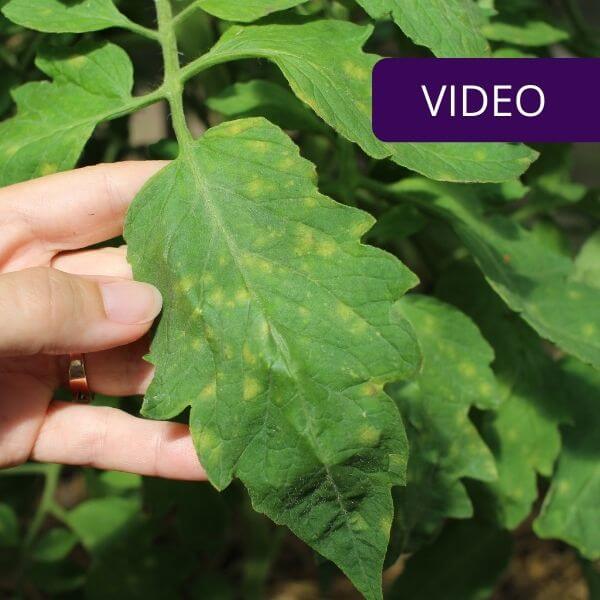
Tomato diseases are usually of fungal origin, we can see their signs on the leaves: they appear as whitish, brown spots. This is what the leaves of our tomatoes affected by brown spot looked like last year:
If many leaves are damaged, we already start treatment, as we did last year.
But if the leaves are nice, if you see just another strange spot, a preventative tomato spray will help. And it doesn’t necessarily require fancy preparations, you can even find some in your home medicine cabinet.
As a base I use potassium permanganate and iodine, both of which can be purchased in pharmacies, they are well known as antiseptics for cuts and scratches, but they are also very useful in the garden. It performs a substantially similar function: it disinfects and creates an invisible barrier against diseases.
Recipe
- Prepare a bucket with water (10 L);
- In a separate container (I use a jar), mix 0.5 a. sh. potassium permanganate;
- Add 20 drops of iodine to that container;
- If necessary, add urea;
- Pour the prepared mixture and about half a liter of milk into the bucket: this acts as an excellent lubricant for the mixture and helps the preparation adhere to the plant.
Mix well: don’t be surprised, the color will change a lot.
Additional ingredient
Others add urea to that mixture. If the tomato leaves were pale, you might suspect a lack of nitrogen. Urea is nitrogen: by spraying it through the leaves, the plant would be able to cope with the lack of nitrogen very quickly. If you have this problem, add to the mix. In our greenhouse the color of tomatoes is normally green, so we don’t add it.
When and how to spray
Do not spray on a sunny day. Wait for overcast skies or spray in the evening to avoid burning the tomatoes.
It is very important that when spraying the mixture gets everywhere, both on the leaves on both sides and on the flowers. So it’s best to spray from the bottom to the top of the plant.
The first spraying of tomatoes can take place in June or later, after which it will be enough to use a mixture with iodine and milk every 3-4 weeks.
latest posts published
Tired of working in the garden? What can be done to reduce maintenance
How to successfully transplant a Christmas tree

Landscaping a new plot: where to start?

What grows in clay: This is what worked on Juste’s farm

Organic seeds: are they worth paying more for?
Preventive spraying of tomatoes with homemade remedies –
Environmental management: how to renovate a bored plot?
Designers answer what are the 3 best plants for the garden
Fruit trees online: how I ordered them and how I planted them