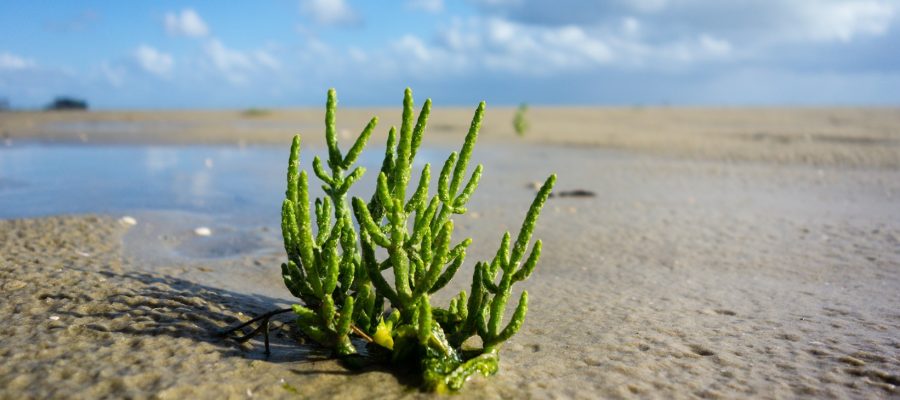
Salicornia is a rather particular plant, not only is it good but also its shape, combined with the name, creates a rather suggestive vision.
With “name” we are not actually referring to “Salicornia”, but rather to what is one of its most common names: “sea asparagus”. A name that certainly doesn’t evoke anything particularly poetic, but I invite you to look at a photo of it. Doesn’t it remind you of coral? One of those who appear in the breathtaking footage of the divers?
Its color is not a bright red, yet in its shape and movements it is not difficult to see a placid coral caressed by ocean currents. Then, when the summer slips away and the autumn months arrive, the green moves aside a little and gives way to nuanced shades of yellow and red which better help the imagination by bringing us submerged reefs and colorful fish.
In addition to this, there are other elements that could link Salicornia to a coral, but we will see them later, now let’s start the article!
THE SALICORNIA
Of the dozens of species belonging to the Salicornia genus, only a few are edible. Among these the Salicornia europaea which we will talk about today; for brevity we will talk about Salicornia meaning this specific species. Salicornia (Sea asparagus) is part of the Chenopodiaceae family (or Amaranthaceae, to which beets and spinach also belong) and it is an edible herbaceous succulent plant.
It is widely distributed on the coastal areas of the Mediterranean, Atlantic and Baltic but also in coastal regions of China, Japan, Korea, India and North America. It usually reaches a height of between 5 and 45cm and is a plant with erect and fleshy, cylindrical stems, with a hairless appearance, which form dense bushes, sometimes resembling wild asparagus. It usually grows in large groups that form brightly colored areas, especially with the autumn color change.
It is an annual plant but it is possible to maintain it even in winter without it dyingaccompanying it in a sort of semi-dormancy in which the vegetation slows down its growth until it stops. The restart occurs in spring, with the peak of vegetation in summer.
The small flowers, green in color and with yellowish anthers, appear in the axils of the leaves during late summer, at the same time as the vegetation changes from bright green to progressively red. If not repaired, low temperatures cause the plant to die in winteras per natural annual behavior.
Its main characteristic, which connects us to the discussion of coral that we were talking about before, is that this plant grows near marine areas as it prefers brackish soils, from this also derives its name “Salicornia”. It is one of the few plants that can be classified as “Love”, that is, capable of withstanding high salt concentrations in the environment in which they live.
GROW SALICORNIA
We often find plants like the Jacaranda which, despite their delicate appearance, are warriors who can cope with almost any threat. Other times, as in the case of Salicornia, we must pay attention to some small precautions to cultivate it in the best possible way.
Nothing complex, let’s go straight to see what it needs.
EXPOSURE
It loves the sun, so it should be planted in one if possible very sunny area.
TEMPERATURE
It thrives in temperate zones, typical of our continental and Mediterranean climates; during the spring/summer season a minimum of 10°C must be guaranteed. In winter it goes semi-dormant but it is still a good idea to protect it from frost by growing it in a pot which will be placed in bright rooms with no temperatures below 0°C.

LAND
It can be complicated to recreate the typical salinity conditions of a sea coast but fortunately Salicornia it can easily be grown in normal soil which however has a high sand content (optimal 50%) and which guarantees good drainage. To bring the right level of salinity to the soil, simply dissolve some cooking sea salt in the wetting water at a dose of 1-2 teaspoons per liter of water.
WATERING
It is able to resist even strong periods of drought thanks to its ability to accumulate water. This quality is guaranteed by the salt concentration inside the plant which retains water within its tissues. It’s important avoid the formation of water stagnation.
Salicornia must be watered regularly, not allowing the sand to dry out completely, particularly when the plant bears fruit.
PROPAGATION
Propagation can occur through seed or cuttings. Propagation from seed unexpectedly requires fresh water. In fact, it is only after germinating that it will prefer salt water.
It is a good idea to stratify the seeds to induce germination, placing them in the refrigerator for 30 days on a slightly damp cotton pad and then placing them in a container or closed plastic bag.
IN POT
Growing Salicornia in a container allows us to give it specific care independent of other plants which in the open ground may not benefit from the salt concentrations it requires. The substrate must also in this case be very sandy and draining, possibly rich in organic substance.
Our advice is to help it during the growing season by administering fertilizer suitable for plants for food use.
SALICORNIA AND THE SEA
Salicornia is really at ease when compared to the sea and this tells us a lot about it. The fact that it grows luxuriantly in areas near the North Sea and the Baltic, in the Mediterranean Basin and on the Atlantic coast suggests its preference for sandy and wet soils.
Furthermore, sea spray certainly won’t stop her: in fact, this daring plant manages to extend up to the tide shore, where it survives in complete tranquility. Just think that they are the plants that can tolerate the highest salt content compared to all the other herbaceous essences on the planet.
Despite this, the sea is not vital to her, in fact it can also grow spontaneously in non-coastal areas, where the soil contains sufficient concentrations of salt.
SALICORNIA IN THE KITCHEN
Salicornia is a very versatile plant in the kitchen, it can be eaten both cooked and raw. It has a rich, slightly spicy flavor and once harvested (it is recommended when the plant is still young, between June and September), it will even be excellent pickled. A useful precaution is to soak the sea asparagus in fresh water for about an hour before cooking them, in this way you will remove some of the saltiness, then naturally it is better to avoid salting dishes that contain Salicornia as it is itself full of salt, risking making the dish excessively salty and uneatable.
In addition to being very good and perfect for flavoring fish dishes, it is also good for your health. In fact, among its main nutrients we find:
- vitamin A;
- Specific minerals (especially potassium, magnesium, calcium, zinc, iodine and iron).
It is also particularly suitable for those following a low-calorie diet, in fact it has a rather low caloric intake, which is around 65kal per 100g.
To preserve it so as to have it available throughout all months of the year, it is possible to pickle it in oil (following the same process that applies to other vegetables), dry it (but thus undermining the taste of the herb, which instead will become excellent as a general flavour) or the most classic of ways, that is, freezing it.
CURIOSITY
Salicornia ash rich in soda (sodium carbonate) was used for the production of soap and to reduce the melting point during the production of blown glass.
When we find Salicornia close to the coast, nothing stops us from picking some to plant it ourselves or eat it, but be careful. The bushes of this plant are home to a good variety of migratory birds, providing them with essential shelter. For this reason it is important to preserve the growth of Salicornia, taking only what is strictly necessary and leaving the rest to nature.
The Vikings loved to consume Salicornia during their long journeys across the seas.
Very good friends, we have now met this very particular plant! If you are curious to try one of the many flavors of the sea or simply to test yourself with a truly particular herbaceous plant, here you have found the plant for you!
latest posts published

Tired of working in the garden? What can be done to reduce maintenance
How to successfully transplant a Christmas tree

Landscaping a new plot: where to start?

What grows in clay: This is what worked on Juste’s farm

Organic seeds: are they worth paying more for?
Preventive spraying of tomatoes with homemade remedies –
Environmental management: how to renovate a bored plot?
Designers answer what are the 3 best plants for the garden
Fruit trees online: how I ordered them and how I planted them