The design of a small plot really poses considerable challenges, especially when the owners themselves decide to create the comfort of their own yard. How to make the space visually appear larger? Landscape architect Ła Marija Bujauskaitė can offer unexpected ideas and practical solutions.
Meet La Marija Bujauskaite
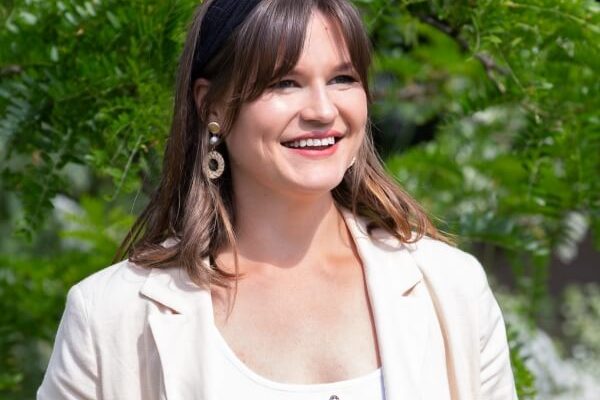
Ła Marija Bujauskaitė, who lives in Great Britain, can be proud of her achievements today. After starting his studies at the Vilnius Academy of Arts, he continued his studies at Birmingham City University, where he studied landscape architecture for a bachelor’s and master’s degree. There she was awarded the Landscape Institute’s John Knight Award for both undergraduate and postgraduate studies.
The talented Lithuanian was also awarded the title of young designer of the Royal Horticultural Society, her garden projects received excellent reviews at prestigious exhibitions. Gardens’ Illustrated magazine also included Ula Maria in its list of Britain’s most inspiring gardeners.
Well, he recently published a popular book called “Green,” which focuses on creating small urban spaces.
Ła Marija Bujauskaitė participated in the conference on environmental design “Garden style”which took place in 2022 on August 27 in Vilnius. The theme of his presentation is “How to create a lasting garden with a unique atmosphere and not subject to trends”. Ła Marija shared helpful tips from her experience and offered ideas for making a small urban space feel more spacious and welcoming. You can listen to Łola Marijas Bujauskaitė’s entire message after purchasing publish here.
The landscape architect has shared several ideas in this article, but before we begin, let’s confirm one more important thing.
Small lot design starts with a good plan
Before we rush to name individual ideas, the landscape architect emphasizes that creating a backyard environment begins not with the details of the furniture or the planting of plants, but with planning. So, first of all, sit down quietly with a pencil and a piece of paper and think about what kind of picture you want to see in your garden.
Plan the functional areas of the yard, for example:
- Peaceful rest (a place to read quietly, sunbathe, etc.)
- Active leisure activities (e.g. playground)
- Kitchen (where the barbecue, table, etc. will be placed);
- Vegetables, etc.
The paths should connect the individual areas to the general design of the terrain. And then you can think about plants that fit into the overall style of the garden.
Well, now let’s get back to specific ideas for a small backyard.
Idea 1: Big things in a small space
Very often we use small objects in small spaces (small plants, small vases, the smallest possible furniture, etc.) thinking that only these things are suitable here. But the specialist says that small measures do not help to increase the space at all, but rather to reduce it even more and make it miniature. So it is much better to use accent objects that at first glance seem too large: huge vases or tall plants.
Such a contrast creates a certain illusion that the space is larger than it actually is. Furthermore, when looking at large and tall objects, the eyes naturally turn upwards and therefore the gaze covers more space than when trying to see small objects that are somewhere underfoot.
Idea 2: Vertical layering
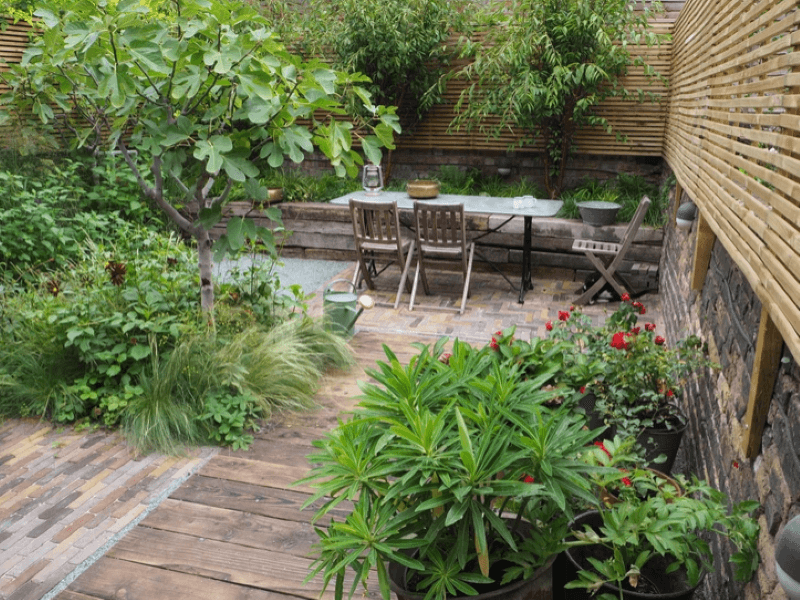
When there is no way to expand laterally, you can always reach upwards. Therefore, the design of a small plot is usually based on verticality, playing with the different heights of the courtyard elements.
For example, designers of small gardens often immediately design raised beds (there may be multiple levels) so that the plants are naturally taller. UM Bujauskaitė recommends placing potted plants in front of such raised beds to create even more layers. Such layering seems to eliminate the clear border of the courtyard, deepen it, create the illusion that the space is larger.
Combine various walls, trellises, pergolas with raised beds. Such vertical elements perform a practical function, help save space, decorate the room, provide structure and optically increase the space.
Idea 3: play with textures
The specialist suggests not to be afraid to experiment and mix different textures, for example, a stone with a rough texture will look very good next to smooth and shiny metal furniture.
Different textures create an interesting play of shadows with each other, enriching the overall image, but not weighing it down, so it is very suitable for small spaces.
Combine different textures in your garden environment:
- Plants – with smooth and shiny, fluffy or feathery leaves;
- Furniture and small architectural elements: they can be made of wood, polished and rusty metal;
- Textiles: from soft fabric cushions to coarsely woven bags;
- Decorative elements: solid, raw concrete vases next to shiny metal details, etc.
Idea 4: Group plants
The landscape designer recommends not using too many plants of different types and colors in small spaces and not placing them one by one. 5 different types of plants will certainly be enough, but get at least 3 of each type. And then group these plants, create their compositions, experiment with their heights.
If there are multiple different types of plants and they are scattered throughout the space one by one, the environment will lack integrity. Meanwhile, repeated and grouped plants add rhythm and harmony to the garden style.
Idea 5: Fewer colors
Don’t panic, we definitely don’t suggest you abandon the colors. It’s just that in a small space it is very easy to multiply them and create not a harmonious image, but a real “visual noise”. Therefore, it is worth choosing a few basic colors that will be repeated throughout the courtyard environment: the exterior of the house, plant flowers, furniture details, etc. Therefore, the design of a small plot will be delicate, unified and pleasing to the eye.
Idea 6: style dictated by nature
When you’re hungry for ideas, look to nature for inspiration. The interviewer says that there is no better designer than nature. Therefore, it is often enough to look around and try to create a forest, meadow, swamp, riverbank or other landscape that you like in your yard. There’s really no need to try to exactly replicate the natural world and attack your garden with wild plants. Just interpret nature. For example:
- If you live near a forest, try to replicate the greenery of the forest in your garden too, choose plants with delicate flowering, in a naturalistic style and avoid very lively styles that contrast strongly with the forest. You can see a great example of a terrain near the forest here;
- Does a riverside view inspire you? I suggest creating paths in the courtyard that wind gracefully like a river and choosing bell-shaped plants similar to hornbeams.
latest posts published
Tired of working in the garden? What can be done to reduce maintenance
How to successfully transplant a Christmas tree
Landscaping a new plot: where to start?
What grows in clay: This is what worked on Juste’s farm

Organic seeds: are they worth paying more for?

Preventive spraying of tomatoes with homemade remedies –
Environmental management: how to renovate a bored plot?
Designers answer what are the 3 best plants for the garden
Fruit trees online: how I ordered them and how I planted them