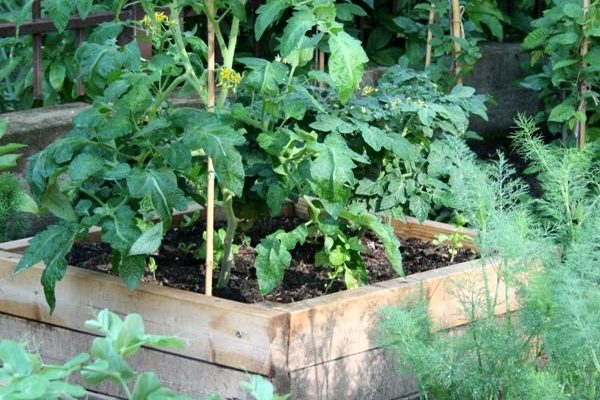
Raised beds and a beautiful garden – These two concepts often go hand in hand. And not for nothing: it’s fun to grow your own vegetables, but ordinary beds don’t look at all against the background of a modern house. Raised beds should be installed not only for aesthetic reasons, but also for easier maintenance, he advises Ingė Auželieneteacher of the “Yellow Wheelbarrow” modern gardening courses.
CULTIVATION IN RAISED AID
The raised beds we are talking about have solid sides made of boards, logs, stones or other materials. A regular bed is also slightly raised, but a bed with sides is more stable and there is no need to weed the sloped edges and rail.
The boundary between the bed and the track is very clear, so the mulch, if we use it, does not spread, but remains inside the bed. We can choose another surface for the path, for example, pavement, bark mulch, mowed lawn, cobblestones – so that it is cleaner to walk and we can get to the vegetables even in slippers.
If the sides of the raised beds are a little higher, it is convenient to sit on them, it is easier to sow, plant and weed. When your knees and back do not get tired, the maintenance itself will be much more pleasant.
Furthermore, the vegetable garden often has few vertical elements. This is especially evident in winter, when the garden appears completely bare. Raised beds provide verticality and aesthetic appeal in all seasons.
In the courses we share ideas for a beautiful garden and other subtleties of landscaping“My garden project”. During the course you will learn about the laws of design, the design process and finally you will create directly on your floor plan. And you will see that landscaping project is a difficult but definitely doable and very interesting task.
Raised beds warm up faster in springtherefore it is worth growing spring crops in it: radishes, lettuce, dill, early carrots. It is easy to attach frames with polyethylene or glass covers to the stable walls to further speed up early harvesting.
For later crops, a little raising of the bed doesn’t make a big difference, so if the whole garden isn’t exactly shaped like that, assign raised beds for early vegetables.
It is often feared that higher beds will get colder. If the bed is low and at least 80 cm wide you will not feel the substantial difference. If the bed is very high and narrow, it can cool faster in winter, so arrange it only for annual plants. A tall bed of herbs on the terrace would be beautiful: nice and fragrant and convenient to choose when preparing outdoor barbecues.
MATERIALS AND MEASUREMENTS
What to make raised beds from, decide based on available materials, aesthetics, durability and allocated budget. Mostly wooden boards are used, less often: processed logs, reinforced stones, plastic boards, masonry.
Conventional boards are easy to reinforce and easy to dismantle, which is an advantage as you may want to reduce or increase beds in the future.
Due to constant contact with the ground, wood wears out quickly, as natural processes occur, so the boards will have to be replaced after 4-5 years. Impregnated boards can last up to 15-20 years and you can paint the outside in a color that suits the environment.

If the plot is in ethnographic styleit is very practical to install beds from sawn logs. If their height is about 20 cm, these beds are very comfortable, because it is convenient to sit on the edge. Plus, it will last much longer than boards. Such beds look great if the railings, swings and sandbox are also made of similar logs.
Near a modern house the logs will probably be no good. If you want the garden to look good, match the materials and repeat the selected elements throughout the plot. Similar brick beds will look good next to a red brick house. Concrete can be suitable for a modern house. In both cases a foundation is required, so installing the beds is more complicated and expensive. But beds like that connect visually garden with the rest of the land, so it does not fall out of context and has a very aesthetic appearance. Plan the arrangement of the beds more carefully, because after a few years it will be difficult to demolish and rebuild elsewhere.
When there are multiple bedsfurnish them with the same materials, and you can choose all the same or different shapes and heights. Uniform flower beds bring symmetry and order (so weeds are less of an eyesore), but different ones can also make a good impression, especially if the taller ones are installed in the farthest part of the garden.
Bed width. A raised bed is usually managed not by climbing onto it, but from the side, so its width must be such that it can be reached freely. If the bed is accessible from both sides, 80cm might be the optimal width. If you grow berry bushes or perennial flowers, where you don’t need constant maintenance, the raised bed can be much larger.
Wrap -half image. You can pave them with the same surface as the other driveways on the property, you can extend the lawn or choose a different surface: bark mulch, crushed stone, straw, tile or concrete paving, wooden driveways. If you have to sow the lawn between the flowerbeds, choose the width of the driveway based on the width of your lawnmower – I. Auželienė says that very often this point is underestimated.
If you use wood chips or bark mulch for paths, it is not worth using a film under it, it is better to put a thicker layer (at least 10 cm) – the effect will be there and the laws of nature will not be violated. The layer will need to be replenished every year.
INSTALLATION OF RAISED BEDS
If you already have a bed and you want to raise it with curbs, you need to turn the soil in the center, frame the flowerbed with the selected curbs and spread the soil evenly again – this is the easiest way. Under the curbs (boards or logs) it is worth compacting the soil and adding crushed stone or gravel so that the wood is not placed directly on the ground and rots less quickly.
If now there is grass instead of the bedThe next steps depend on how quickly you want to start gardening:
The slow version: note the shape of the bed. Covering the lawn with black polyethylene film or cardboard (even better) will produce good quality organic matter over the course of a year.
Quick option: You need to cut the marked area, remove the sod (you can put it in a compost bin) and fill the bed with good compost or black earth.
If the bed is high (at least 30-40 cm), infused weeds should simply rot. If the bed is higher than 50 cm, it is advisable to leave it in the lower part for ventilation, so that an environment is created inside which is favorable to the natural processes that take place there.
According to different technologies, branches, leaves, rotted manure can be placed on the base of the raised bed. But first of all, you need to consider the soil of your plot. If the soil is heavy, clayey, it is worth digging an additional depth of about 30 cm and filling it with gravel or crushed stone for drainage. Vegetables generally do not tolerate waterlogging, so raised beds are a good solution. For example, for carrots to be smooth and straight, they need loose soil, so slightly higher raised beds would be very suitable for them and other root crops (30-40 centimeters). You can learn more about installing raised beds and a spring garden in distance learning courses.
latest posts published
Tired of working in the garden? What can be done to reduce maintenance
How to successfully transplant a Christmas tree
Landscaping a new plot: where to start?

What grows in clay: This is what worked on Juste’s farm

Organic seeds: are they worth paying more for?

Preventive spraying of tomatoes with homemade remedies –
Environmental management: how to renovate a bored plot?
Designers answer what are the 3 best plants for the garden
Fruit trees online: how I ordered them and how I planted them