In the vineyard every autumn begins with the same emotion: the moment of the harvest. It’s the point where a whole year of work, care and waiting meets the decision that can change everything – how the grapes will be harvested.
Each winery defines its own style, but the decision between manual and mechanized harvesting is not made by chance. There are practical and strategic factors behind it:
or large vineyard surface which requires efficiency, lack of seasonal labor which makes it difficult to organize large teams, e.g the desire to control the optimal harvest time down to the minuteso that the grapes arrive in the cellar in perfect condition.
Today, manual harvesting has become more of a privilege. It is reserved for exclusive wines, those special lots where every bunch counts and where the added value is evident: wines with character, wines with a history. On the other hand, modern harvester technology has evolved spectacularly, transforming mechanized harvesting into an option that is not only practical, but also capable of providing raw material of exceptional quality.
Manual harvesting: the tradition that requires patience
Manual harvesting is the classic harvesting method, used for centuries in vineyards around the world. In essence, it involves carefully picking, cutting and packing each grape by the human hand. It may seem like a simple gesture, but it is actually the result of focused attention and expertise accumulated over the years.
A young winemaker should know this in manual harvesting there is a quality filter that no machine can completely replicate. The human hand sees, feels and instantly decides whether a grape is suitable for the wine of your dreams. It is the moment in which only healthy and fully ripe grapes are selected, and those affected by diseases, insects or insufficient maturation remain in the vineyard
The main advantage it is the protection of the grains: delicate handling limits premature crushing and prevents the oxidation of the must from the vine. This is why premium wines, especially those intended for long aging or sensitive varieties, are almost always hand-picked.
Another advantage is flexibility. In manual harvesting you can decide to enter the vineyard only at the moment of optimal ripeness for a plot, without forcing the harvest of the entire area. In this way the grapes arrive in the cellar in exactly the desired shape.
But despite all these benefits, there is also a cost: manual harvesting means more work, more time and more people involved. In today’s conditions, where seasonal labor is hard to find and time waits for no one, this type of harvest is becoming a rare service, reserved for truly special wines. On large areas, where speed is key, manual harvesting can be inefficient and every additional day can lead to quality losses.
For a young winemaker the lesson is simple: manual harvesting is not just a romantic gesture of traditionbut a precision instrument. It is used where every grain counts, where the character of the wine is built from the details and where the added value justifies the effort.
Mechanized picking: speed that does not compromise quality
If in the past mechanized harvesting was viewed with suspicion by many winemakers, today technology has radically changed the rules of the game. Modern machines are no longer simple harvesting machines, but real laboratories on wheels, capable of working quickly, efficiently and with impressive quality control.
A young winemaker must know this the main advantage of mechanized picking is speed. When you have tens or hundreds of hectares and the optimal window for harvesting is just a few days, these machines become precious allies. Furthermore, you can work at night or early in the morning, when temperatures are low and the grapes retain their freshness until they arrive in the cellar.
Current technology goes even further: quality selectors integrated into the harvesting machines, they eliminate non-compliant grains, leaves and other plant residues, significantly increasing the quality of the raw material. Therefore, wines made from mechanized grapes can compete, in many cases, with those harvested by hand, especially in the affordable medium and premium segment.
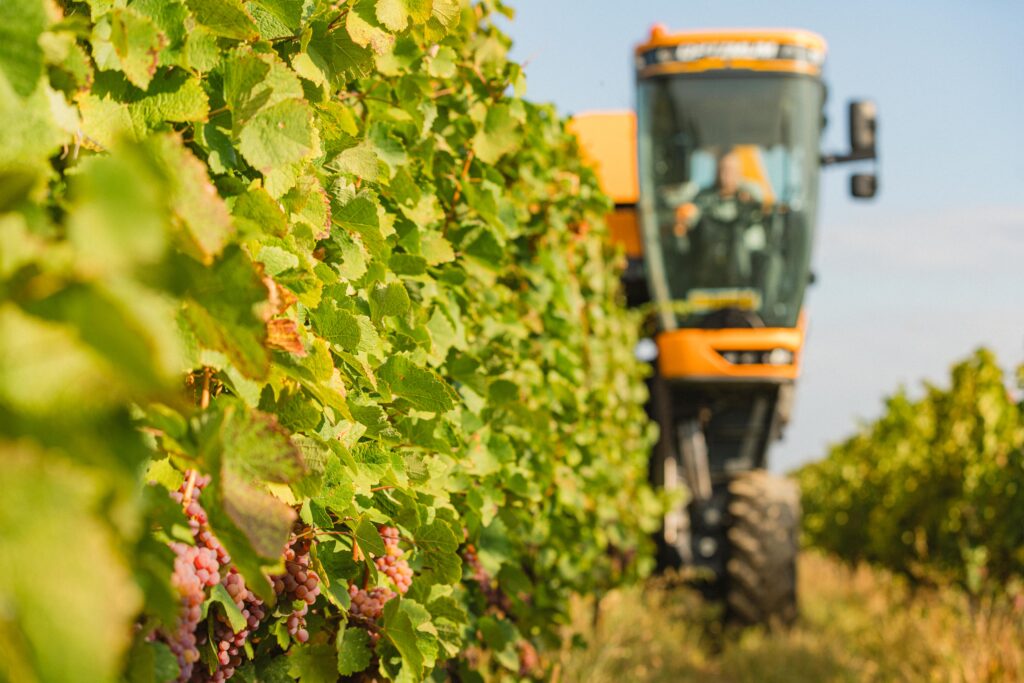
Of course there are limits. Even the best machines cannot match the eye and hand of an expert picker when it comes to the careful selection of grapes. Furthermore, on steep terrain or in areas with narrow rows, machine access is difficult or impossible.
For a novice winemaker, mechanized harvesting may be the solution it offers freedom in planning and security against the vagaries of the weatherespecially where the cultivated surface and the lack of labor make timely manual harvesting impossible.
When mechanized harvesting does not take place
Although modern technology has significantly raised the standards of mechanized harvesting, there are situations when the human hand remains the only option. There are wines that require not only careful selection, but an almost surgical precision, impossible to replicate by a machine.
Wines obtained with the Appassimento method
This technique, originally from Italy, presupposes natural drying of grapes after harvesting, to concentrate sugars, aromas and acidity. For the process to be successful, it is necessary to choose only perfectly healthy bunches, with uniform grains and without signs of disease or mold. They are harvested by hand, with the utmost care, and placed in special boxes, allowing air to circulate between the beans. Any selection error can compromise the entire lot.
This method brings the wines with velvety texture, intense aromas of ripe fruit, plums and spices. At Girboiu Winery, this process is used for specialty wines such as Magma or dessert wine AmberA. It is a humidity and temperature sensitive technique and any faulty bunch can compromise the entire batch, here’s why mechanized picking has nothing to do here.
Ice Wine – frozen wine
Ice Wine is a show of nature and patience. The grapes are left on the vine until temperatures drop to minimum -7°C. The water in the grain freezes, but the sugars and aromatic compounds remain concentrated in the must.
The collection must be done manually and quicklyat dawn, when the ice is still solid. The pressing takes place immediately, obtaining a dense, sweet and very aromatic must. The resulting wines have vibrant acidity and intense notes of tropical fruit, honey and peach. Under such conditions no machine can operate without destroying the grains or starting fermentation too early.
Tokaj sweet wine – the liquid gold of Hungary
In the Tokaj region of Hungary, Botrytis cinerea – so-called “noble mold” – transforms the grape seeds into a true delicacy. The fungus pierces the bark, encouraging the evaporation of water and concentrating the sugars.
The pickers collect by hand only botrytised grainsin which they collect puttonyos (traditional tarns). This process is repeated several times on the same vine as the grapes reach their optimal stage. It’s painstaking work, and any healthy grain mixed in by mistake can change the balance of the wort. The mechanized harvester could not have made such an accurate selection.
Vendemmia Tardiva / Vendange Tardive – patience as a strategy
In this style, the grapes are left on the vine longer than usual to dehydrate slightly and concentrate the sugars. The danger is that, as time passes, overly damaged beans or mold attacks may appear.
That’s why the harvest is over in multiple manual steps through the vineyard, picking only the grapes with the ideal degree of ripeness. It is a preferred method in Alsace, Germany and also in some Romanian wineries for sweet or semi-sweet wines.
Extreme wine-growing areas – where mechanization is impossible
There are places in the world where the vine is not only an agricultural crop, but also a demonstration of courage and patience. In Moselle Valley from Germany, Valea Douro from Portugal or in the picturesque Cinque Terre in Italy the vineyards are planted on steep slopes with narrow terraces dug directly into the rock. Here each row seems like a balcony suspended between sky and earth, and the path towards the bunches is a real adventure.
In such conditions, access to the machine is impossible. The harvest is carried out by hand, often with rear baskets, and the grape crates are lowered with ropes, transported by boat or loaded onto trains that run on rails mounted between the rows. It’s hard work, but absolutely necessary to preserve the integrity of the crop.
For a young winemaker, these regions are the perfect lesson adaptation to the territory. Manual harvesting is not a romantic choice here, but the only possible solution. However, the difficult working conditions do not prevent the obtaining of exceptional wines, on the contrary, they give rise to unique expressions, in which the terroir and the work of man are indestructibly intertwined.
Champagne and other classic method sparkling wines
In the heart of the Champagne region, every autumn begins with a ritual that has remained unchanged for generations: the manual harvesting of the grapes. It is not just a romantic tradition, but a legal requirement. The reason is simple: the beans must arrive whole at the presswithout being crushed, to avoid premature fermentation and the extraction of bitter compounds from the skins and seeds.
In the production of sparkling wines obtained from the traditional method (méthode champenoise), the quality of the base wine depends on the integrity of the grapes. Even a small oxidation before pressing can compromise the freshness and finesse of the sparkling wine. This is why manual harvesting is the only guarantee that the raw material arrives in the cellar in perfect condition.
This rule doesn’t just apply to Champagne. Regions like Cava (Spain), Trento DOC (Italy) or some premium vineyards in New Zealand and Australia follow the same principle, even when it is not required by law. In many wineries, the harvest is carried out early in the morning, when the temperature is low and the grapes retain the acidity and delicate flavors that will define the final wine
In viticulture, the harvest is not just a technical step, but a strategic decision capable of defining the character of the wine. Manual and mechanized harvesting are not rivals, but two different tools in the hands of the winemaker.
The manual remains irreplaceable where every grain counts: wines born from Appassimento, Ice Wine, Tokaj, Late Harvest, harvests from extreme areas or sparkling wines obtained with the traditional method. There, patience, careful selection and the experience of the picker set the tone for quality.
Mechanization, on the other hand, has evolved to the point where it can provide speed, efficiency and exceptional quality, especially in expansive vineyards where the optimal harvest window is short and labor is limited. With integrated modern selection technologies, it can guarantee a constant level of raw material and protect its freshness.
For a young winemaker, true mastery does not lie in the exclusive choice of a method, but in the ability to combine them intelligently. Wine is born not only from the earth and the sun, but also from the inspired decisions made in the vineyard, in the decisive days of the harvest.
latest posts published

Tired of working in the garden? What can be done to reduce maintenance
How to successfully transplant a Christmas tree

Landscaping a new plot: where to start?
What grows in clay: This is what worked on Juste’s farm

Organic seeds: are they worth paying more for?
Preventive spraying of tomatoes with homemade remedies –
Environmental management: how to renovate a bored plot?

Designers answer what are the 3 best plants for the garden
Fruit trees online: how I ordered them and how I planted them