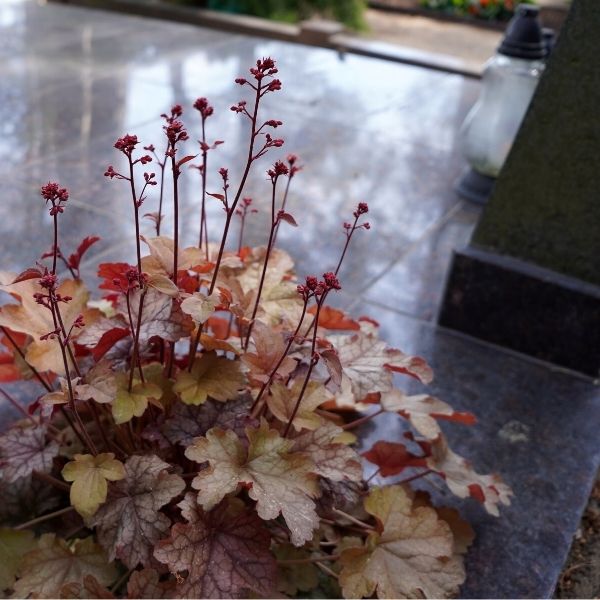
If you are looking for ideas, which potted flowers could add modernity to your terrace? I share examples of my pots and some tips that will help you better understand the principles of composition and use them when planting your pots:
Read on to find out what design principles I use and how they translate into choosing specific plants for the pot.
Flowers in pots: observations and discoveries of the past year
Let’s start with what I already had from last year. Last year I grew annual flowers, perennial bluebells and even boxwood in large pots on the terrace.
The geranium dominated with the beauty of its bright flowers, and was also rich in foliage, while a rounded boxwood provided structure and stability.
And the most beautiful discovery is the ‘Everest’ quinoa. It is a perennial bell plant with white and green stripes, perfect for outdoor flowerbeds. However, it also does very well in pot
Furthermore, the sedge also looks good in winter. Before Christmas I removed the annual plants and added glitter, pine cones and dried flowers between boxwood and sedges: this is how I had a beautiful festive composition on the terrace. Here you can take a look how it looked.
For this year I will expand my friendship with the boxwood, because it has survived as best as possible in pots, and with the ‘Everest’ sedges. Some of them did not survive the winter (or overwatering), and some continue to grow as well as they can.
Potted flowers in the composition: basic rules
According to the rules of classical composition the vases must contain:
- Structural or erect plant;
- Middle layer as filler;
- An oscillating element that creates a beautiful whole.
Following these rules, the following last year’s flowers grow in my pots:
- Boxwood for structure;
- Sorghum as filler;
- Tramadol as a climbing plant (also survived in pots).
Sages are the new potted flowers for this year
Since the boxwood has no height, it still lacks a tall, upright plant. This year I choose a new perennial: goji sage ‘Sens. compact white’. It blooms with white, candle-shaped inflorescences and reaches a height of up to 40 cm.
Of course, it adapts better to a sunny position and well-drained soil, but what’s stopping me from trying to grow it on the north side too? I plant it in the best-lit places in the pots.
Common sage flowers in June. On the northern side it may bloom later. Outdoor salvias can be cut back and will bloom a second time after a while. And in the vase, after flowering, I will decide what to do next, depending on how decorative it will look. If I don’t like it, I’ll simply transplant it into the outdoor flower garden for next year’s beauty, and look for a new upright plant in the pot for the second half of the year.
Don’t be afraid to choose perennials for pots! After all, you will have a much wider selection of shapes and textures than just bakopa and surfinia. If you buy flowers instead of growing them from seeds or small seedlings, the price is also similar: for example, an annual geranium can cost as much as a perennial sedge.
If perennials don’t survive the winter, new potted flowers will take their place, and if they do, you’ll save time and money.
Color in jars
Potted sedges fill the central part of the composition perfectly, but we are missing color. For this, I once again choose time-tested geraniums: a neutral one, blooming in white, and a bright one, blooming in pink.
Here is the color palette I came up with for these potted plants:
Since the pelargonium has not yet bloomed, I planted pink carnations next to it. Since the composition on the terrace is created by three large pots, the color is immediately desired.
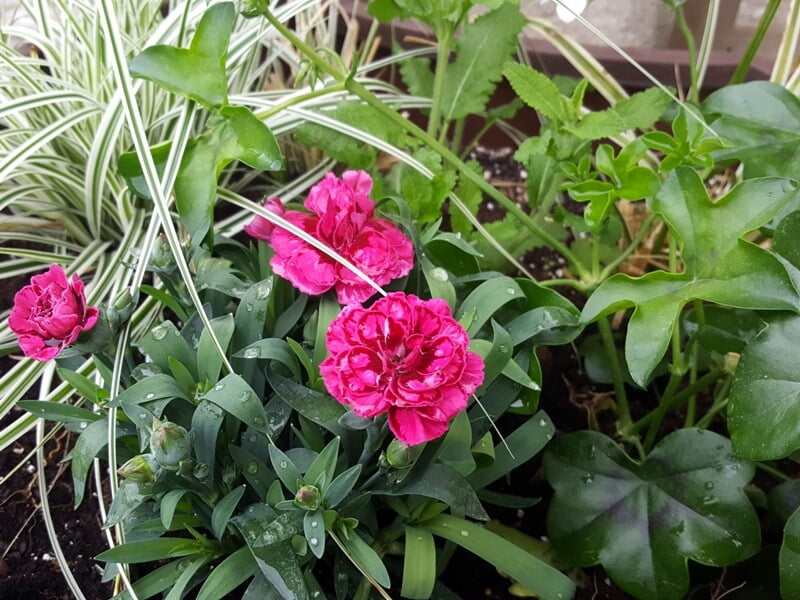
All the other colors this time are neutral: white-sedge green, white-green texture, boxwood green and honeysuckle green.
Hanging potted plants
I decided to keep the tramažola company and integrate this layer of waving plants into the composition with the cypress. With this name you will find plants with a varied appearance, but I mean precisely the one that is also called plectranthus (lat. Plectranthus ciliatus) according to its Latin name. Although, to be honest, I googled this name myself, because I remember from the old days that the name is so complicated that I didn’t even bother to learn it. We simply call them dark leaves, and in our family we immediately understand what we are talking about.
I recommend St. John’s wort because it survives well in the room during the winter. And another nice thing is that it propagates very easily: immerse the branch collected in spring in water, when the roots come out, plant it in a pot.
It is possible and it is even simpler: just put the collected branch in the ground and a new large and beautiful plant should grow. It is important that it is warm and humid enough.
In order for the honeysuckle to grow beautifully, branch and have a beautiful shape, regularly pinch its tops.
Plant selection – result:
Now I have all three elements of the composition in my vases:
- Structural or erect plant – sage for the height and boxwood for the structure,
- Middle layer as filler – sedges, geraniums (white and pink), carnations (pink),
- A waving plant– grass plot and plectrum.
Since I have three pots, each “layer” has a few plants, but keep in mind that not all of them are planted in one pot. For example, in terms of the filling layer, one pot has white geranium, another pink geranium and sedge, and the third has carnations, white geranium and sedge.
Therefore, the compositions are not identical, but it is important that there is another repeating plant, thus connecting the compositions into a whole.
How to help plants grow better
Before planting, the flowers are arranged in the pot and it is evaluated whether it looks good, whether there is enough space for all the plants or perhaps plants are simply missing.
If you see that the plant in the pot has overgrown, the roots are intertwined, if it has been over-watered or dried, I try to help the plants. In order for these unfortunates to take root better, I use organic fertilizers “Humicland” for flowers: just mix 20 ml with 5 liters of water and water. These fertilizers help plants recover and reduce stress.
Water immediately after planting and then every two to three weeks. It is an organic fertilizer produced in Lithuania, certified, so it is completely safe to use it even if you are afraid of small children, allergies or other reasons.
latest posts published
Tired of working in the garden? What can be done to reduce maintenance
How to successfully transplant a Christmas tree
Landscaping a new plot: where to start?
What grows in clay: This is what worked on Juste’s farm
Organic seeds: are they worth paying more for?
Preventive spraying of tomatoes with homemade remedies –
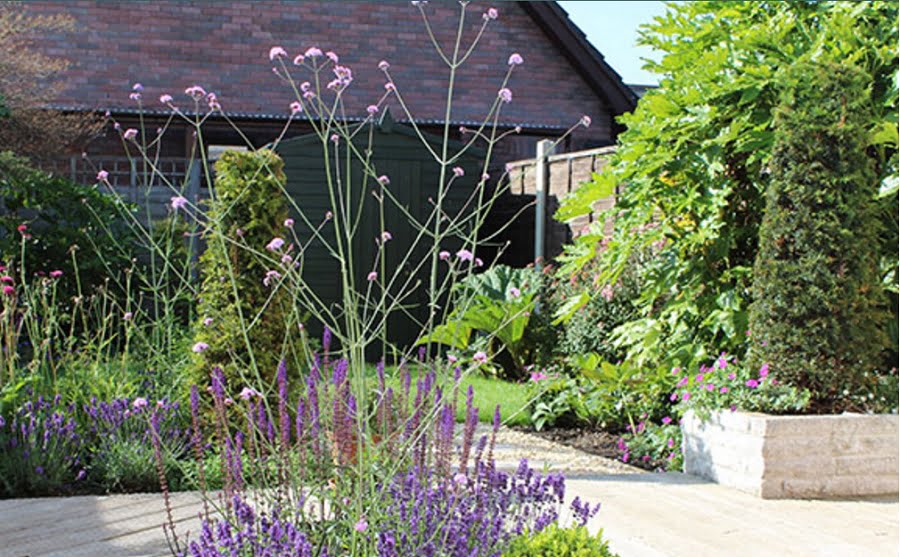
Environmental management: how to renovate a bored plot?
Designers answer what are the 3 best plants for the garden
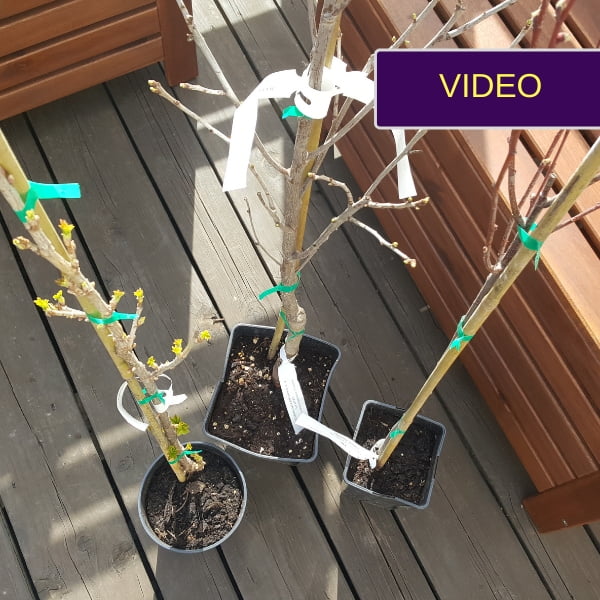
Fruit trees online: how I ordered them and how I planted them