Orange wines have gained more and more popularity in recent years. They have captured the attention of enthusiasts for their distinctive color, which ranges from pale orange to deep amber, but also for their complex aromas and rich texture. But what makes these wines so special? We invite you to find out more in the following lines!
What are Orange Wines and how were they born?
Orange wines represent a distinct category of beverages. They are produced from white grapes, but through a particular method, similar to those for obtaining red wines. This technique, based on prolonged contact with the skin of the grapes, gives the orange hue which also inspired the name of the drink.
Although orange wines seem to be a relatively new trend in the world of winemaking, they actually have a rich history dating back to ancient times. In Georgia, for example, this type of wine was produced several thousand years ago, in clay vessels called kvevri. It has also been obtained in other regions, such as Armenia and northern Italy. Its popularity declined in the 20th century, but has recently been revived thanks to the curiosity of winemakers and wine lovers eager to explore new tastes and aromas.
Today, orange wines are produced in various wine regions around the world, from Italy and France, to Slovenia and Australia. Each territory gives the drink a unique personality, through the vines used, the duration of maceration and the winemaking techniques suitable for each terroir.
Orange wine production technique
The technique with which these wines are obtained is particular, but it starts in the same way as the traditional ones. First of all, the white grapes are harvested with care, when they reach full ripeness. What does this mean exactly? That the flavors of the berries are intense and the sugars have an optimal concentration to favor the fermentation process. The pressing is carried out carefully to best preserve the skins so that the tannins, aromas and pigments can be successfully extracted.
Then follows the film maceration phase. As in the case of rosé wines, the must resulting from pressing the grapes is fermented together with the skins (sometimes also the seeds and the stem) for a certain period. After fermentation, the wine is aged in various containers, such as oak barrels, stainless steel tanks or even clay amphorae, if the process is one that preserves tradition. Aging can last from a few months to a few years, depending on the complexity of the desired flavors.
Towards the end the wine is separated from the solid parts through a process of light filtration or decantation, which has the function of eliminating sediments. The drink can then be bottled, preferably without being stabilized or excessively filtered, to best preserve its natural character and complex aromas.
What are the characteristics of orange wines and how to enjoy them?
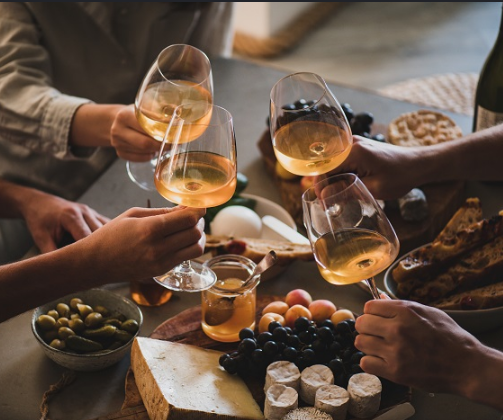
Orange Wines are distinguished from other varieties by a series of peculiarities. Their shade varies from light gold to intense orange, being directly influenced by the duration of contact with the skins. The aromas of orange wines are often complex and surprising, including notes of dried fruit, citrus or even spices. Shades of white flowers are often present and the tannins give a pleasant astringency. The taste varies from dry to slightly sweet, retaining a sparkling acidity and a full-bodied structure. To fully enjoy these characteristics, orange wines should ideally be served at temperatures between 10 and 12 degrees centigrade. The choice of glass is also important. Glasses with a wide opening are recommended to allow the flavors to fully express themselves.
Which dishes can you pair an orange wine with?
Orange wines go very well with a wide variety of dishes, thanks to their aromatic complexity. As a rule, aperitifs with mature cheeses, cured meats, pâtés or salads with nuts and dried fruit find a perfect companion in these wines. Fatty fish prepared in the oven with aromatic vegetables becomes even tastier with a glass of orange wine, as does white meat with creamy sauces. Vegetable and meat curries or mushroom risotto are also perfect choices for orange wines. These drinks are also perfectly suited to steak wines. Do you want the end of the meal to be perfect? You can enjoy an orange wine with a dried fruit dessert, a cheesecake or a chocolate cake!
Tips for a perfect tasting
Orange Wines offer you a special taste experience, especially if you taste them “how you like”. Here’s how you can do it:
- decant the wine for 30 minutes to allow it to fully reveal its aromatic bouquet;
- find a quiet place with natural light and bring neutral snacks, such as crunchy bread or crackers, to cleanse your taste buds;
- carefully observe the color of the wine, then gently shake the glass to activate the flavors and identify them;
- take a small sip and roll the wine across your tongue, feeling the texture, acidity and tannins. Let it reveal itself gradually;
To begin with, it may be useful to choose orange wines that are easier to drink and have a shorter maceration on the skins. As you become familiar with the style, you can begin to compare wines from different regions or grape varieties to discover subtle differences.
Therefore, orange wines are an ideal choice if you want to try something new. With their complex aromas, vibrant taste and distinctive colour, orange wines break with traditional patterns and invite exploration and discovery. If you want to savor a unique taste, try a special edition wine with orange reflections, from the Bacanta range or other refined drinks full of flavors from the Gîrboiu Winery selection!
latest posts published

Tired of working in the garden? What can be done to reduce maintenance
How to successfully transplant a Christmas tree

Landscaping a new plot: where to start?

What grows in clay: This is what worked on Juste’s farm

Organic seeds: are they worth paying more for?

Preventive spraying of tomatoes with homemade remedies –
Environmental management: how to renovate a bored plot?
Designers answer what are the 3 best plants for the garden

Fruit trees online: how I ordered them and how I planted them