Spring, women and mimosas, oh March, what a beautiful month. What a pleasure the month of March! Nature begins to wake up until it slips towards the beginning of spring. The air is warmer, more fragrant and the desire to go out increases.
You can find the first flowers timidly peeking out from the ground in the parks, you can hear the sounds of children starting to go back to playing in the open air, you can smell the long days spent having picnics and barbecues. You touch the green blades of grass with your open hand and, finally, you see men frantically searching for a mimosa.
Have we perhaps ruined the picture? But come on, deep down we know, in addition to spring in March the great protagonist is the woman with her celebration and there is no more classic and representative gift than the mimosa.

As you well know, we are a nursery so we won’t talk to you about the usual cut bunch that you can find almost everywhere, but about the mimosa plant which reaches its peak of splendor in March, the acacia dealbata.
ACACIA DEALBATA
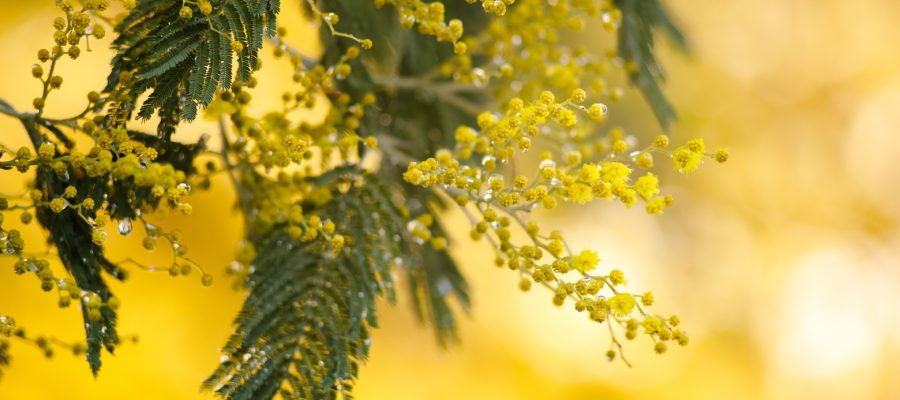
The mimosa that we all know takes the botanical name of “acacia dealbata” and is part of the Mimosaceae family, which includes more than 700 other herbaceous and shrubby species. It’s one evergreen plant widely used as an ornamental, it has a fast growth ranging from 8 to 15 metres. It has large, unkempt and not very thick hair.
The name comes from the Greek “deals with” Meaning what “actor, mime” and the feminine suffix “dare” means “similar”.
This plant that is very common among us today is native to Australia, more precisely to Tasmania. Concentrating on our territory, however, we will find it spreading naturally along the Ligurian Riviera, in Tuscany and throughout the south, but don’t worry, even for those who live in the north it is possible to see mimosas immersed in typical landscapes, in fact it grows on the coasts of lakes, this is because it grows in areas with a temperate climate and does not really like harsh winters which stay below 0 for many days.
The leaves are a silvery green colorvery pleasing to the eye also thanks to their linearity, with entire edges. Even the veins maintain a symmetrical line, running parallel along the leaf. They also grow arranged in 8-20 pairs of thin leaves perpendicular to the midrib.
A curiosity about the leaves reminds us a little of the cornflower which we will talk about in the article on edible plants, in fact the mimosa leaves will be open and full during the day, while in the evening they will close until folding during the night hours.
What about flowers then? We are all aware of those characteristic bright yellow dots, they grow in clusters that can range from 7 to 10 cm, directly from the leaf. Another fundamental element is the scent, we cannot really talk about mimosa without mentioning that intense scent capable of making its way through that of many other plants. Furthermore, the mimosa also produces a fruit, a 4 to 10 cm long legume which, once ripe, turns black.
TAKING CARE OF ACACIA DEALBATA
Have you decided to give a beautiful tree instead of a single twig? We are really happy about it, also because we remind you that the liveliness of its ball flowers, once cut, fades rather quickly. But no more chatter, the time has come to go into detail about this plant, so that we can take better care of it.
You must first of all know that flowering starts at the end of January and lasts throughout Marchit is in fact a plant symbolizing the arrival of spring.
Another very important initial information is that the mimosa It can be cultivated both in open ground and in pots.
EXPOSURE
This plant loves sunny places but if you are planting it in the open ground, be careful to place it in a sheltered spot. Its branches are delicate and will not be able to cope with too strong gusts of wind.
TEMPERATURE
It prefers mild temperatures, does not like the cold and really does not tolerate prolonged frost. As soon as the temperature drops below 0 the plant will begin to suffer and as it drops the situation will get worse. Temperatures below -9/-10° could damage it irreparablyespecially if the plant is very young. Although they are not an indoor plant, as they are not able to withstand the continuous heat that spreads in our homes, it remains good practice to grow mimosa in pots in colder areas. In this way it is possible to repair it and, in case of frost or strong wind, take it to a more sheltered place. Although it is good to keep in mind that if the mimosa branches freeze it is possible to start again from the base.
LAND
Soil is an essential aspect for anyone wanting to plant their own mimosa. This plant has a particular dislike for calcareous soils, preferring slightly acidic ones, with a pH ranging from 5.5 to 6.5. So take a good look at the soil and if it is not suitable, integrate the existing soil with acid peat. Furthermore, soils rich in organic matter are ideal.
IN POT AND IN GROUND
Very well, now that we know the basics, let’s shed some light on the two possibilities we have for making this plant grow well, so that we can decide which one to choose, naturally also based on our homes:
- In pot: since the plant will have to make do with the soil that you make available to it, it is particularly important that this is suitable, the best solution includes placing a base of expanded clay, after which we add just over half garden soil and the remainder acid peat.
The vase will also have to be quite spacious, mimosas live a long time and it would not be comfortable to have to repot it too often. For this reason it is good to have a vase at least 1m high and half as wide. However, you will find yourself having to repot it approximately every 2 years, gradually increasing the size of the pot. - In the open ground: if your garden can’t wait to welcome the new arrival, let’s try to arrange it as best as possible; After all, guests are welcomed in style, right?
First of all you need to prepare the hole where the root system will then be inserted, for this you will need at least a depth of 70-80cm and a width similar to that of the pot we were talking about before: 50-60cm. Once this is done, weeds and stones must be removed. Then place a layer of manure to ensure good fertilization, put back the loosened earth to make the hole and the same warning always applies: if the soil is excessively calcareous, add some acid peat (a smaller amount than normal soil). Now all we have to do is make another layer of manure, add some expanded clay to improve drainage and close everything with another layer of earth.
Oh yes, right, the main part is actually missing: take your mimosa, remove it from the vase, immerse it in water for less than a minute so as to drain the clod of earth well and place the plant in the hole! Having said this, the last step that you will have to take if you want to do the maximum honors to your guest remains, that is provide him with a guardiansuch as a wooden pole) in order to help him while he is very young. Water abundantly and you’re done!
IRRIGATION
On this front, mimosa is a rather adaptable plant It survives periods of drought with particular stubbornness. It therefore does not need any particular precautions, it just needs a little attention during the summer while it is still very young, in these years water it often.
If, however, you are growing it in a pot, your needs change: you will have to give it water every time the plant needs it and you will have to be very careful not to create the much-hated water stagnation.
FERTILIZATION
For plants grown in pots it is important to regularly add flowering shrub fertilizer or rose fertilizer.
PRUNING
In the first year of life of the mimosa it is important to prune it in order to clearly define the shape we want it to maintain during growthyou can choose between the bush shape (leaving more space for the central branches) and the pyramid shape (leaving more space for the lower branches).
Once this first year has been removed, mimosa will require, approximately every 2 years immediately after the end of flowering, pruning aimed at harmonizing the foliage, eliminating dry or damaged branches and taking care again that it maintains the chosen shape.
ILLNESSES
Mimosa can be vulnerable to some fungal diseases and hostile parasites such as scale insects. In any case, it will be enough to treat with specific pesticides and the problem will be solved.
PROPAGATION
It propagates very easily from the seed, or it is possible to use the cutting but it is usually a method that is avoided due to the poor rooting of the branch portion. Another more widespread possibility is grafting which occurs thanks to the use of seedlings of the Acacia retinoides (4-season mimosa).
If you need to repot the mimosa, choose its ideal period which goes from March to May.
CUT BUNCHES
What? Do you already have your favorite mimosa and would you like to give a sprig of it to the women in your life? That’s fine, but do it with caution, the plant is a living being, not a distributor of branches. To prevent the plant from being damaged more than necessary, use very sharp scissors and be careful not to tear off part of the branches.
MIMOSA, SYMBOL OF INTERNATIONAL WOMEN’S DAY
As we mentioned at the beginning, this flower, more than any other symbol, immediately brings to mind Women’s Day. Thanks to the initiative of parliamentarian Teresa Mattei, the mimosa becomes a symbol of the social and political achievements achieved by women over the years. The mimosa was chosen because of its symbolic meaning, which represents strength and femininity.
Furthermore, the meaning can really be of free interpretation and inspiration; for example, we also think of the use of mimosa to hold the land together near the slopes. This is thanks to its well-developed but superficial root system. It reminds us a bit of that connector that the role of women has long been important for families, useful in work, but superficial, never included like the others. But now things have changed and that superficial apparatus is no longer a problem, on the contrary, it becomes a strength that leads women to be fundamental and fluid in society. Because in a somewhat abstract parallelism, if man is the soil, woman is the root, both important, both indispensable because if the soil were removed from the roots they would not be able to survive but if the roots were removed from the soil it would fall to pieces.
Furthermore, the mimosa is so used for this occasion that it even lends its name to a famous cake that is prepared on that very day.
Did you also know that near Genoa, in Pieve Ligure, there is a festival dedicated to mimosa which takes place in February? For this year it’s over, but next year everyone will be in Pieve Ligure!
In closing we would like to leave a final thought to the nice men we left running around looking for mimosas at the beginning of the article. Don’t worry about bringing a bunch of mimosas, as a gesture it is appreciated but not essential. The fundamental thing is, as we now know, to show respect to women every day and, above all, to remember that many still experience disadvantaged situations, both socially and at work.
To say this we are addressing men and women without distinction: we who are lucky enough to live correctly according to our characteristics, aptitudes, desires, without having to suffer the weight of the sex with which we are born, must remain united so that everyone is granted this same freedom of ours.
Well, at this point we say goodbye, we wish all the women our best wishes and, for any curiosity or question, we remain at your disposal!
“Being a woman is so fascinating.
It’s an adventure that requires such courage,
a challenge that never ends”
Oriana Fallaci
latest posts published

Tired of working in the garden? What can be done to reduce maintenance
How to successfully transplant a Christmas tree

Landscaping a new plot: where to start?

What grows in clay: This is what worked on Juste’s farm
Organic seeds: are they worth paying more for?
Preventive spraying of tomatoes with homemade remedies –
Environmental management: how to renovate a bored plot?
Designers answer what are the 3 best plants for the garden
Fruit trees online: how I ordered them and how I planted them