Basil can be grown on a windowsill, in a greenhouse or simply in a bed. Not sure if it will work? One time it didn’t survive and the next time it grew into inflorescences too quickly? The scent of basil immediately takes you somewhere in Italy, so it’s really worth growing it. I share how to do it successfully: here are 3 ways to grow basil and some important maintenance tricks:
Growing basil is pretty simple once you know some important rules and tricks. Then read below:
- What are 3 easy ways to grow basil at home;
- When to sow basil seeds and when to transplant the seedlings;
- What conditions are necessary for basil to grow and flower successfully;
- How to take care of prolonging the basil harvest period.
METHOD 1: GROW BASIL FROM SEEDS
This method is ideal for those who want to try more interesting basil varieties. The variety of basil seeds is really wide: you can grow those that smell like lemon, anise, bay leaves, their leaves can be green, purple, small and large. In short, there is so much to choose from.
When to sow basil depends on where you plan to grow it:
- If you grow basil in a pot on the windowsill, you can also sow the seeds in March. There will be no frost in the house, so the only challenge will be the lack of sunlight. For this reason I do not recommend sowing basil before March.
- If you plan to grow basil in a greenhouse or outdoors, sow seeds at the end of April. They will have time to grow to the required size of seedlings so that they can be transplanted into the ground in May.
WHAT SUBSTRATE TO USE AND WHAT TO SOW
You can use:
- Pressed peat tablets (one tablet for one seedling). Pour some water to make it swell and sow two seeds in each (the weaker one will have to be pinched later to leave only the stronger one) or one seed immediately;
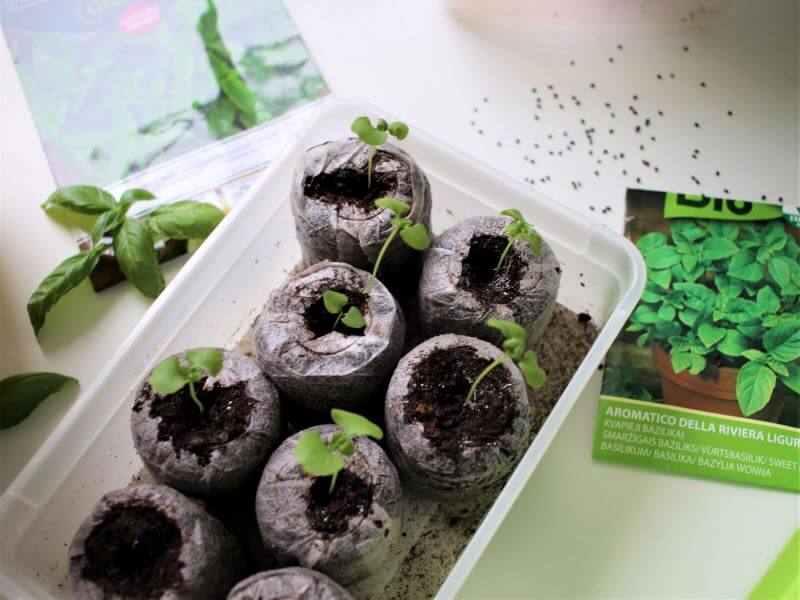
- Simple deacidified peat or special peat substrate for seedlings. You can sow in plastic nurseries or clean containers from yogurt or sour cream. But you can sow right away in beautiful ceramic pots. Clear instructions on how to do it, can be found here.
Although there are other alternatives today, such as coir, I still prefer peat. Because – you can read here.
WHEN TO TRANSPLANT IN THE FIELD OR GREENHOUSE
After sowing after 2-4 weekswhen 4 true basil leaves appear, the shoots must be collected, that is, separated. Then transplant each seedling into individual pots.
If you can already plant outdoors, transplant the seedlings directly into the ground.
When transplanting seedlings into the greenhouse, be guided by tomatoes: both basil and tomatoes are plants of hot countries. This pair is friends both on the plate and in the greenhouse. The transplant period is also similar: when you plant tomatoes in warm soil in May, transplant basil at the same time.
The same applies if you do not grow in a greenhouse, but outdoors without cover: when you plant tomatoes, then also basil.
METHOD 2: GROWING BASIL FROM THE SHOPPING MALL
This method is the simplest and fastest, because there is no need to sow seeds or wait for sprouts to grow from them. All you have to do is pick out the prettiest, lushest basil bush in the store, in the vegetable section, and care for it properly when you bring it home (more on that later). That’s all.
You don’t even need to transplant this basil into another pot – you can simply place the plastic pot the plant is already growing in into a slightly larger and prettier container.
Of course transplant would be even better. You will find several basils in one pot: divide them and transplant them into separate pots: this way you will have several from one basil plant.
METHOD 3: GROW BASIL FROM A BRANCH
Another method that few people think about is growing basil by rooting a sprig. After all, we equally grow flowers in pots, which we will look at in someone’s house. If you want to grow exactly the kind of basil that your friends grow at your house, ask them to give you a sprig of that basil. Next, do the following:
- Break off the lower leaves of the twig;
- Dip the sprig in water to begin rooting;
- When the branch has roots, transplant it into a pot with soil.
IDEAL CONDITIONS FOR GROWING BASIL
Basilio really likes it:
- Heat – that’s why they have so much fun in the greenhouse;
- Humidity: so water often and make sure the soil does not dry out;
- Lots of sun: this is why it is better to keep basil on the windowsill at home and not plant it outdoors, in the shade.
In fact, the growing conditions of basil are very similar to those of tomatoes. Basil is even believed to protect tomatoes from certain diseases. Whether this is really true is difficult to say. But I can confirm that there is a positive “chemistry” between them. Basil and tomatoes definitely seem happier growing side by side in the greenhouse.
HOW TO GET THE LONGEST HARVEST
People often complain that their basil blooms very quickly, the leaves become less aromatic, lose their fragrance and juiciness. This is what happens when we pluck individual basil leaves from the sides of the bush, fearful of plucking too much, as if we were saving money. But if we don’t stop the growth of basil, the harvest will last for a short time.
Therefore, there is really no need to save. After all, we grow basil to eat, so use it with confidence. You just need to pinch not individual leaves from the side, but pinch them peaks. In this way we slow down the growth and favor the branching of the basil. Instead of one top four new leaves appear, next time six new ones – isn’t that our goal? If you see a knotting loop, pinch that too.
The longer we do not let the basil flower, the more leaves we will have, the longer we will harvest them aromatically, the more beautiful and full the basil’s spell will be.
I hope that from now on growing basil will no longer seem complicated to you, so you will grow it boldly, the windowsills will turn green, and the house will smell of the wonderful aroma of basil!
latest posts published
Tired of working in the garden? What can be done to reduce maintenance
How to successfully transplant a Christmas tree
Landscaping a new plot: where to start?
What grows in clay: This is what worked on Juste’s farm
Organic seeds: are they worth paying more for?
Preventive spraying of tomatoes with homemade remedies –
Environmental management: how to renovate a bored plot?
Designers answer what are the 3 best plants for the garden
Fruit trees online: how I ordered them and how I planted them