The Japanese garden has been in fashion for many years. But we’ve seen so much kitsch through them that it’s sometimes hard to tell which is a cheap copy and which is a subtle authentic design. So I talked about creating such a garden and its philosophy with a Japanese garden expert in Lithuania, a landscape architect Laura Popkyte-Fukumoto.
How a Japanese garden became part of Laura Popkytė-Fukumoto’s life
The landscape specialist says that after completing her studies at Klaipėda University, she went to Japan to gain practical knowledge on creating a Japanese garden. She was so involved in these activities that she also spent about 5 years in Japan in the last 12 years.
While there, Laura watched her teacher, a master at creating Japanese gardens, at work. She herself contributed to the restoration of centuries-old authentic gardens and the creation of new gardens. All this allowed us to intuitively feel what a Japanese garden is.
So today Laura Popkytė-Fukumoto passes on her knowledge and experience by creating Japanese gardens in Lithuania too, but more on that later.
Basic principles and features of creating a Japanese garden
As the expert says, the Japanese are guided by the principle that nature is perfect and there is no need to change it – just follow it. Japanese gardens are also created according to this principle and are characterized by:
- representation of natureas if you transfer real landscapes in nature to your garden; this is done in a very scrupulous and delicate way, depicting details in an extremely realistic or abstract way;
- an effort to convey the atmospherecharacteristic of a specific natural landscape – for example, if mountains are depicted, the visitor to the garden should feel as if he is in them;
- the effect of surprise and surprise – the Japanese garden is not immediately visible as in the palm of a hand – it gradually opens up to the visitor’s eyes, revealing increasingly unexpected corners, details and suggestions; after all, even when you are in nature, you don’t know what you will see when you walk down the path, or what you will see when you go up the mountain;
- respect for the environment – when creating their gardens, the Japanese take into account what is already there in their living environment and try to harmonize it with their vision of the garden; for example, if there are trees growing outside the courtyard, the Japanese plant trees of the same type, but perhaps smaller and with a particular shape, in their courtyard, in order to create a harmonious environment both inside and outside the courtyard.
So a Japanese garden is much more than just stones and bonsai. It’s more an attitude towards nature and the desire to be part of it. As the specialist states, the main goal of the creators of Japanese gardens is to bring peace, harmony and nature into people’s daily lives.
Lithuanian landscapes in a Japanese-style garden
To create a Japanese-style garden in your backyard, you don’t really need to look for oriental decorative elements: just choose a landscape that is close to your heart and try to recreate it in your garden. For example, according to the principles of the formation of the Japanese garden, in Lithuania you can try to reproduce the landscape of the Curonian Spit or any expressive shore of a lake or river.
And having a vision for your garden, of course, you also need a concrete plan on how to achieve it. We teach how to design garden spaces and create a harmonious garden style in the courses”My design for soda”.
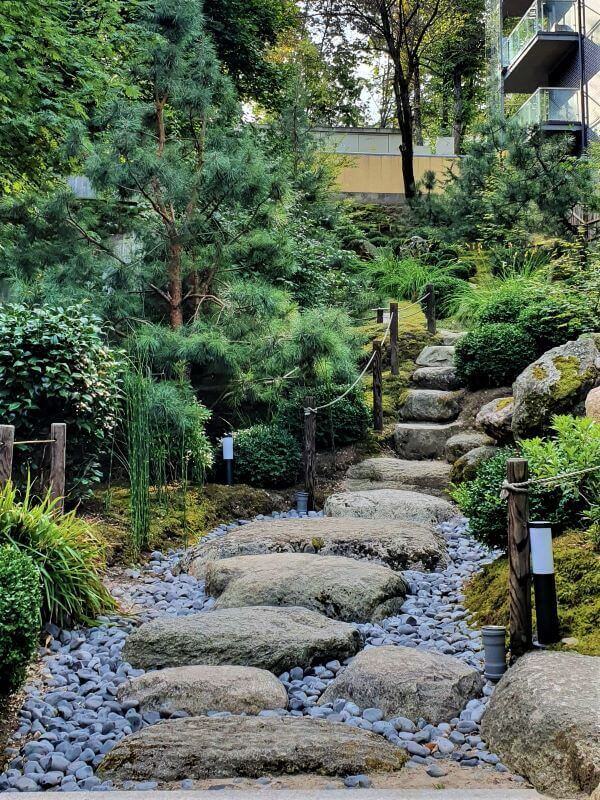
Stones are the basis of the Japanese garden
The landscapes of Japan are characterized by mountains and rocks. It is no coincidence that the foundations of the Japanese garden are made of stones. Their plans not only reflect real landscapes, but also create an effect of stability in the garden.
According to Laura Popkytė-Fukumoto, stones have their own character, shape, texture, so the Japanese choose them very responsibly. The goal is to make the stones placed in the garden look as natural as possible, as if they have always been there.
The meaning of the symbols in the Japanese garden
A Japanese garden is often imagined as a system of complex oriental symbols, where every detail is like a code or sign that determines its success. The expert says that the Japanese garden really has many symbols, it is full of deep meanings and there is nothing casual about it. Behind the exterior of every garden element lies a meaning, otherwise known as the “miracle of things.”
This attitude towards nature was developed by the ancient religions of Japan: Shinto and Zen Buddhism. The Japanese perceive nature through intuition and go to the garden not only to admire the created landscape, but above all to observe, think and delve into the essence of things and themselves.
Asymmetry and odd numbers
The aesthetics of the Japanese garden is characterized by asymmetry, and compositions are necessarily created from an odd number (usually 3, 5, 7) of objects. Laura Popkytė-Fukumoto explains that this principle is also dictated by nature itself, which the Japanese follow. After all, natural nature is perfect, full of surprises, but it is very rare to encounter perfectly ordered and symmetrically arranged objects. That perfect imperfection of nature creates the impression of harmony and balance that a Japanese garden aims to convey.
This is why you will never see four stones intersecting in the shape of a regular cross in the paving of a Japanese garden. Or next to a well-laid stone path, there will be several, at first glance, accidentally left, etc. This is done deliberately, with the aim of making the Japanese garden a single indivisible creation, like nature itself.
Trees and shrubs in a Japanese garden
Most often, the Japanese garden is decorated with woody plants, which seem to unite everything into a harmonious whole. Laura Popkytė-Fukumoto listed the most common trees and shrubs in Japanese gardens, such as:
- camellias,
- plums,
- cherry blossoms,
- handmade maples,
- ornamental trees,
- Japanese cryptomeria,
- bamboo,
- Japanese knotweed,
- pines (black, red, small-flowered),
- osmantai
- sharp,
- woody peonies,
- Japanese Pieris (bereinushi),
- azaleas,
- rhododendrons,
- hydrangeas,
- lanksvos,
- two-tone clover,
- Nandina etc.
These plants are widely grown in Japan, both in public and private spaces.
Interestingly, each Japanese garden has a dominant season, which is the most sought after. For example, if the dominant season is autumn, we try to have as many trees and shrubs as possible in the garden, which flower in autumn. Therefore, spring flowering in such a garden will be much more modest and moderate.
In other words, a Japanese garden avoids the continuous flowering of different plants throughout the year. A pause is also given to the tranquil green background of the garden.
A Japanese garden without flowerbeds
The type of flowerbeds we create in our gardens are not at all characteristic of a Japanese garden. The Japanese avoid symmetrical and strict forms of greenery, because you will not find them in nature. On the other hand, the Japanese also love flowers, but they decorate the environment with delicacy and parsimony. Very often in Japanese gardens you can see:
- chrysanthemum is a symbol of the emperor’s family, so in autumn they are abundantly planted in pots (but not in flower beds) at the entrances, they also have a special shape,
- wild orchids,
- Japanese ligularia,
- thorns,
- cosmonaut,
- vilkdalgius,
- Japanese utility bills.
Japanese garden in Lithuania
To create a Japanese-style garden you need to move away from the simple belief that it is simply an outdoor space decorated with oriental accents. Because a Japanese garden does not consist of individual details, but of a whole system in which there is nothing superfluous and each element has a clear purpose and message.
By following the philosophy inherent in this art it is possible to create a truly unique and authentic environment.
Here are a couple of wonderful examples of Japanese garden in Lithuania, which Laura Popkytė-Fukumoto helped install:
- SEI SHIN En (lit. Pure Heart) Garden in Vilnius it is located near the Montano and Neris Park. The main purpose of this garden was to “resurrect” an underground spring that originates in Montano Park. In this way, the space and atmosphere characteristic of the spring mountain landscape were created. Here you can sit quietly in the gazebo, listen to the gurgling of the spring and the chirping of the birds.
- The Japanese garden designed by Laura Popkytė-Fukumoto is completely different In Klaipėda, in the courtyard of the Psychopedagogical Service. It depicts a bay or lagoon landscape. It is interesting that this garden is karesansui type (dry), so the water contained in it is symbolized by a stone chip. A space has been created here for educational and therapeutic activities, where lessons are held with children, their parents, psychologists and other specialists, as well as dog therapy lessons. Laura says that in creating this garden, she wanted her visitors to be able to relax, even just for a while, put aside their pressing worries and meet themselves in peace.
Thanks to Laura Popkyte-Fukumoto for this very interesting story about the little-known philosophy of creating the Japanese garden. I spoke with an expert on Japanese gardens in the “Plant Enthusiasts” program on “radio Ziniù”, you can listen to the whole interview by clicking here.
latest posts published
Tired of working in the garden? What can be done to reduce maintenance

How to successfully transplant a Christmas tree
Landscaping a new plot: where to start?

What grows in clay: This is what worked on Juste’s farm

Organic seeds: are they worth paying more for?

Preventive spraying of tomatoes with homemade remedies –
Environmental management: how to renovate a bored plot?
Designers answer what are the 3 best plants for the garden
Fruit trees online: how I ordered them and how I planted them