Astilbe are perennial flowers whose flowering peak is in midsummer. Get to know them and fall in love. Fantastic flowers, just a sea of flowers – in the VDU botanical garden in Kaunas:
In the video and article below, Žibutė Baškienė, senior specialist of the VDU Botanical Garden and curator of the astilbe collection, talked about astilbe varieties and their cultivation.
What conditions are necessary for astilbes to grow and flower successfully?
Astilbes require certain growing conditions: before you buy a new plant, look around to see if you can find a similar place in your garden.
Astilbe would like:
• a more humid place (also suitable for coasts);
• partial shade (especially for better humidity conservation);
• light and loose terrain (even if otherwise the terrain is not demanding).
If the soil is sandy, “tighten” the soil with clay to retain moisture. If, on the other hand, the soil is clayey, mix it with sand so that the water does not stagnate.
Conclusion: if you have a humid and semi-shaded place, plant some astilbe and you won’t have problems. It is an undemanding plant and there is no need to “cack” it.
If you want to grow astilbes in an arid and dry place, the irrigation system will be your greatest help.
Shapes of astilbe brooms
There are four main forms of astilbe brooms, let’s look at the astilbe varieties from this angle:
Pyramidal inflorescences
An example of a pyramidal inflorescence is the astilbe ‘Cattleya’. July is a time of mass flowering and buzzing of bees. This astilbe is very woody.
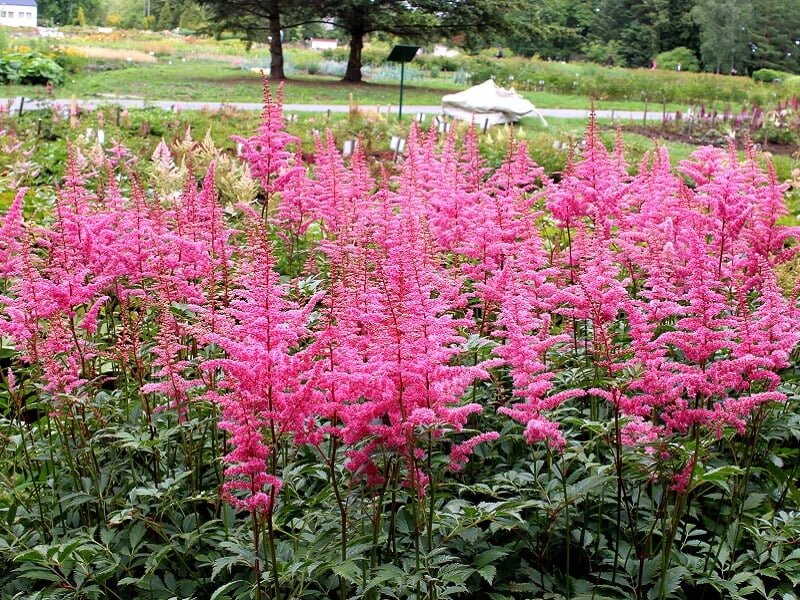
The variety ‘Cattleya’ is very suitable for naturalistic greenery due to the decorative shape of the inflorescence and the beautiful foliage.
Broom-shaped inflorescences
The representative of this group, the astilbe ‘Purpurlanze’, belongs to the later varieties. It is very decorative: the leaves are curly, not so shiny, maybe even rougher – the lower part of the leaves is even hairy, dark. And due to the brightness of the flowers and the darkness of the stem, the variety is very popular.
In the background is the Astilbe ‘Bergkristall’. They are a little earlier, but still bloom in early August.
Rhombus-shaped inflorescences
The rhombus-shaped inflorescences are generally very compact. For example, the variety “Weisse Gloria”: its inflorescences are compressed, dense, fluffy.
It looks really impressive – this is one of the most interesting white-green varieties. These astilbes are precocious: in mid-July the inflorescences are already half full.
Hanging inflorescences
Swinging astilbas are much rarer. One of the representatives is Astilbe thunbergii (Astilbe thunbergii) decorated with pink waving gorse ‘Prof. Van der Wielen’.
And here’s a confusing thing: Thunberg hybrid astilbe ‘Straussenfeder’ is so similar to arugula that many people confuse it.
Astilbe and arugula are actually related, so it’s no wonder that this waving white astilbe is a source of confusion.
And you can distinguish them at the time of flowering: arunki are much earlier. In July, when we photographed the astilbes, the arunki had already flowered.
Extremely low Astilbe – for collectors
Ž. Baškienė says growers are now “hunting out” astilbe varieties to the lowest possible level. There are some in this botanical garden too.
One of these is Astilbe x rosea, characterized by small hanging inflorescences.
Another option is Chinese astilbe var. pumila Its inflorescences look like candles and have a bright lilac color. An interesting feature is that it creeps through rhizomes, so it reproduces very easily.
Another miniature variety is Astilbe x Crispa ‘Perkeo’. Very low ring, curled leaves: the most expensive and popular at the moment are precisely these astilbes, says Ž. Baškienė.
By the way, I will also say that if you want more astilbe names, be sure to check them out video!
When astilbes flower, is it necessary to prune them?
After flowering astilba, the specialist recommends cutting the inflorescences so that the plant does not ripen seeds, does not waste its energy, and the roots strengthen and prepare for winter.
But in naturalistic style greenery the flowers are not cut and left to overwinter for decorative purposes. If the brown color is acceptable to you, feel free to leave it, and the broom-shaped inflorescences will decorate the flowerbed for a long time.
By the way, if you cut the inflorescences before they turn brown, you can do this dry They. Light inflorescences are likely to turn brown, but inflorescences of dark red hues retain their color quite well.
Astilbe leaves are half the story!
Although astilbas bloom for 3-5 weeks, their leaves are decorative during warm weather, so be sure to pay attention to the leaves.
Don’t be fooled, there are some that change the color of their leaves over time. For example, the leaves and stems of astilbe ‘Bronzelaub’ are red-brown in spring and turn green after flowering. Ž. Baškienė says that after purchasing astilbe in the spring, you may later think you bought the wrong variety.
When Astilbe ‘Bumalda’ begins to flower, the dark leaves also begin to lighten.
Main diseases and parasites
The Astilbe have no major enemies, the only more serious one is aphids. It seems that they only attack tall plants. Aphids feed before the flowering of astilbe, so damaged inflorescences look undecorative, twisted. Spraying is recommended against aphids because the plant needs to be protected and helped, says Ž. Baškienė.
Of course you can choose if spraying with chemicals is not acceptable.
Another enemy of Astilbe is the deer! In the VDU botanical garden, these animals love to feast on astilbe flowers. And who would have ever thought?…
Combining astilbe with other perennials
Astilbe blooms only for a good month, after flowering brown inflorescences remain. My advice is not to plant them with large colored spots in the most visible place, I would suggest mixing them with other plants that would be decorative in the first half of the year or after the astilbas have flowered.
Here are some plants suitable for the same growing conditions:
- Blues (Hosta): the broad leaves will contrast with the cut leaves of the astilbe, so they will blend well with each other;
- Astrantia (Astrantia) – also likes partial shade and humidity,
- Rogers (Rodgersia) – while astilbas bloom, large leaves of Rodgersia with an interesting texture look beautiful at that time,
- Ž. Baškienė says that the following combination worked in the botanical garden: white flowering in spring lanksvos looks great together with the first astilbe leaves,
- Japanese feathers will bloom in the second half of the year, similar growing conditions are also suitable for them.
latest posts published
Tired of working in the garden? What can be done to reduce maintenance
How to successfully transplant a Christmas tree

Landscaping a new plot: where to start?
What grows in clay: This is what worked on Juste’s farm

Organic seeds: are they worth paying more for?
Preventive spraying of tomatoes with homemade remedies –
Environmental management: how to renovate a bored plot?
Designers answer what are the 3 best plants for the garden
Fruit trees online: how I ordered them and how I planted them