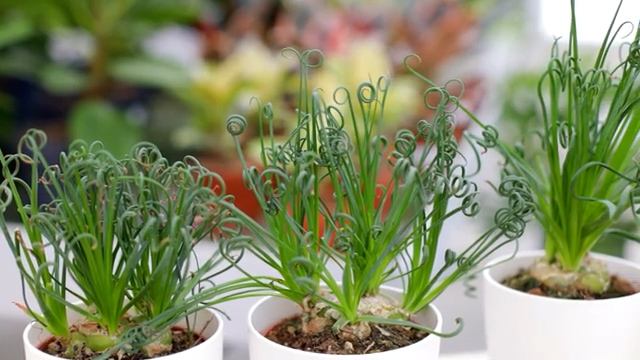
If you are looking for an unusual and fascinating plant, Albuca spiralis might be just the one for you! This species, with its characteristic spiral leaves and its resistant bulb, it is a perfect choice for those who love particular but easy-to-grow plants. Let’s find out together everything there is to know about this iconic plant.
Albuca spiralis
Albuca is a genus of flowering plants belonging to the Asparagaceae family. There are about a hundred species, spread between Northern Africa and the Arabian Peninsula. The name Albuca could derive from the Latin “albus“, in reference to the color of the flower of the first species described flowers vary from white to yellow-green and are often characterized by a pleasant vanilla scent.
Albuca spiralis is native to South Africa, in particular the Cape region, where it grows in arid and rocky habitats. This feature makes it one resistant plant and suitable for those who don’t have much time to dedicate to watering. It has a compact habit and reaches aheight of approximately 20 cm.
How to grow Albuca spiralis
The cultivation of this plant is quite simple, as long as its vegetative cycle is respected. Let’s look at the most important factors:
1. Light and positioning
Albuca spiralis love the light! To obtain its typical curled leaves, the plant must receive a lot of light, preferably direct. An unobstructed south-facing window is the ideal solution. Alternatively, if grown indoors with little natural light, a grow light can be used.
2. Ideal temperatures
Albuca spiralis can tolerate temperatures up to a few degrees above zero (up to about 1-5°C), but the ideal is to keep it between 8 and 15°C during the growing season. If you have a cold greenhouse or sheltered balcony, you might consider growing it outside in the cooler months.
3. Watering and substrate
Albuca spiralis is a succulent plant with a bulb that acts as a water reservetherefore it requires moderate watering. During the growing season (autumn-spring), water it only when the soil is completely dry. The ideal is to use sub-irrigation, avoiding wetting the bulb directly. For the substrate, choose a well-draining mixture, I always recommend the legendary One plus, but a soil for succulents and succulents will also be fine.
4. Repotting and multiplication
Albuca spiralis does not grow very wide, but may need a annual repottingpreferably at the end of winter. When repotting, leave the bulb slightly exposed from the soil. If you find small bulbs next to the mother plant, you can separate them and grow them individually.
4. Fertilization
How can we feed Albuca spiralis? Obviously we feed it when it is in the vegetation phase, in conjunction with watering, even if this is sparse. I get along very well with Cifo’s fertilizer for succulents and succulent plants, but the fertilizer for green plants is also an excellent choice. Furthermore, I won’t hide from you that I give it a little boost with Bio Oro, to encourage more vigorous growth.
The vegetative cycle of Albuca spiralis
This plant follows a particular vegetative cycle:
- From autumn to spring: it is actively growing, develops leaves and can flower.
- On the estate: enters vegetative rest, loses its leaves and the bulb remains inactive.
- Watering in summer: Suspend them completely until fall growth resumes.
As we were saying, with the heat and the increase in temperatures, the plant enters vegetative rest and the vegetation begins to dry up. However, often before this moment, Albuca spiralis gives a beautiful flowering. Its flowers, yellow-green and slightly drooping, are not particularly showy, but they have a delicious vanilla scent. This is the last active phase before vegetative rest.
If the flower is pollinated, a very recognizable three-lobed capsule will mature. When the capsule is completely dry, you will find its contents inside seeds, dark and flatsimilar to small disks. You can try sowing them to propagate the plant!
Why don’t the leaves curl?
If the leaves of your Albuca spiralis do not curl, it could be due to three factors:
- Poor light: Increase sun exposure or use a grow light.
- Imminent flowering: during the formation of flowers, the leaves tend to lose their spiral shape.
- Too much water: reduce watering and let the soil dry completely between waterings.
Dry ends in Albuca spiralis: is this normal?
Another common problem concerns dry tips of the leaves. There are two main cases:
- the plant is entering the flowering phase and then the vegetative rest. Dry ends are an early sign of oncoming dormancy.
- Even during the growing season, it may happen that the plant develops some dry tips. It’s not a worrying problem! The tips come off easily with a finger and are part of the normal growth cycle of Albuca spiralis.
Are pets allowed in Albuca?
THE Albuca spiralis sap is slightly toxic and may be irritating to the skin. If you have pets that like to gnaw on plants, place it in a safe place.
Where to buy Albuca spiralis?
You can find Albuca spiralis and other 8,000 varieties of indoor and outdoor plants on our online shop Sell Plants Online.
If you liked this article, leave us a comment and tell us your experience with Albuca spiralis! And always remember our motto: Create the jungle!
latest posts published

Tired of working in the garden? What can be done to reduce maintenance
How to successfully transplant a Christmas tree
Landscaping a new plot: where to start?

What grows in clay: This is what worked on Juste’s farm
Organic seeds: are they worth paying more for?
Preventive spraying of tomatoes with homemade remedies –
Environmental management: how to renovate a bored plot?
Designers answer what are the 3 best plants for the garden
Fruit trees online: how I ordered them and how I planted them