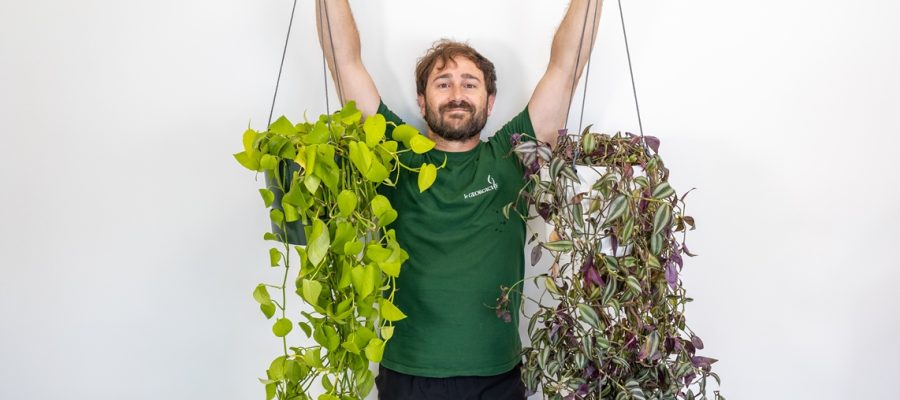
Using hanging ones for the green furnishings of the house is a choice that rewards positions that are not very spacious towards the top but are generous in terms of the space available towards the floor: shelves, small raised compartments, pedestals and so on.
Hanging indoor plants are not necessarily the prerogative of expert green thumbs and there are a couple of plants that I always recommend to anyone who wants a easy to manage and not very demanding about treatments.
Two always very valid allies in this sense can be the Pothos and the Tradescantie.
Pothos and Tradescantia as hanging plants indoors
Pothos and Tradescantia, in fact, have common characteristics that make them sensible choices:
- They do not require frequent watering (in particular the Tradescantia which is almost a succulent): they can be watered in moderation, waiting for the soil to dry between one administration and the next. By using a high quality soil like ONE+ we can afford some extra watering during the hot season (especially if we keep them outside in these months and the soil dries sooner due to the greater evaporation of the soil and transpiration of the plant). A few extra touches of humidity in the soil, although not essential, seem to me to be well appreciated in summer also by these plants, which are very tolerant when it comes to water.
- If Tradescantia prefers bright positions, Pothos also tolerates less irradiated areas of the house very well and can often be chosen even for those slightly high shelves where not much light never reaches. I would like to point out that ‘low light tolerant plants’ do much better when well lit by the sun. The only precaution is to avoid direct rays in seasons/hours with strong sunshine. In winter you can throw them under direct light, shielding them a little as spring advances and so on until the end of summer. I always find it makes little sense to say that some plants want light ‘but not direct’ (what time of year are we talking about?). A note on Tradescantia: not that it suffers in less bright positions but certainly the color tones of the leaves will be much paler and faded, furthermore we risk losing its beautiful, albeit minute, little flowers.
- If you are a beginner and would like to try your hand at some simple cutting propagation exercises, these are for you: taking a Pothos and Tradescantia cutting is very simple and they root quickly even immersed in a glass of water. So they are excellent plants for some training on home cutting of tropical plants.
- Both are available in numerous species and varieties, which allows us to have different and never identical ones, all with a particular livery, leaf morphology or peculiar characteristic (for example the vesicular variegations of the Pothos trebie which we mentioned in this post).
We have spoken extensively about Pothos here and the vulgar Anglo-Saxon name Devil’s Ivy or Devil’s Vine is attesting to its robustness, testifying to the (almost) impossibility of killing them. In today’s video I took one as representative samples of these two genres Tradescantia zebrina and a Pothos ‘Neon’: they are two plants that, if well cared for, grow luxuriant and give satisfaction. Both explode outside and up to 10°C we can keep them outside without problems.
Repotting: option or necessity?
Today in particular I am dedicating myself to their repotting: I have been procrastinating for several months and now I find all the limits dictated by pots that are too narrow. When this happens we can notice:
- Imbalance in the soil structure which is compressed by the expansion of the roots
- Consequently, the soil stores less water and the plant often presents the symptoms of thirst (added to this is the resulting stress)
- In relation to the lack of water availability, difficulties are observed in the absorption of minerals (cause of further weakness of the plant)
- Hydrophobia: the soil may be resistant to water penetration (in the video the soil of the Tradescantia rose due to the expansion of the roots)
Sometimes people are scared that delays in repotting plants could cause their death: I have never come across this extreme conclusion. Normally the plant is able to size the root system according to what it has available even if in the long run it is possible that it will try to launch roots everywhere or exert such pressure as to break (in some extreme cases) even plastic pots. In the mountains I see small fir trees growing among the rocks and it is fantastic to admire how the powerful action of the roots can even play a role in the disintegration of the rock. Bonsai are another example of how limited spaces can still guarantee the life of the plant while keeping its growth restricted.
Even the size of the vase to choose as a new home for my friends requires a conscious choice: vases that are too large are not a correct option. Large volumes of soil retain moisture in areas that are not reachable by the roots of a newly transplanted plant; gradually increasing the size of the pot rather than planting in the largest pot available at first is a good choice.
A few other tips I’ve found helpful over the past few months for perfecting my repotting technique:
- If possible, do not compress the root system by trying to fit it into a pot that is too small at all costs
- Avoid removing soil from the root ball of the plant unless necessary
- Avoid breaking the roots unless necessary
- In case of presence of aerial roots (often happens with Monstera deliciosa) these can also be buried without problems
Sometimes these replanting plants tend to shed a little, especially in the initial part of the vegetation (the one closest to the ground) or they develop in an uneven manner preferring certain directions (typically the more illuminated sides): we can take advantage of repotting to place some cuttings in the new soil in order to re-thick them. Taking cuttings from the terminal parts of the shoots is also useful for equalizing the growth of the vegetation and for stimulating new shoots (as if it were trimming).
Friends of the #clangeorgici I hope that these two plants can be part of your home jungle and if you are inexperienced I highly recommend them! If you have any doubts, write to me in the comments.
latest posts published
Tired of working in the garden? What can be done to reduce maintenance
How to successfully transplant a Christmas tree
Landscaping a new plot: where to start?
What grows in clay: This is what worked on Juste’s farm
Organic seeds: are they worth paying more for?
Preventive spraying of tomatoes with homemade remedies –
Environmental management: how to renovate a bored plot?
Designers answer what are the 3 best plants for the garden
Fruit trees online: how I ordered them and how I planted them