Rhododendroneh varieties are not everything: to choose you need to pay attention to which group the rhododendrons belong to. Some tolerate shade better, others would be better suited to a sunny position near the terrace, still others automatically indicate a tall bush. We will introduce you to the most common groups – they talked about them VU Botanical Garden curator of botanical collections Ramune Žemgulytė.
I recommend the seminar to anyone looking for their own color “Color matching in the garden“ – You will like these tutorials if you want to create harmonious combinations of plants in your garden and learn to control colors according to certain rules.
In nature there are around 1,000 different species of rhododendrons, which gardeners divide into at least 5 groups:
- Two groups of evergreen rhododendrons;
- Two groups of azaleas;
- A group of semi-evergreen rhododendron
It is very important to know which group a rhododendron belongs to, because the care of rhododendrons belonging to different groups is also different.
Large-leaved non-scaly rhododendrons
Ramunė says that when visitors to the VU Botanical Garden ask where they can see rhododendrons, they expect to see large-leaved rhododendrons.
This is the most appreciated group of rhododendrons from an aesthetic and commercial point of view, which includes numerous varieties.
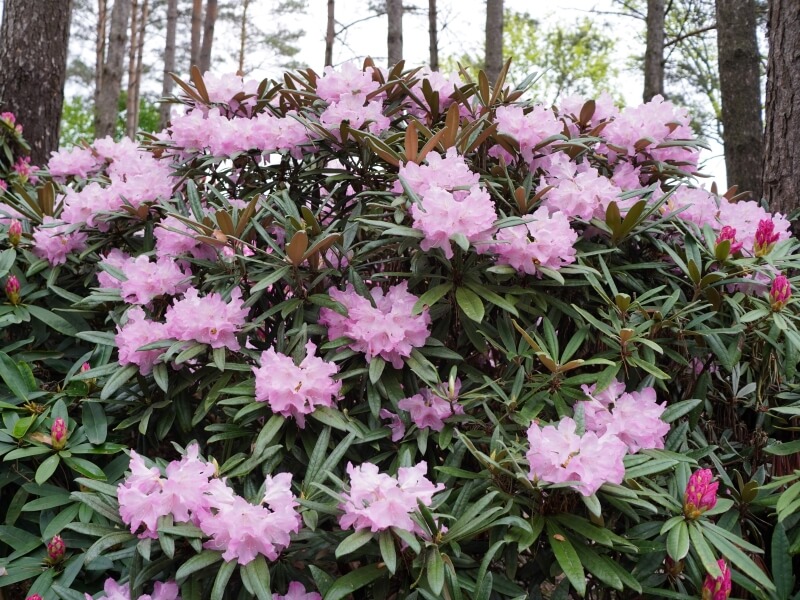
Stemless rhododendrons usually grow as medium or large shrubs, the height of which can reach from several tens of centimeters to several meters. The flowers are odorless, usually pink, lilac, red or yellow.
These rhododendrons are evergreen, meaning they do not lose their leaves in winter.
In the wild, these rhododendrons grow in the undergrowth, so in gardens they prefer the proximity of taller trees because they provide changing shade. If such conditions cannot be provided, plant at least in the eastern or northern part of the site, do not choose the western or southern part: these rhododendrons will not grow successfully there.
Most interesting varieties of these rhododendrons
The following varieties of broad-leaved rhododendrons are grown in the VU botanical garden:
- ‘Panenka’ is a spectacular hybrid variety bred in the Czech Republic with large leaves and bright purple flowers. The bushes become large, can reach a height of several meters. However, this variety is sensitive to cold, so it does not always winter successfully in Lithuania.
- ‘Schneekrone’ is a Yakushima rhododendron hybrid best suited to growing in sunny areas. All Yakushima hybrids are quite compact and have identifying hairs on the inside of their leaves. This variety grows up to 1.2 m tall and 1.5 m wide and blooms with pale pink flowers that change color.
- “Koichiro Wada” is another Yakushiman rhododendron hybrid, named after the Japanese botanist who gave it to the English. From this rhododendron came all the other varieties of Yakushima rhododendron known in Europe. The bushes grow extremely compact, blooming with pink flowers which then fade to white.
- ‘Scarlet Wonder’ is a creeping rhododendron with red flowers. It grows into extremely compact bushes, very suitable for planting on slopes or grown in rock gardens. It grows well in shade or partial shade.
Small-leaved scaly rhododendrons
This is a less popular group of rhododendrons with few varieties. These rhododendrons are characterized by compact dimensions (height usually does not exceed one meter), decorative cushion-shaped tufts and small inflorescences. Scales grow inside the leaves which protect the plant from the cold.
In the wild, these rhododendrons grow on highlands and have a wide growth range, from the northernmost to the southernmost points. The flowers open gradually, depending on the weather conditions: first some open, then others. Mostly blooms in lilac, purple, white color.
The small-leaved scaly rhododendron variety ‘Ramapo’ is grown in the VU Botanical Garden: it is a low, frost-resistant variety with small purple flowers that has established itself in the Lithuanian climate.
Evergreen or Japanese azaleas
Not everyone knows that azaleas are not a separate plant, but exactly the same rhododendrons, only they have soft leaves and a slightly different flower structure.
Evergreen azaleas are distinguished by a huge variety of varieties. The flowers are small and odorless and can have a wide variety of colors and shapes: hollow, solid or semi-hollow.
This group of rhododendrons is more difficult to adapt to the Lithuanian climate – although evergreen azaleas should not shed their leaves by nature, in our country their leaves turn brown in the cold season, or fall in autumn and grow again in spring.
It is necessary to cover young evergreen azaleas in winter, but with age their resistance increases and from 5-6 years of age it is no longer necessary to cover azaleas if they live successfully.
Summer azaleas
Summer grasses, or deciduous azaleas, are a very popular and diverse group. These are the rhododendrons that adapt best to our climate and are the least demanding, which is why they are very popular with gardeners.
Depending on the variety, herbaceous summer azaleas can reach several meters in height. They tolerate sunlight, can grow in more open areas, are not as sensitive to soil acidity.
These azaleas do not need to be covered in winter: they go dormant like most other flowering shrubs we are used to. If you have not yet grown rhododendrons and are not sure whether they can successfully winter in your area, it is worth starting with these azaleas.
Summer azaleas are characterized by an extraordinary variety of colors and are the only rhododendrons growing in Lithuania that give off a strong scent.
Also, unlike other rhododendrons, their leaves change color in autumn and are painted in orange, red or cherry shades, which gives additional decorativeness to the bush.
Dwarf rhododendrons
Some gardeners do not distinguish rhododendrons as a separate group of rhododendrons, but they have distinct differences. These are rather large and tall rhododendrons that bloom very early and begin to collect flowers as soon as the frost leaves the ground.
They are interesting in that in autumn some leaves turn orange, red shades similar to summer grass azaleas and fall off, while the other part remains growing at the top of the bush without changing color.
Daurinia rhododendrons are not particularly delicate and winter perfectly in Lithuania, but they are sensitive to spring frosts, so their early harvested buds may freeze.
If you grow such a rhododendron in your garden, be prepared that one year you may get very abundant flowering, and the next year there may be no flowers at all.
latest posts published
Tired of working in the garden? What can be done to reduce maintenance
How to successfully transplant a Christmas tree
Landscaping a new plot: where to start?
What grows in clay: This is what worked on Juste’s farm

Organic seeds: are they worth paying more for?
Preventive spraying of tomatoes with homemade remedies –
Environmental management: how to renovate a bored plot?
Designers answer what are the 3 best plants for the garden
Fruit trees online: how I ordered them and how I planted them