“Save money,” the neighbor tells me, “plant small trees and bushes for hedges, and they will take root and grow when you build a house.” It seems logical, I thought then, since smaller plants are much cheaper and you will have to wait a few years for them to reach the desired size before they start bearing fruit. After construction we will move into the house, the trees and hedges in the yard have already grown a lot and we are already picking apples.
But I can say that if you plant trees right before or during construction, you can become hostage to your own decision. I interviewed the landscape architect, teacher of the modern gardening courses “My Garden Design”. Lina Puodžiūtėwhich is often underestimated and needs attention.
POSITION OF THE TREE ON THE GROUND
Usually, you first build a building on the land and only then start taking care of the environment. This applies not only to the works, but also to the design phase. Therefore the first frequent mistake mentioned by L. Puodžiūtė is planting the tree in the wrong place.
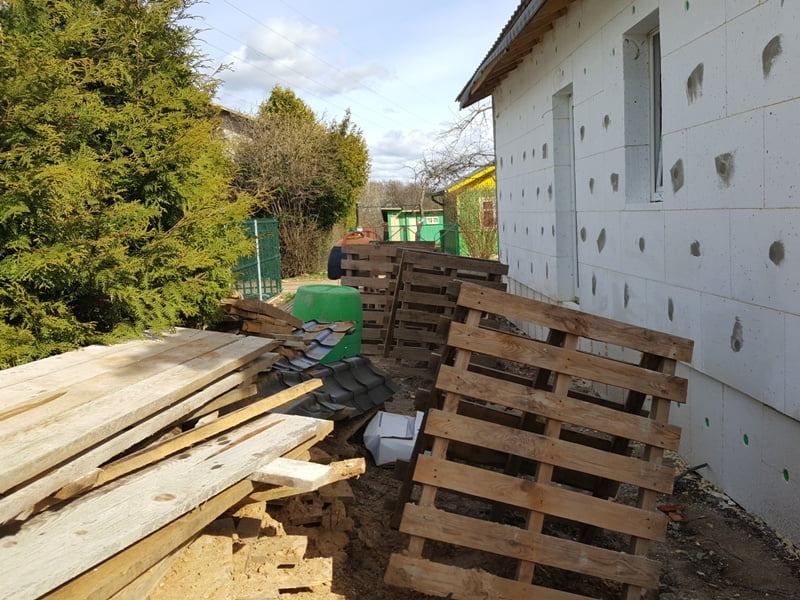
Let’s start with the fact that trees can interfere with the construction process. You won’t tell builders to protect your trees. Plants can be injured, covered with earth and other materials, they can be trampled, broken, hit by passing machinery, objects can fall on them. This does not mean that they will do it on purpose, but we cannot guarantee that we will be able to save the facilities while the work is underway. In addition, dust and other volatile substances can fall on the plants, which will disrupt the plant’s respiration through the leaves.
Secondly, as long as there is no plan, any place seems suitable for a tree. The owner measures a few steps from the fence and a few steps from the house, chooses a sunny place and walks away. When construction finishes and the landscaping project begins, it turns out that the place where the tree grows would be the perfect place for a trail.
Or you would like to make a spacious terrace, but it turns out that the tree would be right next to it. What to do then: move the tree or make a bend in the path? Move a tree or reduce the terrace?
Therefore, the owner becomes hostage to his own decision. Time and money have already been invested, the tree has grown, it’s a shame to move it, it’s a shame to give it up, but I don’t want to sacrifice another solution either.
FUNCTIONAL AREAS CONFUSIONS
It happens that trees or bushes do not physically hinder the arrangement of the yard, but simply do not fit in terms of style and function. The specialist says: “It is better that everything is done in order – so we also teach in gardening courses (now training is also Internet). First, the existing conditions are ascertained, what the family’s needs are, then a sketch is made and only then we move on to the plans. If we start with plants (for example, you plant currants), then you can mix the functional areas (a terrace must be built near the currants, because that is also the best place for the terrace).”
The placement of the plants must be determined when the concept of the plot, of the entire frame, is already clear. If we know exactly where the entrance is, how wide the paths are, where and what size the gazebo, greenhouse is, then we can also plan places for plants.
Of course, the plants can be moved to another part of the site later, but the question is: did planting the plants during construction really make sense?
An exception may be if a landscape architect or professional designer is designing the project for you. It will ask you questions you hadn’t thought of and you will avoid some mistakes.
IF THE GROUND FLOOR IS CHANGED
It is risky to plant trees and shrubs on a site if you do not yet know the future ground level or know that it may change. In these cases, the soil may be adjusted, so its level may be different than before the start of construction:
- If the land is located on a slope or in a valley,
- If there are large holes,
- If the vegetation layer is pushed uphill to the rear of the plot and will be spread later,
- If the natural soil is very clayey it will be necessary to level it.
How do plants react to changes in soil level? Bad. If you need to raise the soil level and cover the grafting site of the apple tree with earth, it will most likely die. And if it was necessary to lower the soil level, you would have to expose the roots of the tree: in this case, the fastest way would be to leave a small hill specifically for that tree. Neither this nor that, then it is better to replant.
L. Puodžiūtė came across similar cases where oers refused to level the land where trees were growing to save them. Of course, if the soil is old and the trees are mature, this would be the right decision. But if you planted them yourself a year or two ago at the same level, and now you want to raise or lower the level, you’ve just caused yourself an additional headache.
SO WHAT TO DO?
Don’t rush to plant early. Complete the construction and live on the land at least a year. Find out which place is most suitable for relaxation, create a living area there. Which place will turn out to be sunny, but less used, plant fruit trees there, create a garden.
L. Puodžiūtė says that the foundation usually takes place… in December, before Christmas. I think you will also agree with this: then the last warm days will be exhausted and the last late works will be over. Having settled in the winter, the hosts already begin to rustle in early spring, they want to plant the plants as soon as possible and enjoy them.
But the environment changes every season. After going outside in early spring, missing the sun and warmth, it seems that the best place for a terrace is the south side of the land. The specialist laughs that it is difficult to prove that in summer that place will be as hot as a pan, you wouldn’t want to be on the bare south terrace at all. Then you need to get out of the situation: buy umbrellas, think about curtains.
Having lived on the land at any time of the year, you will already know the places where it is nicest to drink coffee in the morning, where it is fun to spend the evening, when you can actually see your yard, where neighbors spend their holidays, from which direction the drafts come. You will plan accordingly.
Therefore, the teacher suggests planting trees and bushes not before construction, but after the house is built, arranged and lived in for at least one warm season. As for apple trees, plant them not in the first spring you live on that plot, but in the fall, when you’ve had at least one warm season. Planting plants during construction is not the optimal solution, take your time.
HOW TO SAVE LIVESTOCK?
The same can’t be said of hedges – who wants to wait a year and see an ugly sight behind the fence? It is common for owners, without a specific plan, to plant a hedge along the entire perimeter of the land. You need a lot of plants, so the price difference is very noticeable. The smaller the plants, the lower the price. Therefore, you want to plant the perimeter of the plot as soon as possible and thus save money.
However, if you plant thuja trees two bays tall, it won’t take two or five years for them to create the necessary cover. L. Puodžiūtė says that once settled, a hedge is needed here and now: who wants to wait 10 years? But think about whether it is really necessary for the whole plot.
He argues that a high hedge is needed only where there is a real need to disguise something: where the neighbor’s warehouse, compost containers are visible, where the abandoned area is neglected, where industrial buildings are located. Most often, these things are not placed along the entire perimeter of the plot. And if the entire plot is surrounded by tall thuja trees, it is possible to cover not only bad, but also beautiful views. Furthermore, a plot framed by a high continuous hedge will make you feel claustrophobic and it will be more difficult to create a beautiful design.
So let’s go back to the plan, to the project. The specialist says that it is a smart choice to choose those places that need to be covered and just plant there hedge plants at least 1.5 m high. This will solve the problem immediately. Yes, tall plants will be more expensive, but you will plant fewer of them, only where necessary, and they will really do the job of hedging. You won’t need to increase your budget and you will get the effect immediately.
MEET YOUR NEEDS
The teacher of the landscaping courses says: “When the owners buy land, they pay for each hectare. And often about 1/3 of the land is not used at all: the lawn is simply mowed and that’s it, without function, without any benefit.”
He suggests that it is better to plant more plants that can provide both beauty and benefits. After all, it is not necessary to limit yourself to apples and plums and read about interesting plants in magazines as if they were exotic plants. Grow yellow-flowered dogwoods, which bloom with yellow flowers before forsythia and produce edible berries in the second half of the year. Grow edible honeysuckle for delicious, long-lasting berries. Shrubs will always take less time than a constantly mowed lawn.
If you don’t want to make mistakes, take your time, feel the advantages and disadvantages of your garden, delve into what you really need. You will find that not all standard solutions that worked for your neighbor will work for you.
latest posts published
Tired of working in the garden? What can be done to reduce maintenance
How to successfully transplant a Christmas tree
Landscaping a new plot: where to start?
What grows in clay: This is what worked on Juste’s farm

Organic seeds: are they worth paying more for?

Preventive spraying of tomatoes with homemade remedies –
Environmental management: how to renovate a bored plot?

Designers answer what are the 3 best plants for the garden
Fruit trees online: how I ordered them and how I planted them