Spring comes with the most important ritual that we must perform if we want to enjoy luxurious roses. Yes, spring pruning of roses. All roses need it and the beginning of vegetation signals: it’s almost time! The frost has completely disappeared and the buds are swelling.
Coincidence or not, but it is precisely in this period that forsythia begins to bloom. Well, you should not be afraid of light frosts at night – they do not harm pruned roses.
Is pruning necessary? Yes, if you want:
- of old, sick, weak witches without branches;
- new and strong branches;
- beautiful foliage and bush shape;
- larger and more abundant flowers;
- long-lived and vibrant roses.
We are preparing to prune
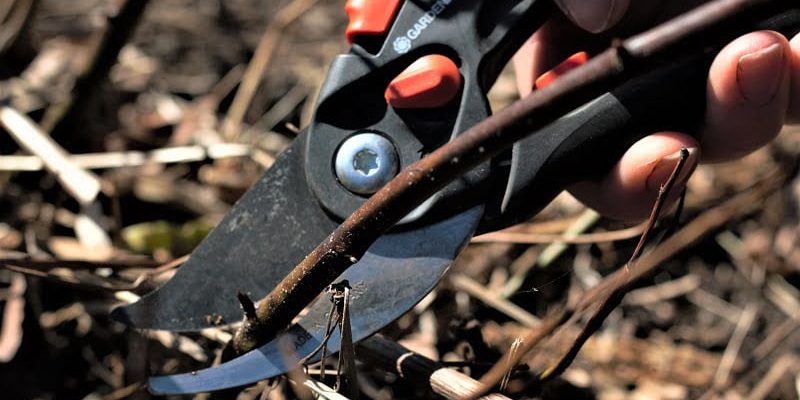
What is the most important thing before pruning? And get the special tools for this. They must be clean and sharp. It is very important that the branch of the plant is cut and not crushed. In the photos you can see my shears from the Comfort “Gardena” series (we talk about them here), which I have seen and seen many, but they are very reliable. Just don’t buy shears with folding blades – they are designed for cutting dry branches, not for pruning roses. The cut must be precise and free of splinters, so spring pruning of roses should not even begin without a good sharp tool.
If you only have some shears, it will be more than enough for thin rose branches. And thick ones may require garden shears or even a small saw. And be kind, don’t skimp when looking to purchase such a tool. This is a long-term investment, as a tool like this will serve you for many years with proper maintenance.
Spring pruning of roses: in order
Here is the sequence we follow during pruning:
- let’s take a good look at the rose bush, evaluate the state of the rose and the age of the branches;
- we remove all dead or diseased branches;
- prune all frozen branches to a healthy green bud;
- we remove some branches that grow in the bush to allow air to circulate and the branches to receive more light.
Subsequently, a refreshing pruning of the bush is carried out, cutting off some old branches. But how do you know which ones to cut and how many?
In most modern roses, a three- or four-year-old branch can already be considered old. Often many regret pruning green branches, but then notice that flowering becomes less and less.
The old branches are much thicker, darker and sometimes don’t even bother to sprout new branches in the spring. They hardly feed the upper branches, do not provide them with enough water and nutrients. We choose 2 or 3 branches of this type and cut them as close to the ground as possible, thus encouraging the rose to develop new branches.
A common rose suffers from late blight in spring. Red-brown spots appear on the branches, which increase in size, surrounding the branch. Such branches must be pruned to a healthy place and sprayed with a fungicide.
How to make a cut correctly?
The branch is cut diagonally, leaving 0.5-1 cm above the eye. Cutting closer could accidentally damage the eyelet. After cutting the branch, you should see light, greenish, vibrant wood with no brown spots.
The branch is cut diagonally, leaving 0.5-1 cm above the eye. Automatic photo R. Laurinavičienė
Frozen rose branches should be pruned to healthy, green wood. Automatic photo R. Laurinavičienė
How are roses of different groups pruned?
Remember that:
- hybrid tea roses are usually pruned heavily to produce the largest flowers possible;
- floribunda roses are usually pruned hard or moderately, so they bloom faster and bloom continuously throughout the season;
- For most modern bush roses, light pruning is sufficient, but every few years it is worth cutting off some old branches to renew the rose bush.
Peculiarities of pruning roses that bloom only once
Ancient roses and thistles that bloom once do not need to be severely pruned: they bloom on second-year and older shoots, and flower buds form in the upper and middle parts of the branches. And vegetative shoots, from which branches grow, are located in the lower part of the bush, closer to the ground. Therefore, if the branches are significantly shortened, branches and leaves will grow on the tree, and the flowers will have to wait at least a year.
Pruning climbing roses
Before getting climbing roses, it is important to know which group they belong to: climbing, single-flowering or repeat-flowering climbing. It depends on the pruning method required.
- For climbing roses that bloom once, we cut some old branches right at the base, thus renewing their charm (if there are more than 7 branches left from last year). However, if few branches remain after the winter, it is not advisable to prune the old branches, in which case we only shorten the two or three year old branches during the spring. We do not shorten last summer’s newly grown branches.
- Repeat-flowering large-flowered climbing roses usually produce many large branches that send out lateral floral branches. Young branches do not require pruning and lateral branches are shortened by a third. We can prune the older branches, leaving 3-5 healthy branches.
After pruning, we tie the climbing roses to the supports, trying to bend the branches horizontally: this favors more abundant flowering.
Further care of roses in spring
Well, the pruning is finished. But nothing is spared for the beauties of the garden, therefore:
- we spray roses with copper preparations (burgundy mortar, “Champion”, etc.);
- we rake fallen and old rose leaves, loosen the soil, weed out weeds;
- we fertilize with complex fertilizers (30-40g/m2) and, if possible, well-rotted manure..
latest posts published

Tired of working in the garden? What can be done to reduce maintenance
How to successfully transplant a Christmas tree

Landscaping a new plot: where to start?

What grows in clay: This is what worked on Juste’s farm

Organic seeds: are they worth paying more for?
Preventive spraying of tomatoes with homemade remedies –
Environmental management: how to renovate a bored plot?

Designers answer what are the 3 best plants for the garden
Fruit trees online: how I ordered them and how I planted them