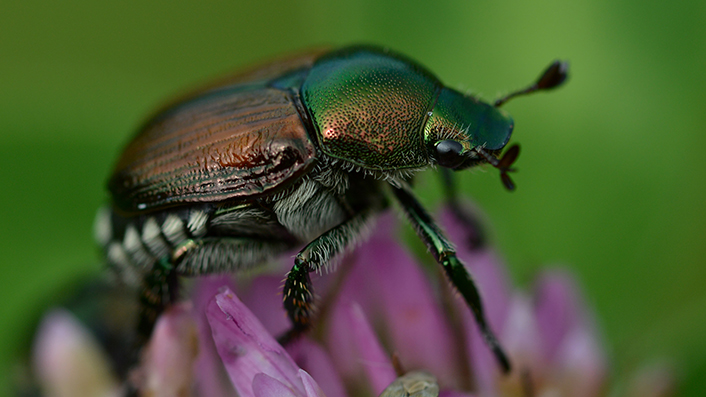
Popillia japonica it is a beetle of Asian origin which in recent years has also been rapidly spreading in Italy, especially in the North. Perhaps not everyone knows it yet, but this insect has already been reported in various areas of Lombardy, including cities such as Milan and Bergamo.
But what is it exactly? What damage can it cause to our plants? And, above all, how can we defend ourselves? Let’s find out now!
Popillia japonicaalso known as Japanese beetleis an insect belonging to the Scarabeidae family, native to Japan and of Eastern Russia. In these areas, its presence is kept under control by natural predators, which is why it does not pose a serious threat to the environment.
Its spread outside Asia began at the beginning of the 20th century, when it was unintentionally introduced into the United States and Canada. From there it continued to expand: in the 1970s it was identified in one of the islands ofAzores archipelagoand finally, in the summer of 2014, it appeared for the first time in continental EuropeBetween Piedmont and Lombardy.
In the 2017 Popillia was also found in Swissconfirming a constantly growing diffusion.
Unlike its native habitat, in Europe and North America Popillia japonica finds few natural enemiesand this favors its rapid proliferation, making it a serious problem for ornamental plants, lawns and agricultural crops.
Know the development cycle of Popillia japonicaor Japanese beetleit is essential to be able to recognize and counteract it effectively.
- Egg
THE eggs of Popillia japonica are placed in the ground. Once formed they measure approx 1.5mm in diameterbut as the embryo develops they can almost double in size. The shape varies from spherical to ellipsoidal or slightly cylindricalwhile the color is transparent or creamy whitewith characteristics hexagonal areas visible on the surface; - Larva
THE larvae of popillia are typically cream white or transparentwith a body covered with brown hairs and blunt spines scattered over the entire surface. It is at this stage that they begin to feed on the roots of plants, causing significant damage to lawns and herbaceous crops; - pupa
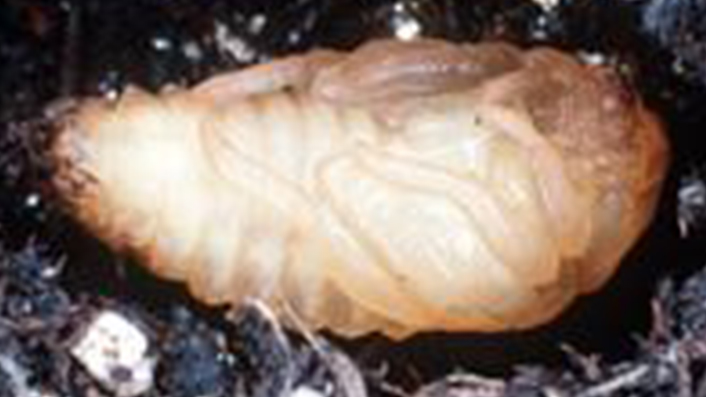
THE transformation into pupa it occurs inside a small underground cell that the larva builds using the soil. The pupa measures approx 14mm long and 7mm wide. The color changes with age, going from a pale cream yellow A metallic green as it approaches the adult stage; - adult
Iadult of Popillia japonica it is approximately long 10 mm and wide 6 mmwith a black body bright metallic green. The elytra (upper wings) are one color bronze or copper. An easily recognizable distinctive feature are the five patches of white hair on each side of the abdomenwhich make the insect unmistakable.
Popillia japonicaalso known as Japanese beetleworries gardeners and farmers for a specific reason: its extreme destructiveness. This beetle attacks indiscriminately ornamental plants, fruit plants, vegetables and lawnsquickly reducing them to green skeletons. Few plant species can resist it.
An efficient and aggressive life cycle
The life cycle of Popillia japonica is generally completed in a yearalthough in colder areas it can extend up to two years. THE eggs are laid in the groundtypically in grassy areas close to vineyards, bushes, pastures, cultivated or uncultivated fields.
A single female lays from 1 to 3 eggs at a timearriving at 40–60 eggs in its lifetimewith a maximum of 16 depositions.
From the larval stage to the adult: a destructive path
Eggs yes they hatch in 10–14 daysgiving life to larvae which, for the first 2–3 weeks, feed on the younger roots. After the first moult, they continue their trophic activity for others 3–4 weeksand then change a second time.
The third larval stage is reached when temperatures begin to drop below 20°C and continues until approximately 10°Cwhen the larvae enter a dormant phase. With the arrival of spring, the larvae return to feed on the roots for 4–6 weeksthen they transform into pupae in a period that lasts from 1 to 3 weeks.
The adult stage is reached around mid-May in warm areas and between June and July in colder areas.
How long does an adult Popillia live?
A Grown nipples it has a relatively short but intense life: the males live from 9 to 74 dayswhile females come on 17 to 105 days. During this time they feed voraciously and lay eggs continuously, spawning rapidly very extensive infestations.
Which plants are infested by Popillia Japonica?
As we said before, few plants are exempt from the unwelcome visits of Popillia Japonica, in fact this beetle infests more than 300 species of plantsamong the most common: strawberries, tomatoes, peppers, peaches, raspberries, corn, soybeans, vines and hazelnuts. However, it also affects broader genera such as Maples, Caladiums, Asters, Hermerocallis, Irises, Oaks, Roses, Viburnums and many others.
However, there are some resistant or immune plants, including Abies, some maples (rubrum and saccharinum), Clematis, Forsythia, Ilex and Pinus.
What damage does Popillia Japonica cause to plants?
The damage caused by Popillia japonica: skeletal leaves and destroyed roots
Let it be larval stage that in adult stageTHE Popillia japonica represents a real threat to many plant species. But what damage does this really cause? infesting beetle?
Adults: skeletal leaves and fruit damage
The adult specimens of Popillia japonica they feed voraciously on leaves, flowers and fruits. On hot, sunny days, these insects gather in groups, starting from taller hair of the trees and then progressively descend downwards, consuming all the foliage.
The most characteristic damage is the skeletonization of the leaves: adults eat only the leaf tissue between veinsleaving the laminae with a reticulated and transparent appearance.
A single specimen is not worrying, but the real problem arises when it does gather en masserecalled by aggregation pheromones. Once an initial group attacks a plant, other beetles quickly arrive, worsening the infestation.
The larvae: invisible enemies of the roots
THE larvae of Popillia japonica they live in the soil and feed on roots of herbaceous plantsespecially lawns, turf, public parks and even golf courses. This hidden attack compromises the plants’ ability to absorb water and nutrientsmaking them vulnerable to water and thermal stress.
In cases of severe infestation, the lawn may appear dry, yellowed and give way easily underfoot, a sign that the roots have been completely destroyed.
There are some now tested methods to combat Popillia Japonica, here we will see the main ones and some horror stories. In what sense? Well, time to time.
How to protect yourself from the Japanese beetle? The methods we recommend are:
- Diatomaceous earth works very well on adult insects, sprinkled on vegetation. Diatomaceous earth is composed of algae reduced to powder which, however, for insects is equivalent to very sharp pieces of glass that they disturb the advance of Popillia also going to break his chewing apparatus;
- First aid mixture against Popillia and similar beetles (e.g. Colorado potato beetle), doses referred to 1 liter of water:
- 10 mL of Neem Oil;
- 5 mL of seed oil or linseed oil;
- Recidal Sil in coverage
- Prolonged coverage mixture, doses referred to 1 liter of water:
- Trap for monitoring Popillia japonica, a method born in Italy that works through pheromones and floral attractants (take a look at our “green care” category).
It is an insecticide-free trap, so it does not contaminate plants, fruits or the environment itself. Its function is attract adult insects and make them fall inside the bag connected to the trap itself. The bag in turn must then be removed, emptied in a specific way and repositioned. This trap works through the use of pheromones that attract insects, which is why it is suitable if you are dealing with a good number of beetles or you risk making the situation worse by attracting all the ones in the area. The trap must be placed at approximately 120cm tall and at least 10 meters from the plants (to keep insects away from areas where they can cause damage)
In general the fight is divided into:
- monitoring: check the presence or absence of Popillia and, in case of infestation, be able to determine its severity. One possibility to do this is to use traps and see how quickly the bag fills. Instead, for the larvae it is necessary to estimate their density in the soil, choosing causal areas of the garden as samples, paying particular attention to those that appear dry
- chemical control: Popillia Japonica insecticide? Here it is in this category, used mainly in the professional field, it uses insecticides belonging to various classes;
- biological struggle: this type of fight uses elements already present in nature and here we can “admire” some horror stories. So who are I natural predators of Popillia Japonica? In addition to two types of bacteria that are used to act against both adults and larvae, there are also ants, some carabid beetles, moles, skunks and raccoons, as well as many species of birds. Nematodes are also very useful.
However, there are 3 species of parasitic insects from Asia capable of acting against Popillia … in their own way:- Tiphia vernalisa wasp similar to a winged ant. The female digs into the ground, identifies a Popillia Japonica larva and, using her sting, paralyzes it and deposits her egg inside. When the egg hatches, the wasp larva begins to grow by eating the Popillia Japonica larva;
- Tiphia popilliavorait is also a small wasp that lays its eggs inside the Japonica larvae, causing their death;
- Histochaete aldrichia fly that, similarly to the small wasps seen before, acts as an internal parasite. The female Istocheta aldrichi can deposit up to 100 eggs within 2 weeks directly into the body cavity of Popillia Japonica, killing it rather quickly.
- Plant plant species that are immune or resistant to Popillia Japonica.
latest posts published
Tired of working in the garden? What can be done to reduce maintenance
How to successfully transplant a Christmas tree
Landscaping a new plot: where to start?

What grows in clay: This is what worked on Juste’s farm

Organic seeds: are they worth paying more for?
Preventive spraying of tomatoes with homemade remedies –
Environmental management: how to renovate a bored plot?

Designers answer what are the 3 best plants for the garden
Fruit trees online: how I ordered them and how I planted them