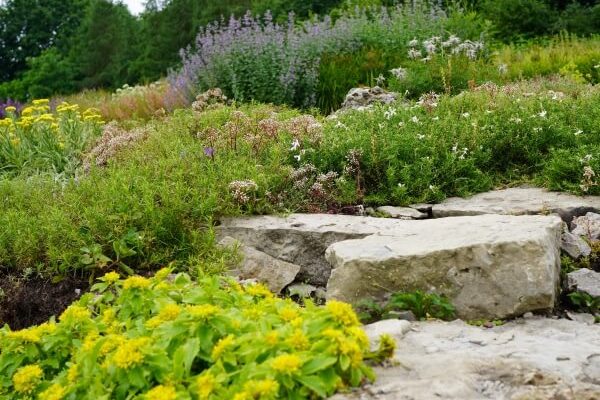
Modern rock garden: how much gravel is needed, which stones to use, how to stratify and how to manage water? It looks impressive, but you need to know some nuances to make it aesthetically pleasing. And it is even more important that it works well not for six months, but for a decade. There is an alpine slide in the botanical garden of Klaipėda University, so I invited you Laura Normantecurator of the Department of Decorative Herbaceous Plants of the Botanical Garden, at the program “This is my garden” to tell you all the tricks of the setup. We showed it on the show, and now I’ll list it all here, read below.
Stones for rock garden
The stones of the Alpinarium do not necessarily have to be brought from the mountains: beautiful stones can also be found in Lithuania.
Pakruoj dolomite is used in the botanical garden of Klaipėda University. It is honeycombed, rots naturally and releases limescale, which is particularly beneficial for alpine plants.
If the origin of all the stones is the same (in this case they are all dolomite, of the same color), you can combine both the polished round ones and the split ones.
If you use different stones (origin, color, patterns), still look for common elements to be harmonious. For example, similar shapes, similar shades.

You can also use other Lithuanian stones in your rock garden. For example, on a natural-style farm near a lake or forest, ordinary boulders will work perfectly.
The rule for composing stones
Many beginners have a question about how to compose stones, what to guide when placing them in space.
Laura Normantì explains that there is a certain composition rule:
- a larger stone with a more interesting texture and plants planted around it,
- a group of three (or five) stones of different sizes but similar consistency.
Attention: If the stones are larger, do not place them in the rock garden as monuments, but leave at least a third of them in the ground. Then they will look more natural and fit into the overall picture, and the plants next to them will also feel great.
The base of the rock garden
Laura says the slope is not necessary for a rock garden, but it is recommended. Once the slope is achieved, it is not necessary to remove much of the firmer subsoil because it is already formed naturally.
However, even on completely flat terrain, you can create terraces and reliefs and form your own collection of mountain plants within them, but you will have to work harder.
A good foundation for a rock garden is very important. Laura Normantì recommends creating the base of the rock garden with a layer of gravel, which should reach approximately 15-20 cm.
Gravel will provide the perfect drainage that any rock garden needs. Mountain plants do not tolerate waterlogging, especially in winter or when there is a lull in spring. Therefore it is necessary to ensure that water does not accumulate at the roots, but runs away from them – this is what we do by filling the layer with gravel.
Important: after pouring the gravel, it must be compacted well so that the rock garden does not collapse over time.
I invite you to sign up Newsletter “Yellow Wheelbarrow”. – I will share more specific tips that will be helpful in creating an environment.
How to make the soil substrate
You can easily prepare the soil mixture for the rock garden yourself. The substrate for the rock garden should consist of three parts:
- a portion of normal turf (may be poor),
- a part of very fine gravel (you can also mix a little sand or sand),
- a little compost soil.
Don’t make the mistake of adding too much compost. Upland plants should grow in poorer soils that match their natural growing conditions. So these plants will feel great in the summer heat and survive the winter well.
Rock garden layering: what goes after what
Stones, plants, soil – when setting up a modern rock garden, you really have to remember a lot. Here’s a quick reminder of layering, so you don’t forget what happens after what in the rock garden, we’re looking at it from the bottom layer:
- Drainage (coagulated gravel);
- Large, large stones (buried at least one-third in the ground);
- A mixture of lands;
- Plant;
- Small pebbles among the plants.
Water in the rock garden
Laura Normantì says that you need to water the rock garden only in the first season when new plants have been planted. For example, if you planted the plants in early spring, water them after planting and then don’t water them until mid-summer, because they need to live in their natural environment.
But Laura’s other advice is important: manage the water with stones. When laying stones, pay attention to whether there will be places in the rock garden where rainwater will flow with a strong current. You can control them by creating a physical barrier and placing additional stones where water flows. Then the water will not flow in a crazy stream and wash the plants, but will distribute more slowly in the rock garden and calmly drain into the lower layers.
A modern rock garden requires effort and time, but if you install it correctly, you will be able to enjoy the view for many years. Thanks to Laura Normante, curator of the Department of Decorative Herbaceous Plants of the Botanical Garden of Klaipėda University, who explained to me how to set up a rock garden. In short, a complete show”This is my garden” see the post in the LRT media library.
latest posts published
Tired of working in the garden? What can be done to reduce maintenance
How to successfully transplant a Christmas tree
Landscaping a new plot: where to start?
What grows in clay: This is what worked on Juste’s farm

Organic seeds: are they worth paying more for?

Preventive spraying of tomatoes with homemade remedies –
Environmental management: how to renovate a bored plot?
Designers answer what are the 3 best plants for the garden
Fruit trees online: how I ordered them and how I planted them