Is your lot not as flat as a table? Thoughtful slope management can solve terrain problems. More: a sloping plot is much more interesting, so you can find elegant and unique solutions. I therefore invite you to take a look at the examples of two plots, in one of which maintenance of the slopes has just started, and in the other the slopes were repaired a few years ago:
Green specialist They were Marozienė explained how slopes are managed, when it is worth abandoning a sloping slope and when it is better to build retaining walls, how to deal with trees, if the ground level changes when changing the terrain. Vaiva shows more nuances in the training courses we organize “Ecological Academy”intended for those starting a business in the fields of environmental creation and management. But now let’s break down what newbies looking for an idea to “hook” need to know.
Slope maintenance: abandon the slope or the terrace?
When there is a lot of space on the ground and the slope is not steep, you can leave the slope as it is. The main rule is that if the slope is steeper than 45 degrees, it is usually impossible to abandon it because it will be inconvenient to use the terrain: walking, pushing a wheelbarrow or bicycle, in winter it will be slippery.
But even a smaller slope can be arranged in such a way that walking is more comfortable and the space is used better. All you have to do is create terraces: larger floors. A steep slope often just takes up space and serves few functions. Meanwhile, the planes can be used however you like. If instead of one slope several terraces are formed, many possibilities open up: one terrace can accommodate a recreation area, another a children’s playground, another an outdoor kitchen. The terrace can be surrounded by more interesting flower beds, small adapted architecture – after all, all this decorates the plot.
When is a retaining wall necessary?
And what to do with the slopes between the terraces? If you have land space, Vaiva says you can leave the slopes and seed them with lawn or cover them with plants.
If there isn’t much space on the ground, any slope is a waste of space. The solution is a retaining wall. It clearly separates the lower terrace from the upper one, making the most of the lower space.
The biggest disadvantage of a retaining wall is its cost. Vaiva points out, however, that if you have sloping terrain, you need to fix the base from the beginning. This is the only way to create a beautiful, comfortable and functional texture. If financial resources are limited, it is not necessary to do everything at once – you will plant the plants later, but the soil will need to be repaired immediately.
Maintenance of the slopes of the tree-lined land
If trees grow on the land, it is important to preserve them even when changing the soil. In order not to have to wait decades for trees to grow again, it is worth looking for ways to save existing ones. Many trees do not like to change the height of the soil: both filling the trunk with soil and exposing the roots are equally dangerous. What to do?
Vaiva claims that the maintenance of slopes and the formation of the land takes place taking into account the trees growing on the land. Right of way: For the cultivation of trees, efforts are made not to bury or bury them. Therefore, the relief is formed mainly taking into account the trees, so that they remain at the height at which they grow. It’s like a starting point for creating new terraces.
If the new ground level was lower than the growing trees, it would become problematic to save them. And if above, there are several ways to save trees:
- Cementing of the tree: a concrete ring of sufficient diameter is created, which avoids crushing the tree and leaves it space to grow;
- A metal arch with mesh is placed which, like a concrete ring, protects and provides space.
On the other hand, before starting to plan the formation of the site, it is worth inviting a specialist to the construction site to assess the condition of the trees. It may be that not all trees are healthy and safe.
Management of concrete apron slopes
Vaiva’s personal plot is a great example of how a sloping plot can be arranged. The management of the slope of the land was carried out several years ago and now we can already see a beautiful result.
The land has an area of 9 acres, the altitude of the land was 10 meters. And the situation was similar to the managed terrain shown before: a continuous slope up to the top. The need for green space is very high: there are children, a dog, a lot of time is allowed in the courtyard and plants are also needed.
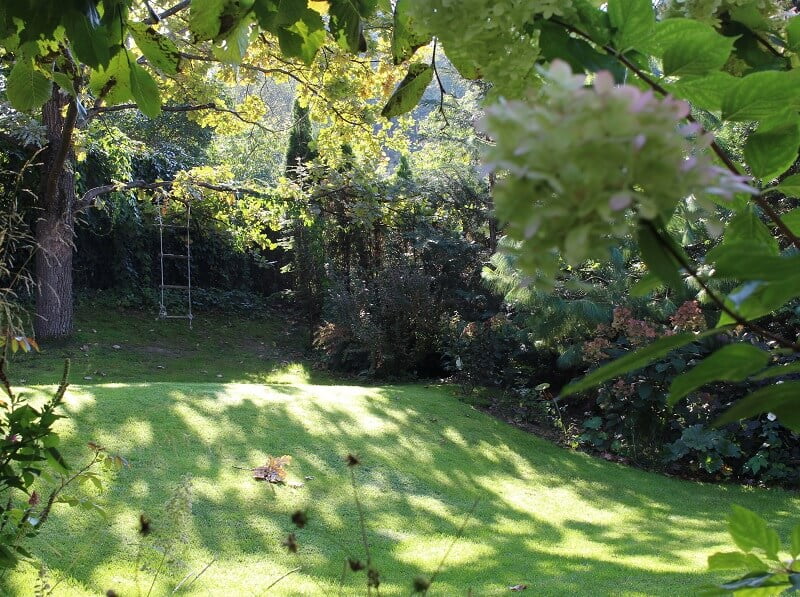
The slopes of the land were managed taking into account the trees growing on the land: they established how many terraces there would be and at what height.
Once the terraces have been formed, it is automatically no longer necessary to think about the areas of the land: where there was a plan, an area has appeared. For example, on Vaiva’s plot, a table and chairs appeared on one terrace, a children’s climbing frame on the other, and Vaiva planted a flowerbed on the slope, which is problematic for mowing.
The biggest increase in height is left at the end of the diagram – you can’t even see that place in the photos. The extremely steep slope was also reinforced with stones and beams with flowers planted in between. The highest slope has no irrigation system, so the plants planted there must be quite aggressive and have strong roots that support the slope itself. And aggressive plants become less aggressive in difficult conditions. On this steep slope grow strong and resistant plants: miscanti, bumblebees, asters and even rhubarb. By the way, plants in such a place must be planted densely so that weeds cannot penetrate.
Slope maintenance and terracing not only freed up functional spaces, but also controlled rainwater, which had previously caused many problems.
Some important nuances
When choosing plants growing on a slope, keep in mind that they will receive less moisture than usual, as some of the rainwater will run off before being absorbed. Therefore, choose plants that like drier growing conditions.
Be sure to pay attention to lighting when choosing plants to grow near a retaining wall. They will likely receive less sunlight, as the retaining wall will block it for part of the day. Don’t just think about summer when the sun is high: the spring sun is lower, so see how much light the corner near the wall actually gets. Choose sun-loving or shade-tolerant plants accordingly.
Sloping terrain has a fun advantage. If the house is lower and the slope goes up from the house, you can plant plants on the slope and feel like a flowering amphitheater. Although it is usually necessary to group plants by height, if planted on a slope they can be displayed very well without much effort. If you haven’t already, go back to the video at the top of this article to see how beautiful a sloped lot with patterned terraces can look.
latest posts published
Tired of working in the garden? What can be done to reduce maintenance
How to successfully transplant a Christmas tree
Landscaping a new plot: where to start?

What grows in clay: This is what worked on Juste’s farm

Organic seeds: are they worth paying more for?

Preventive spraying of tomatoes with homemade remedies –
Environmental management: how to renovate a bored plot?

Designers answer what are the 3 best plants for the garden
Fruit trees online: how I ordered them and how I planted them