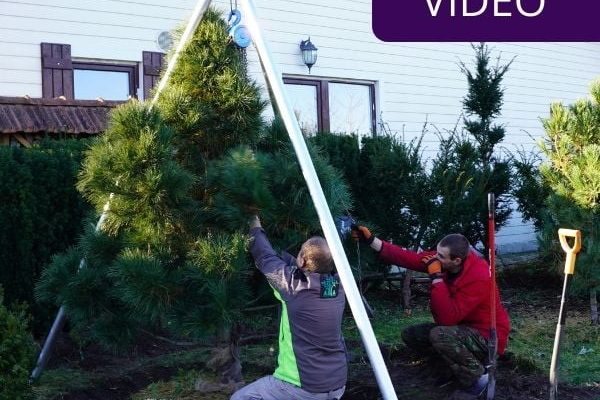
When I found out how to transplant a tree without special equipment, I thought that a person with a lot of desire and not backward hands can do this work alone. Companies transplant large trees with special equipment, which costs a lot. And how to get away without that special technique, he showed me Leonardas Mekionis from akademijosarboristai.lt See for yourself:
Is it possible to transplant large trees successfully?
For several decades only young trees were planted. Now more and more mature trees are being planted because no one wants to wait decades for them to grow. And it’s nothing new, just a somewhat forgotten method, Leonard says. An arborist recently purchased a horticulturist’s book published between the wars, in which he found techniques for transplanting large trees. So don’t think that transplanting large trees is a modern fantasy.
Large trees are especially important on farms. If you are planning changes in yours, we invite you to the course “Farm Landscape”. You will learn the basics of creating a farm, which will help you not to be a slave to the environment, but to live in harmony with it. Get tips and design ideas for easier maintenance.
Mature trees are usually transplanted with special equipment, but not everywhere a heavy truck can reach. How to carefully “uproot” a tree without special equipment, we will soon present in detail.
Situation overview
Here is our example. A cedar pine (Pinus cembra) stands green in Leonard’s yard. The 35-year-old plant produces high-quality and tasty pine nuts, the same ones we buy at a high price in the store. And here it simply grows on a tree.
Now it has been decided to transplant the pine. This isn’t the first time Leonard has done this: This cedar pine has already been transplanted five times during its 35 years of existence. If it hadn’t been pruned this pine would be taller than Leonardo’s house, but the pruning makes it look quite compact.
We will transplant it.
How to transplant a tree
Instructions on how to transplant a large tree yourself:
- Use a spade to dig a trench around the tree, about five to eight feet away, depending on how large the roots may be.
- Use the longer blade of the spade to dig as far under the roots as possible.
- Now help yourself with the tripod. Leonardo’s tripod is made from aluminum rods, but if you don’t have any, three longer logs will do just fine. Connect them at the top with rope and attach a “winch” (found at hardware stores). Place the tripod around the tree so that the top of the tree is centered as precisely as possible.
- Lower the rope so you can secure it behind the trunk.
- It is very important to protect the tree trunk from rubbing against ropes or chains. Wrap the trunk with material – this will not hurt the bark.
- Attach a rope or special belt to the bottom of the trunk and gradually lift the tree with the tripod “winch”.
- Take your time: not all roots will be attached yet. You lift it up a little, root it where it’s still firm, and dig under that spot with a shovel. When it melts, you lift a little again.
- This will carefully lift the root ball along with the soil. It doesn’t need to be hanging in the air – stop when you realize the entire root ball is hanging off the ground (if you hang it in the air, it can fall to the ground and further damage the roots).
- It is important to take care of the roots right away. Place jute and netting under the roots. The jute will hold the grounds so they don’t fall apart. Pack the roots. The tree is already ready for transport to a new location.
What trees can be transplanted in this way
I asked Leonardo if this transplant method is suitable for all trees. According to the arborist it is important to evaluate the situation. If the tree is not already in the top ten and has never been transplanted, it can be difficult to transplant such a tree by hand. There is a risk that the thick, widely divided roots of the tree may be damaged when the tree is dug up and the chances of recovery are significantly reduced. However, if the tree has already been transplanted or is simply younger, smaller, this transplant principle applies to several trees.
Tree care after transplanting
The tree should be planted in the new place with the roots wrapped, i.e. with jute and a net. Leonard says he often hears angry comments that city trees are planted without even unpacking them. However, this is exactly what should be done: then the soil will not break away from the roots and the probability of rooting will be greater, and the roots will certainly find their way through the holes in the net.
After transplanting the tree, do not rush to fertilize it for the first year, but rather use a growth activator that will help the plant take root.
latest posts published
Tired of working in the garden? What can be done to reduce maintenance
How to successfully transplant a Christmas tree
Landscaping a new plot: where to start?

What grows in clay: This is what worked on Juste’s farm

Organic seeds: are they worth paying more for?
Preventive spraying of tomatoes with homemade remedies –
Environmental management: how to renovate a bored plot?

Designers answer what are the 3 best plants for the garden
Fruit trees online: how I ordered them and how I planted them