After having successfully experimented with growing houseplants outside the house during the summer, the time is approaching to bring them back inside, before the rigors of winter. If you missed the topic you can retrieve it from HERE and save it to review it again at the end of winter.
Personally, this year I will try to leave them outside for as long as possible, also with the aim of testing firsthand their ability to tolerate low temperatures. I’ve already talked about Alocasia macrorrhiza of the abandoned restaurant near my house, which remained outside with minimum temperatures of 5-6°C until the end of November. Last year I simply sheltered the Ceropegia from the frost, keeping it outside under the porch and pushing it to night-time lows of 2-3°C: it didn’t grow but it didn’t die either and if you see it now it’s the liveliest and most lush plant in the world! However, without having to evaluate, plant by plant, their resistance to the cold it is good to set some general rules that they can help us in this key step.
Some advice I can give concerns 4 fundamental aspects: temperatures, light, water and parasites.
Temperature
The plants we use indoors are tropical plants, with an optimal temperature range indicated on average at around 18-25°C. I’m not always too convinced of this indication and neither is mine Alocasia ‘Portodora’ which with the 30-35°C of July (in partial shade) has practically exploded. However, it is known that they tolerate temperatures above 30°C. Always ideally, night-time minimums foresee excursions of around 10°C compared to daytime temperatures.
Basic steps
- Plan your return (even a little at a time) before temperatures drop below a minimum of 10°C (usually happens at night): keep checking the weather forecast!
- Having to make a choice: I take the younger plants to shelter firstthose with more tender leaves or those that I know are less tolerant (I shelter the Sansevieria Orchid first). For succulents, for example, in many cases it is not necessary to bring them back into the home environment: they can be kept in a cold greenhouse or on the porch, perhaps by creating a tent with a plastic sheet or using a mobile greenhouse; the important thing is to remember that they fear humidity much more than dry cold.
- THE graduality always increases the resistance, pay attention to sudden collapses in both directions (no more than 5-10°C difference)
The last days out
Wanting to extend the life of plants outside is not a bad idea. I remain firmly convinced that nothing makes them feel as good as direct light and flowing air. For those who want to take outdoor parking to the extreme, I can recommend some precautions:
- Administer Algatron induces greater resistance to cold (even when given via leaves).
- Position the plants so they receive as much light as possible, too direct. A small, sheltered and bright porch facing south would be perfect.
- A position must be chosen that protects the plants from the cold wind that may be present in the area of interest.
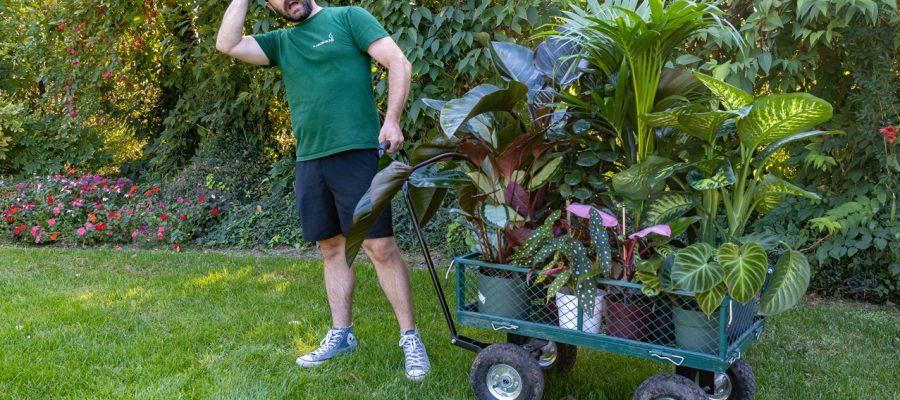
- A greenhouse with wheels is the solution I adopt, as I don’t have a south-facing porch: I keep it underneath during the night and expose it to the south during the day, perhaps opening the cover.
- On some plants (I’m always talking about the daredevils who want to push them to the extreme or who live in slightly milder areas) it is possible to mitigate the cold with TNT (breathable) or with transparent plastic sheet hoods (in this case I recommend opening during the hottest hours to avoid stagnation of air and humidity, often the cause of cryptogams).
We go back inside
Most likely, however, at a certain point, the cold will take over and we will be forced to bring the plants back inside the house. Incidentally, as I always say: Italy is varied in terms of climate and these indications must be read and compared according to where we are. On average I tend to talk about continental climates, a good middle ground between the Alpine climate of the northern mountain and Apennine regions and the Mediterranean climates of the central south, especially coastal, or in some cases lakeside in the north.
What conditions must plants find when they return to our homes? The guiding principle is still that of minimum possible differential.
- If you have left them outside with temperatures of 8°C at night, don’t throw them out of the blue at 28°C, move them little by little from cooler to warmer areas of the house. As a rule, the rooms always have temperatures between approximately 16-25°C which are optimal.
- We avoid positions of the house affected by cold currents or heat sources too close.
- It is better for the leaves to be a few centimeters away from the glass, which is a poorly insulating material that cools down a lot during the night. There are areas of the country where the windows freeze and in these cases it is a good idea to create an air cushion with a heavy curtain.
Exposure
It is not the temperature that is the most difficult factor to manage, but rather the light. Except for the use of grow lights, this parameter is beyond our control. In their areas of origin these plants enjoy a good amount of natural light throughout the year, both in terms of hours and intensity.
Both of these factors tend to change in our latitudes from the end of August – beginning of September. Exposure is the most critical issue in the cultivation of indoor plants during the winter: put your heart at rest, it will torment us and cause a thousand annoyances, especially yellowing and leaf necrosis, stunted growth and loss of leaves, general states of the plants far from summer vigour. Let’s grit our teeth and try to ferry them as best we can towards the future spring: they won’t always be beautiful for racing but they won’t die either if we follow a few simple precautions. Here are some tips to help plants cope with changing light levels.
GENERAL RULE: let’s abandon the concept of ‘shielded light’: all plants prescribed as such must be positioned as far as possible in full and direct light until March-May (depending on the latitudes and climate trends). That’s why I try to keep them outside as much as possible.
- As for the temperature: let’s make sure that they don’t go drastically from good external exposure to the darkness of the most hidden corner of the house.
- The amount of light that reaches the windows of our homes drops by a good 50% in winter: the sun is lower and shines for fewer hours/day. The ideal is to move all the plants (or at least the most demanding ones in terms of light) to windows facing south and west.
- In general: we bring the plants as close as possible to the windows, preferring the most exposed ones.
- Clean windows allow greater light filtration.
- Clean leaves are able to intercept more light with greater efficiency of the photosynthesis processes and consequently a better state of health of the plant: keeping the leaves clean with a damp cloth helps; some small plants can also be showered.
- I don’t use them much but grow lights can help particularly desperate situations.
Parasites
I know many of us are held back by the ‘pest’ issue when taking plants outside. In my experience I have not found any major differences, perhaps outside it is easier for a plant to encounter a louse but this risk is largely compensated by the healthier conditions of the external environment. However, it is best to avoid bringing parasites into the house from outside when we shelter the plants before winter. Here’s how I recommend acting (you can also adopt more practical variations of mine, I’m interested in conveying the meaning of the procedure).
- A couple of weeks before the expected drop in temperatures below the warning thresholds we inspect the plants looking for parasites: we remove everything that seems suspicious to us, we clean the dry or rotting vegetation and in case of obvious attacks we intervene with the appropriate products (insecticides, acaricides, fungicides).
- If there is nothing particularly suspicious, we give it a pass with soft soap (10 ml/litre, passed three times 10 days apart, so we will do part of the treatment with the plants already in the house). It is a natural barrier that helps us prevent last-minute attacks.
- After 5 days I also start with the preventive antifungal treatment with cifoblock natural barrier, so I start 5 days later than the soft soap and do 3 sprinklings 10 days apart.
- After 10 days we inspect the plants again and check that everything is ok.
This is a nice time to spend with the plants, if you took some photos of them before taking them out you will have the opportunity to observe the amazing growth that has taken place.
Water and humidity
While they are outside I love to wet them with a rubber and a hand shower, generously watering them, aware of using excellent substrates that always drain perfectly (I have never heard of people having stagnation problems using professional substrates). The soil always dries quickly outside but this is not the case at the turn of the hot season: it will dry more and more slowly, both due to less activity (and use of water) of the plant and due to less transpiration of the leaves and evaporation from the soil. So, in general, we will have to change our habits and water less frequently.
- The most common problem houseplants suffer from in winter is overwatering. The soil should dry almost completely before wateringthis applies to almost all plants (with the exception of Bananas, Pachiras, Ferns and Citrus fruits, among others). If we don’t use excellent quality soil we will have difficulty getting it to dry.
- When we do the ‘finger test’ we take care to go deep: we may even have a dry surface but the roots develop above all lower down and it is there that we need to check for the presence of humidity.
- Raising the pots before and after watering is an excellent way to learn to evaluate when they are dry, through their weight.
- Dry air is the enemy of many tropical plants native to humid areas: in addition to some welcome vaporization, remember that dry environments dry out the pots first.
- Never leave water in the saucer after watering.
Fertilizer
Here I have my idea, different from what I often read on the web: I don’t stop fertilizing tropical evergreen plants in winter. The reason is that I always see them growing (slowed) and I notice the production of new leaves and tissue. My advice is to thin out (perhaps halving the doses rather than the administrations) but not to suspend.
In the saddest moments of winter, alongside the fertilizer there is also a biostimulant such as Bio Oro.
Last precautions
Last minute repotting: the right time to repot most houseplants is during periods of vegetative growth, in spring and summer. If in October you realize that a plant needs repotting, just postpone it until spring.
Tropical plants that lose all their leaves: some plants can be induced into a state of quiescence by changes in light/temperature. I think of Ficus and their habit of defoliating a lot during the winter, often suddenly. Some Alocasia can go dormant for short periods, losing their leaves and revegetating when the rhizome feels suitable conditions again. In the case of total loss of vegetation it is best to stop watering until the new shoots reappear.
Friends of #clangeorgics I hope I have given you some useful information. Now comes a difficult period for our plants but we don’t have to worry: they will manage and soon the new hot season will bring them to their usual splendor!
latest posts published
Tired of working in the garden? What can be done to reduce maintenance
How to successfully transplant a Christmas tree
Landscaping a new plot: where to start?
What grows in clay: This is what worked on Juste’s farm

Organic seeds: are they worth paying more for?
Preventive spraying of tomatoes with homemade remedies –
Environmental management: how to renovate a bored plot?
Designers answer what are the 3 best plants for the garden
Fruit trees online: how I ordered them and how I planted them