They don’t starve, they don’t bite and they don’t emit an unpleasant odor, but if you let them into your flower garden, you may regret it later. You wouldn’t even think that these amazingly beautiful plants can aggressively expand into the flower garden and even “escape” beyond its border.
SANDSTONE RYE FACE
Expressive beauty with blue leaves – rye sand (lat. Leymus arenarius). Some are attracted by the color of its leaves – in fact such a bluish hue is rarely seen anywhere – while others prefer its straw-colored ears, which appear in the second half of the year. In a modern neighborhood, it might satisfy the idea of a modern environment, and in a loft area, next to concrete and steel, such a bluish color would look very extravagant. Steep and even rough leaves are reminiscent of friends from the cactus family, so for lovers of the exotic – the same. Oh, and the neighbor from the next street, when they gave her a bunch to plant, says that these beautiful leaves don’t need care, they expand on their own and don’t need to do anything else.
Here lies their problem – rye sand it expands so aggressively that it can not only conquer the territory of your flower garden, but also appear in your neighbor’s garden. This plant spreads by root shoots, and is said to reach several meters away. Once it starts, it is very difficult to stop it, because it is difficult to find and locate all the roots. Therefore, when growing sandy ryegrass, the work increases precisely due to its control.
It is not recommended to plant it anywhere there are no restrictions (concrete curb, wall, foundation, etc.), but it is especially dangerous – on open farms, where it will be extremely difficult to catch a rye face behind the cash register. The spread of such an aggressive plant in nature is dangerous for naturally formed local vegetation, because it takes their place, uses food resources, and larger vegetation can compete with less resistant plants.
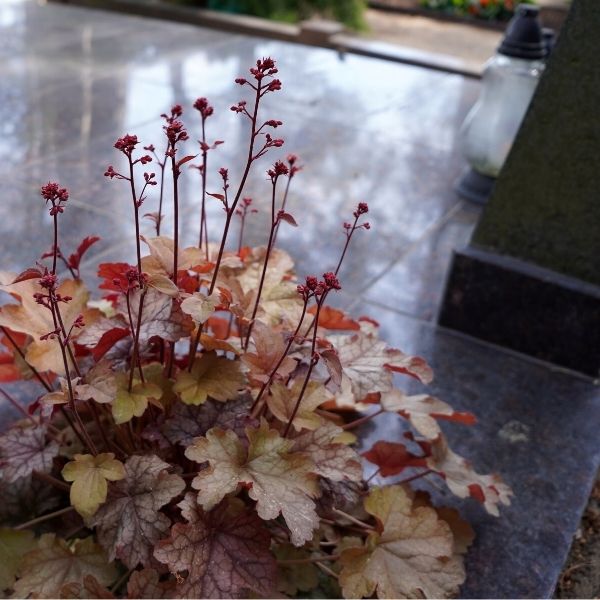
The exception is particularly small areas of the city, such as a fenced flowerbed surrounded by hard surfaces, away from open ground. The photo shows an example in Kaunas.
If you really want bluish foliage, look for alternatives, e.g. the more graceful blue legs appear (lot. Helictotrichon sempervirens).
CANE STRIP
Of course, not all ornamental grasses are aggressive growers, but these two have made some people suspicious of all similar grasses. Why cane strip (lat. Phalaris arundinacea) – deceptively cute and beautiful. Its structure is similar to that of reeds, and the white streaks make it particularly decorative. The sound of the stripes rustling in the wind is reminiscent of holidays, the sea and the dunes. Also, such striped leaves look good in bouquets and various compositions.
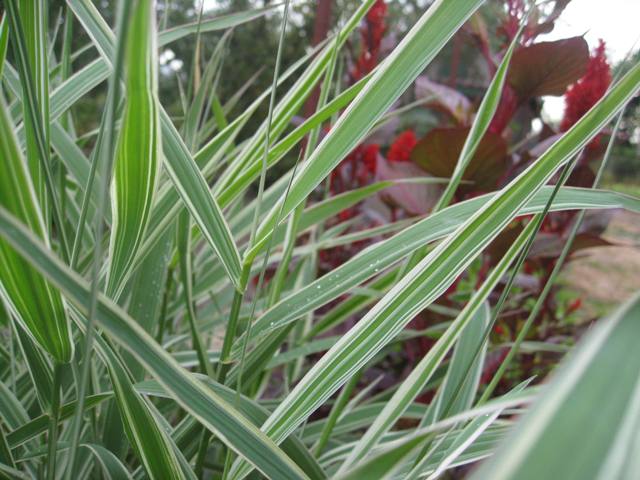
In spring cane strip he wakes up early and enjoys his budding stems. However, in the second half of the year it is already noticeable that it has grown three times more than a year ago. This plant actively spreads through root shoots, growing in a dense thicket, spreading to the sides and overshadowing other nearby plants. Even after digging and carefully selecting the roots, you will likely find a seedling that has survived and sprouted after a year, maybe even several.
Choose in your mixed flower garden other ornamental grassesthe selection is now really large and there will be fewer problems with them. In the course “Modern flower garden” you will learn to choose the right plants from a large number. Some with white stripes: Miscanthus ‘Morning Light’, ‘Variegatus’, spiky-flowered marigolds ‘Overdam’, ‘Avalanche’.
And in public spaces, where only a small patch is left for the plant, surrounded by sidewalks, slabs, cobblestones, etc., the strip of reeds could rustle over itself and please the eye from spring to late autumn, instead of annual flowers that are replaced every year.
SOIL MINT
Useful and beautiful: in the common courtyard edible plants now coexist with decorative ones. And the spice garden in general is a matter of honor for every hostess. However, with mint (lat. Mentha arvensis L.) particular attention must be paid.
You can’t say you don’t grow mint: you will use it for sweets, and as a medicine, and to refresh yourself in summer, and to shake a cocktail, and to dry it for the winter. You probably know more uses for mint. The smell itself is exceptional: just stop when you pass and the fresh aroma spreads.
However mint must be limited – if it likes the growing conditions, it will create such a tangle of roots that it will overshadow the other plants, and it will be difficult to ask it to come out. The most common solution is to plant mint by burying a bucket with an empty bottom or using another similar container. Raised beds, which are now popular, also work: Mint’s roots aren’t very deep, so it’s likely to reign in the bed you choose, but won’t spread to others. So grow mint, but conserve it.
Another option is to look for breeding ticks, see that they are not breeding as actively. And the aromas can be more diverse: with an aftertaste of lemons, apples, etc.
OTHER PLANTS THAT CAN “ESCAPE”
Aggressively spreading plants can always be curbed and contained, but this is work you have to appreciate. Think not only about how much time you can devote today, but also about the natural properties of the plant, how long-lived it is. The worst happens when plants are left unattended after a change in living conditions, and then “escape” from the garden or flower garden into the natural environment.
One of these plants is five-sheet cartouche (lat. Parthenocissus quinquefolia). If properly maintained, this wonderful climbing plant can hide an unsightly wall, create a welcoming shaded area and cover a steep slope. And in autumn the vine turns bright red. If you don’t need to cover large areas, choose another climbing plant that grows less quickly.
Fernsbrought from the forest to your yard, in an uncontrolled way it can spread more than necessary. Used to fighting for survival in the forest, the fern will pop up here and there in your garden too. It is not invincible, but keep this feature in mind if you choose plants for a shady spot. Also, pay attention to the various varieties bred, they do not have such an active start of reproduction.
Winter (lat. Vinca minor) is another large creeping plant with dark green leaves and blue flowers. Indispensable in the shade, in places similar to woods, under trees, but in an uncontrolled way they can spread and take the place of others that grow naturally.
The most important thing is to choose plants not only based on their beauty, but also based on their characteristics.
latest posts published

Tired of working in the garden? What can be done to reduce maintenance
How to successfully transplant a Christmas tree

Landscaping a new plot: where to start?

What grows in clay: This is what worked on Juste’s farm

Organic seeds: are they worth paying more for?

Preventive spraying of tomatoes with homemade remedies –
Environmental management: how to renovate a bored plot?
Designers answer what are the 3 best plants for the garden
Fruit trees online: how I ordered them and how I planted them