Apple tree rootstocks, grafts – confusing names that can be explained very simply. When deciding to buy an apple tree it is important to choose not only the variety of apple tree, but also the rootstock. We asked a specialist what apple tree rootstocks are and how to choose one suitable for your plot. In this article, longtime apple growers, nursery owners Danutė Sodaitytė suggestions.
This text is based on the program “Čia mano sodas” broadcast on LRT television. You can also view it online, LRT mediatekoje.
Apple tree rootstocks and grafts
The specialist says that an apple tree begins with a rootstock. In other words, these are the roots of the tree – a scion onto which the desired apple variety is grafted. It will primarily determine the height of the apple tree and how successfully the apple tree will live on your plot.
Graft: The upper part of the tree, which is grafted into the rootstock. It is the thorn that determines which variety of apple. Therefore, in the nursery, it is necessary to find out not only the variety of the apple tree and whether its apples are tasty, but also on which rootstock this apple tree is grafted.
There are two main types of rootstocks: dwarf and tall seedlings, as well as many medium-sized intermediate rootstocks. The most common in Lithuania are the following rootstocks:
- Rootstock M26 – semi-dwarf apple tree, 2.5-3 m high, begins to bear fruit in the second-third year. Cold resistant.
- B396 (dwarf) and B118 (medium height) are resistant to frost and root collar rot and will also be suitable for heavy, clay soils. Extremely productive rootstock.
- The MM106 rootstock is a medium-sized apple tree, 3.5-4 m tall. It can be grown without permanent supports. Suitable for light, sandy, not wet soils. Productive, but slightly less resistant to cold.
- Seed (tall) rootstocks grow more than 5 m, have an abundant and strong root system, can grow in problem soils, will last 50-70 years, but the first harvest will also have to wait several years.
Taking into account the criteria listed above, it remains to choose what will fit into your plot. For example, if the yard is only 6 acres and the soil is heavy and clay, it is worth purchasing an apple tree with B396 rootstock, which is suitable for clay soil, and the apple tree will become small and suitable for a small yard.
Depending on their ripeness, apple trees are divided into summer, autumn and winter.
We are choosing a seedling
When inspecting an apple tree in the nursery, pay attention to:
- It is in the correct shape;
- The branches branch out in all directions equally;
- There must be a pronounced peak;
- Apple trunk: smooth, straight;
- Trunk bark without scratches or cracks.

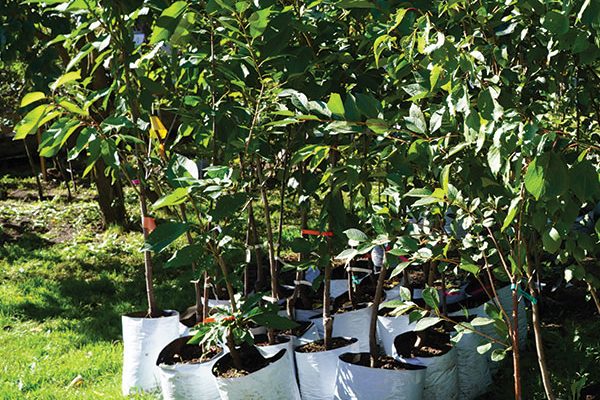
When we buy a bare root tree, we should see beautiful and abundant roots. It is true that such open roots should be extremely protected and not stored in an open, dry place. Even half an hour in the wrong conditions can be disastrous for the smallest roots. This will also damage the growth of the entire tree.
Variety of varieties
One of the most important questions is whether apples will be tasty. And there’s no arguing about taste! When choosing an apple tree in the nursery, you will certainly be told about the taste characteristics of the varieties. And here Danutė Sodaitytė especially recommends a noteworthy variety: ‘Auksis’.
‘Auksis’ is gold medalist in an international exhibition, that’s why it is called that. Lithuanian breed, which is even a kind of national pride. This variety fascinates both for its taste qualities and for its excellent shelf life. With proper storage, you will eat these apples until spring. You will start harvesting on September 1st. “A garden without ‘Auksi’ is not a garden,” jokes Danutė.
We brought the apple home. How to plant?
One of the most important things when planting an apple tree seedling in the ground is not to bury the grafting site. The graft should remain 5-10 cm above the ground. If you brought home a potted apple tree, plant it at the same depth it grew in the pot.
Interestingly, the height of the apple tree is determined not only by the type of rootstock or the characteristics of the apple variety itself. For example, how much Auksis will grow grafted onto a dwarf B396 rootstock will depend on the fertility of the soil and the planting depth of the apple tree. If the apple tree was grafted into the rootstock very high (15 cm above the ground) and we did not bury it deeper during planting, in this case the seedling will grow weakly or not at all, it will remain in place.
On the contrary, by deepening the seedling, we create the conditions for more abundant roots and stronger growth, but if the grafting site is completely buried, any dwarfism could disappear. That is, if the dwarf plant is buried deeply above the grafting site, it can send out additional roots and begin to grow as a tall plant.
latest posts published
Tired of working in the garden? What can be done to reduce maintenance
How to successfully transplant a Christmas tree
Landscaping a new plot: where to start?
What grows in clay: This is what worked on Juste’s farm
Organic seeds: are they worth paying more for?
Preventive spraying of tomatoes with homemade remedies –
Environmental management: how to renovate a bored plot?
Designers answer what are the 3 best plants for the garden
Fruit trees online: how I ordered them and how I planted them