It is difficult to imagine that the rose garden with winding paths, round boxwoods and an arch wrapped with vines – here was just a potato field. Although maybe I’m lying, it’s very easy to imagine, because just look around and you’ll see these potato fields nearby. AND Giedres Adomaitytė the farm was like that.
But this is what passion for plants, knowledge and diligence means: take a look at the impressive rose garden created by his hands:
This is a romantic style garden carefully thought out and created with love, a rose garden, where roses of various varieties are complemented with perennials, aromatic herbs and decorations in a classic style. I asked Giedrė how he created this garden.
A rose garden instead of a potato field: the beginning of the beginning
This is the personal opinion of the green designer Giedrė Adomaitytė, our course “Plant composition laboratory” teachers, plot. For the rose garden Giedrė chose the part of the land that can be seen from the kitchen window. It was this place that became the starting point from which he began to paint a living picture.
Rosario was established on an area of about 4 acres. A clear hand designed the project, where it predicted the plant areas and the lines of the lawn paths. Although the area is quite small, it is possible to walk along winding paths, and as you walk you may discover hidden curiosities that are not seen at first glance:
- it is a bench hidden in the cool shade of an elm tree,
- an arch wrapped in roses,
- magnolias in bloom in spring,
- a round flower garden of pastel roses with a romantic birdbath.
After identifying the main points of attraction, Giedrė transferred all the lines drawn in the project to those 4 acres, delimiting the green and lawn areas.
The rosary is created without haste
Today, when we visit Giedrė, the garden is already 7 years old. It wasn’t created all at once, but gradually: by taking your time, having fun, observing, changing and learning:
- In the first autumn, various roses and structural trees were planted in the vegetal areas, namely mountain elm (Ulmus glabra), Japanese magnolia (Magnolia kobus) and birch;
- In spring the paths were sown with grass and thus the structure of the garden was completed;
- Subsequently Giedrė filled all areas of the factory with plants: this process of adaptation and filling is continuous and continues today.
Scented resting place under the elm tree
Let’s go to the garden to explore. After crossing the little bridge, on the left we see the mountain elm ‘Camperdownii’, which has been growing here for 7 years. The elm casts a dark shadow, very useful on hot summer days.
Behind the elm there is a special place: a bench was built there, on which a wonderful view of the rose garden opens. Persistent roses on a green background and you can’t even see the lawn from there! Giedrė has chosen deliciously scented old and English roses for this special place. True, they do not grow alone, but together with medicinal plants: lavender, medicinal sage, catnip, oregano. They also emit an aroma, so sitting on a bench next to an elm tree is a pleasure.
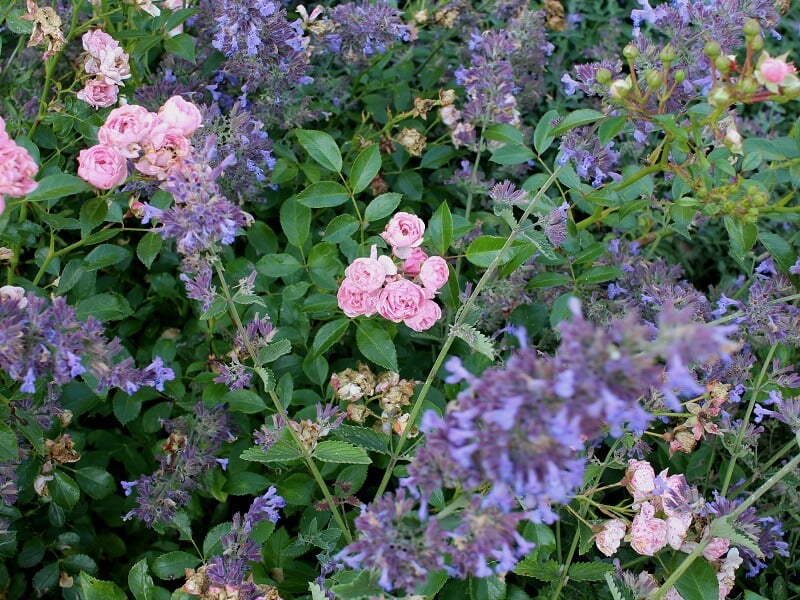
In this part of the garden, not only the plants, but also the garden decorations attract attention. Metal birds are stuck in the flowerbed for a reason: they protect the catnip from cats. They liked to roll on the delicate catnip, so Giedrė decided to skewer the decoration and thus protect the plant until it got stronger.
Roses are combined with perennials
Some rose lovers grow them alone and leave plenty of space around them, while others combine them with herbaceous perennials. Giedrė follows this approach: roses grow in the garden along with echinacea, catnip, calimmer, decorative garlic and others. At any other time of year you wouldn’t even know it was a rose!
Giedrė says it’s best to combine roses with perennials for several reasons:
- Roses are decorative for a limited period, especially some varieties. Therefore, by planting plants that bloom earlier and those that retain their decorative appearance after the roses bloom, you can enjoy the beautiful view longer. This is especially relevant for historical roses: you can learn about their peculiarities read herewhere I interviewed an employee of the VDU botanical garden. Bulbous plants are also planted in the Giedres rose garden, so flowering begins here at the beginning of spring;
- The lower part of the rose bush is often leafless and looks undecorative, especially when the rose flowering is about to end. It is therefore very useful for background plants to grow in the rose garden, which mask the lower part of the roses when necessary;
- Scientific literature and Giedrė’s personal experience say that when the spaces between roses are filled with perennial plants, they are less attacked by parasites and less bothered by diseases. Of course, some of them occur, but so far the critical threshold requiring the use of insecticides or other special chemical preparations has not been reached. And this is definitely an advantage!
The highlight of the garden is a light rose
We travel further along the route. In the center of the garden there is a classic round rose garden, the style of which is enriched by a statue in the centre, a bird feeder and rose flowers in light pastel colours.
A birdbath is more than just a slogan. Can you believe it: the water is changed every day because wild birds don’t like acidic water! I can’t help but be surprised by Giedrė’s love for nature: how much understanding, knowledge and passion is needed to be able to create such an oasis not only for oneself, but also for visiting birds…
The most fascinating thing is that in the garden there is a perfect harmony between function and aesthetics. Here there is a rose garden with a birdbath, surrounded by box trees (Buxus in Latin). They act as a border of the rose garden and the openwork mountain sedge (Carex montana) growing in the empty spaces gives it modernity and dynamism.
The birdbath is surrounded by two types of roses: the white rose ‘Iceberg’ (Kordes, Germany) and the pastel-coloured roses, called ‘Pastella’ (Tantau, Germany). The spaces between the roses are filled with blue-flowered catnip (Nepeta).
Judging by the color palette, this flower garden is the whitest of all garden corners.
Trees in a romantic garden
For easier maintenance and cleaner lines, garden trees and shrubs grow alongside flowers, leaving the lawn driveway empty. This principle is still rarely applied in our plots, more often we see trees planted on the lawn, which need to be trampled every time you mow. When the lawn is empty, mowing is much faster.
Along with perennial flowers, birch trees also grow in the garden, and another juniper and a dogwood bush are mixed among the flowers. Giedrė did it quite decisively, because:
- Separating the lawn from the plants makes lawn maintenance much easier;
- A clean lawn has an aesthetically pleasing appearance;
- The lawn works like a path.
However, there are some exceptions here too: these are the Japanese magnolias which bloom impressively in spring. They appeared in the lawn as a spring accent plant.
4 Acre Rose Garden: Romance or Misery
Continuing the journey we will see an arch surrounded by red roses and witches, a true attribute of the English garden style. You can take a closer look at it in the video report.
This arch is the gateway from the rose garden to the spice garden and berry orchard. In the spice garden oregano, mint, lemon balm grow and in the berry area there are cranberries, currants, quinces and cherries.
On this cool summer evening, the garden seems like something out of a fairy tale: it is a tribute to beauty, smells, taste and even wild birds. I asked Giedrė if he felt he had achieved his dream. He agreed that the garden is like therapy, relaxation and a field of creativity.
latest posts published
Tired of working in the garden? What can be done to reduce maintenance
How to successfully transplant a Christmas tree
Landscaping a new plot: where to start?
What grows in clay: This is what worked on Juste’s farm

Organic seeds: are they worth paying more for?

Preventive spraying of tomatoes with homemade remedies –
Environmental management: how to renovate a bored plot?
Designers answer what are the 3 best plants for the garden
Fruit trees online: how I ordered them and how I planted them