I learned to tie tomatoes from my mother and have been tying them this way for years. I also want to show you this method for tying tomatoes, because it is very convenient. You will only need a couple of tools: jute rope and stakes.
You can learn more about the nuances of growing fruits and vegetables in our distance learning courses “Modern vegetable garden“. In them we do not teach how to grow a specific plant, but convey the entire system of how plants grow, how to ensure the right conditions for them and how to identify various problems in time.
Let’s start with sowing
First of all we plant tomato seedlings. How I plant tomatoes in the greenhouse, what substrate and fertilizers I use, read here – I have described everything below.
How to tie tomatoes: the necessary tools
You will only need two tools for this method of tying tomatoes: stakes and jute rope.
I recommend choosing jute instead of synthetic, because once the tomato season is over you can throw these ropes together with the tomato waste directly into the compost and they will decompose as best as possible. No extra waste, everything is very convenient and eco-friendly.
I used Aseja jute ropes (advertisement). They are available in rolls or packaged in jars.
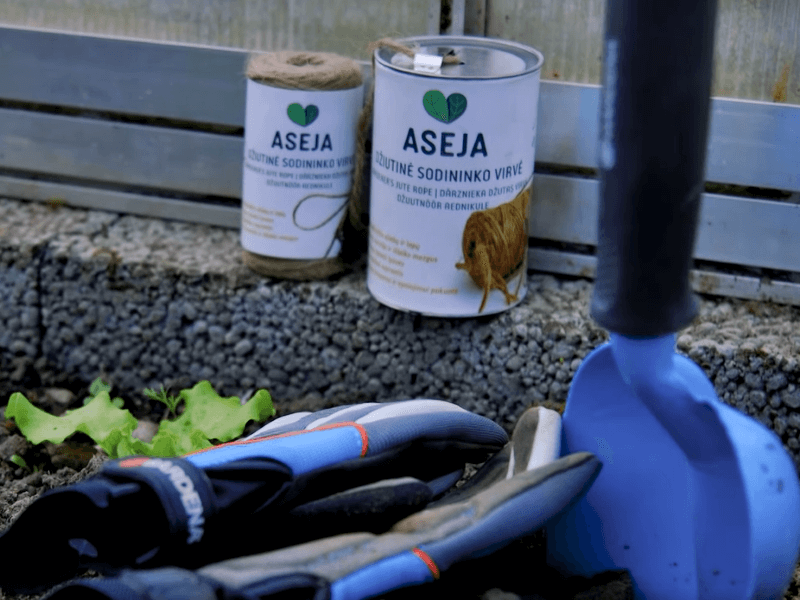
You will still need pegs to tie the ropes to. I use homemade metal stakes. It’s best to have the end of the stake slightly bent (I’ve seen these for purchase in stores).
But the simplest straight wooden stick or a stronger bamboo stick will definitely work.
How to tie tomatoes step by step
The first thing we do after getting the rope is measure the distance from the ground to the point along the roof where we will tie the rope. Double this length.
It is very important not to shorten the rope too much. After stretching the string from bottom to top, it should be completely sufficient and still have some left, about a spring. It’s better to have a rope that’s too long than one that’s too short, and you can always shorten it.
Cut the measured part of the rope and fold it in half.
Then make a loop like this from the rope, put it on the stake and secure it.
Stick the stake with the rope into the ground near the plant, slightly away from the roots, so as not to damage them. You can tilt the stake itself so that it is closer to the tomato, so it will be more convenient to tie it.
Wrap the twine lightly around the tomato to give it support – no extra staples, ties or ribbons needed. A tomato wrapped with a light movement around the string will hold better.
Tie the ends of the rope to the ceiling of the greenhouse (if there is nothing, you will have to further stretch the strong ropes along the ceiling). It is very important to tie the rope at the top not with a knot, but with a simple ribbon, so that it is not difficult to untie.
Remember how I said at the beginning to hold the rope longer than necessary? If the tomato produces many large fruits, it may no longer support its weight. There is no need to torture it: you can untie the string and, after loosening it a little, tie it again with a ribbon. If you run out of length, you won’t be able to do it properly. Even if you tie a knot, it won’t work. Then tie it with a ribbon and stock up.
How to tie tomatoes if you grow them with two stems
The double string method works especially well when growing tomatoes with two stems.
When you notice the tomato plant starting to branch, untie the double rope and separate it. You will dedicate one rope to wrap around one tree and the other to wrap around the other tree. Very convenient.
latest posts published

Tired of working in the garden? What can be done to reduce maintenance
How to successfully transplant a Christmas tree

Landscaping a new plot: where to start?

What grows in clay: This is what worked on Juste’s farm

Organic seeds: are they worth paying more for?

Preventive spraying of tomatoes with homemade remedies –
Environmental management: how to renovate a bored plot?

Designers answer what are the 3 best plants for the garden
Fruit trees online: how I ordered them and how I planted them