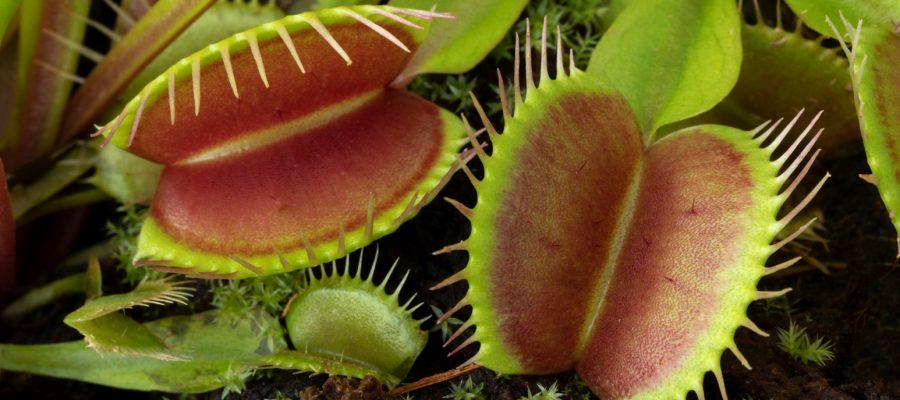
Dionaea is a plant that arouses a lot of curiosity, with those “toothed” mouths halfway between cute and horror movie. There are many myths about it to dispel, because it is true, it is a carnivorous plant, but this does not mean that it must be fed to the sound of flies or that it follows different rules from those of other plants. But let’s not get lost in chatter, also because this time before seeing my advice for taking care of it we must necessarily understand the plant itself better 😉
Carnivorous plants
Certainly the main characteristic of the Dionea is being ‘carnivorous’. They are relatively rare examples in nature but still have around 600 species included in 12 genera: some native to temperate climates such as Dionea, Sarracenia and Drosera and others instead spontaneous in tropical areas such as Nepenthes.
If evolution has endowed these plants with such an elaborate system it must necessarily be due to a felt need: this need is induced by the strong nutritional deficiencies typical of the soils in which they grow spontaneously.

Typically these are peat bogs, swamps, rocks, soils with acidic pH and a low concentration of calcium, phosphorus, potassium but above all nitrogen.
Carnivorous plants have it like this modified its leaves to turn them into trapsof various types, and are equipped to digest the bodies of insects and other small arthropods in order to integrate these minerals.
The traps of Dionaea muscipula
One of the best known is the snap trap of the Dionaea muscipula, Venus flytrap.
It works thanks to the mechanism we already know about thigmonastyto be clear, what causes the leaves of mimosa pudica to close.
As in all systems of this type there is a sensor and an actuator (you see that an engineering degree comes in handy 😉 ). THE sensors it is these hairs that we see inside the trap: they work intelligently, in the sense that at the first touch they go on alert but a new stimulus must follow within 30-40 seconds or the trap resets its calculation system. This avoids empty closures (rain, falling leaves).
The trap closes and if the prey is unable to escape, it begins digestion by releasing digestive enzymes.
We know Dionea
Dionea grows spontaneously in the humid peat areas of the Carolinas in the USA, an area with temperatures that do not fall below 1°C even in winter. It’s one rhizomatous perennial carnivorous with leaves composed of two leaf surfaces joined symmetrically with small soft teeth at the edge to capture and prevent the escape of the insect. During the winter it goes into vegetative rest losing all the leaves but keeping the underground root system alive which will produce new leaves in spring. In spring it produces a small, white flower which is usually cut to avoid stealing too much energy for the plant.
Despite its funny appearance we are not dealing with a toy, we must not play with it also because a trap, once triggered too many times in vain, will then necrotize.
Caring for Dionaea
What an exposure to give the Venus flytrap
It is recommended to give it direct sun as long as possible to color the leaves red and therefore attract more insects. During the hottest hours of the summer months, however, it is good practice to protect it under a shade cloth so as not to cause stress. Likewise, after repotting or if in precarious conditions it is better not to expose it to strong sun.
What temperatures to give to Dionea
Dionea is a plant that can live both indoors and outdoors, having good resistance to various temperatures. It can withstand temperatures even below zero without danger of death and in fact it can remain outdoors even in winter. It does not tolerate prolonged frosts, in this case it is better to move them to a cold greenhouse.
The ideal range is from 20 to 38°C during the vegetative period and come on 2 at 10°C during vegetative rest.
How to water Dionaea
Give water only distilled or rain water. During the growing season, place 2-3 cm of water in a saucer for 15 minutes and then remove it to avoid the formation of spores and mold. It should never be watered from abovethe water must be administered from below by capillarity.
During the rest season, watering can be reduced, leaving a maximum of 1 cm of water in the saucer and making sure to let the soil dry between one watering and another.
She loves to have good quantities of water but is quite fussy about the type:
- rainwater: the first collection should be avoided so as not to have high concentrations of dust and not collect it in copper containers;
- water for irons: not the scented one;
- bottled mineral waters: only those with low fixed residue, which must be less than 50 mg/l and never greater than 100:
- waste water from air conditioners: not collected in metal containers.
What substrate to use with Dionaea muscipula
it must be poor in nutrients; the ideal is a mixed soil composed of 2/3 acidic, nitrogen-poor peat and 1/3 sand or perlite to make the soil draining. In reality, however, there are different mixes that every enthusiast experiments with to try to give his plants the most suitable substrate (such as 3/5 peat and 2/5 perlite). It is advisable to avoid using sand or quartz gravel as they would weigh down the soil without however bringing benefits.
We recommend Florenacid.
How to fertilize the Venus flytrap
Dionaea does not like any type of fertilization as it can be fatal. Rather, it is recommended to administer a biostimulant, in particular:
- Sinergon: 1 ml/litre every 2 months during the vegetative phase;
- Algatron: after the summer in anticipation of the winter, half a dose.
Dionea diseases and parasites
Dionea can be subject to attacks by aphids and red spider mites but incredibly it is one of the few plants to be immune to cochineal!
What happens when the plant is dormant?
Don’t worry, It is normal for Dionaea to undergo an annual rest period 3 to 5 months long during the cold months. During this period the temperatures to which the plant is exposed should not exceed 10°C and fall below 2°C (despite, as we said before, they are able to survive light frosts).
During dormancy it is important to reduce watering to avoid incurring mold and rot.
Frequently asked questions
Does it eliminate the problem of annoying insects?
No, it does not eliminate the problem of flies or mosquitoes (furthermore, being blood-sucking, they certainly have no interest in settling on the Dionaea)
Do they need to be fed insects?
I read that in nature they catch 1-2 insects a year and therefore should not be ‘fed’. You can do it once if you want to understand how it works.
Can I give them food?
I read shocking things about people who give pieces of tuna or beef to these poor things. Absolutely not, also because they are called carnivores but they don’t eat hamburgers.
What should I do with the flower?
The particular flower of the Dionea develops upwards to prevent pollinating insects from ending up in traps, in short, it is a real strategist! You can cut it if you don’t need the seeds or if you don’t want to see it flower.
Can Dionea resist frost?
Yes, it tolerates light frosts quite well. It can also survive more intense frosts (around -10°C), but the important thing is that they are short, so that they do not last for too many days. In order to survive, the plant needs to thaw with the sun during the day.
latest posts published
Tired of working in the garden? What can be done to reduce maintenance
How to successfully transplant a Christmas tree
Landscaping a new plot: where to start?
What grows in clay: This is what worked on Juste’s farm

Organic seeds: are they worth paying more for?
Preventive spraying of tomatoes with homemade remedies –
Environmental management: how to renovate a bored plot?
Designers answer what are the 3 best plants for the garden
Fruit trees online: how I ordered them and how I planted them