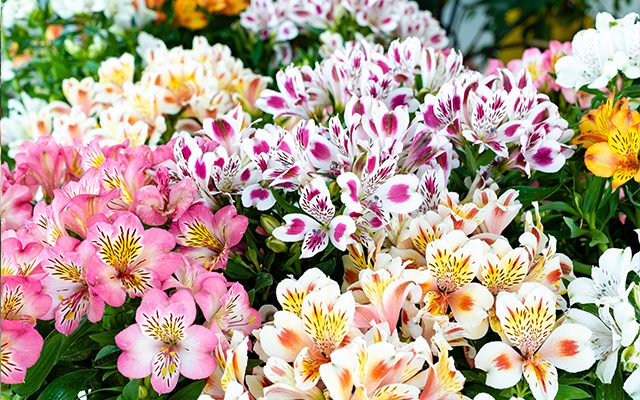
Alstroemeria also known as the “Peruvian lily” or “Inca lily” is a small jewel native to South America. With its bright color and long life, this perennial is certainly worth knowing!
Alstroemeria care
What exposure to give to Alstroemeria
These plants flower most abundantly in full sun (six to eight hours a day), but in the summer months they will also appreciate a little shade during peak afternoon heat.
What temperature does Alstroemeria want?
The roots resist temperatures down to -10°C.
The ideal temperature range for the Peruvian lily goes from 18 to 27°Ctemperatures above 32°C could cause a lack of flowering, in this case it is advisable to expose the plant only to morning light and then place it in areas of partial shade.

How to water Alstroemeria
The Astroemeria requires constant moisture in the soilespecially when summer temperatures begin to be felt. It is recommended to water whenever the first centimeters of soil feel dry.
Which substrate to choose for Alstroemeria
The lilies of the Incas love fertile, well-draining soils. They do not have great demands on the type of substrate to use, but prefer slightly acidic pHs.
The ideal fertilization of Alstroemeria
Fertilize at the beginning of spring with a fertilizer for flowering plants and continue throughout the growing season following the doses on the label.
Propagation of Alstroemeria
Astroemeria can be propagated in several ways, but the simplest and most reliable method is division of tuberous roots. The best time to propagate is early spring, before the new growing season begins.
Prune Alstroemeria
Pruning can be done after flowering to prevent plants from expending energy on seed production. To encourage flower growth, cut off less productive stems.
Parasites and diseases of Altroemeria
Astroemeria can be affected by attacks by snails, mites and aphids, but in general it is a rather resistant plant.
It is important to provide adequate space to encourage air circulation which will allow any spores that cause fungal diseases, such as botrytis, to disperse.
Frequently asked questions about Alstroemeria
Plants do not stay upright
The Peruvian lily is characterized by thin stems and large flowers, which makes this problem common. The solution is simply to place a small support next to the plant.
The Altroemeria is well watered, but the stems and leaves are wilting
This is a classic sign of root rot. You can try to prevent it by ensuring porous and well-draining soil.
The lily of the Incas has stopped blooming
It is normal for these plants to gradually stop flowering as they age, although the foliage continues to be lush.
This usually happens around the plant’s 5th/6th year of age, and is the best time to divide the roots!
What is the difference between the Peruvian lily and the common lily?
They are both brightly colored flowers enriched with darker “freckles” and are particularly appreciated in the cut. However, the Peruvian lily and the common lily are different in many ways:
- the blooms of the common lily are larger (ranging from approximately 12 to 15cm), they grow at the top of tall stems with rather thin foliage;
- The common lily is also much more resistant to cold.
Description
Alstroemeria is divided into two groups depending on its origin:
- Central Chile: winter growing plants
- Eastern Brazil: summer growing plants
They are all perennial plants with a long lifespan. Many of the plants that are currently on the market are hybrids, some of which are made between species from Chile and Brazilian species. In this way the “problem” of seasonal dormancy has been solved, leading these plants to become almost evergreen, with blooms throughout most of the year.
The leaves of the Peruvian lily are arranged alternately, twisted on the petioles so that the underside of the leaf faces upwards. Generally the leaves have variable shapes and smooth edges.
The spectacular flowers are solitary or borne in umbels, they are composed of six long petals that can reach up to five centimeters.
The colors are certainly the strong point of these flowers which we can find in shades of red, orange, purple, green, apricot, lavender and white, mottled and streaked with darker colors.
Most cultivars flower between late spring and early summer.
Planting Alstroemeria
Alstroemeria should be planted in spring, once frosts no longer pose a threat. They are moderately fast growing plants that often flower the first year, except bare root plants which may not flower until the second year.
Taxonomic description
Alstroemeria is a genus of plants belonging to the Alstroemeriaceae family.
The name “Peruvian lily” is assigned to many Alstroemerias, these tuberous plants are not true lilies but the summer blooms that extend from the lanceolate foliage are very reminiscent of lily flowers.
Habitat
The Peruvian lily is native to South America although some varieties have naturalized in the United States, Mexico, Australia, New Zealand, Madeira and the Canary Islands.
Curiosity
The genus takes its name from the Swedish baron Clas Alströmer, a friend of Linnaeus.
Pets allowed?
The ASPCA website reports this plant as non-toxic to humans or pets, while the University of California places it among the mildly toxic plants that can cause relatively mild digestive disorders if consumed and skin reactions.
In any case, since it is not a true lily, it does not have the high toxicity for humans and animals that is generally found among Liliums.
latest posts published

Tired of working in the garden? What can be done to reduce maintenance
How to successfully transplant a Christmas tree

Landscaping a new plot: where to start?
What grows in clay: This is what worked on Juste’s farm

Organic seeds: are they worth paying more for?
Preventive spraying of tomatoes with homemade remedies –
Environmental management: how to renovate a bored plot?
Designers answer what are the 3 best plants for the garden
Fruit trees online: how I ordered them and how I planted them