When we first saw it in the forests of Estonia giant megaphoneswith which you can hear the mysterious sounds of the forest, we immediately understood that the forest is no less important for Estonians than the culture of the city. But there is no need to exaggerate here, obviously young people and citizens are needed strongly encouragedso that they remember mother nature in their daily routine and running. Megaphones are one of the methods of calling, non-standard, interesting, which attract a lot of attention to the forest and nature. Maybe we should think about similar projects?
Pasikalbinom Hannes Prakshead of the Department of Architecture and Interior of the Estonian Academy of Arts, who initiated this giant megaphone project, how the idea came about and how the forest theme came to fruition here.
LINA LIEBERTAITĖ: HANNES, WHAT IS THE PURPOSE OF THIS MEGAPHONE PROJECT?
Hannes Praks: The megaphones only became megaphones at the end of the course, where 12 freshmen were studying. They spent 6 months thinking about the final decision the concept of “forest library”.listening to countless people: filmmakers, computer scientists, designers, architects, art critics, who gave a conference on solitude, the forest, hiking, awareness of the body and space, etc.
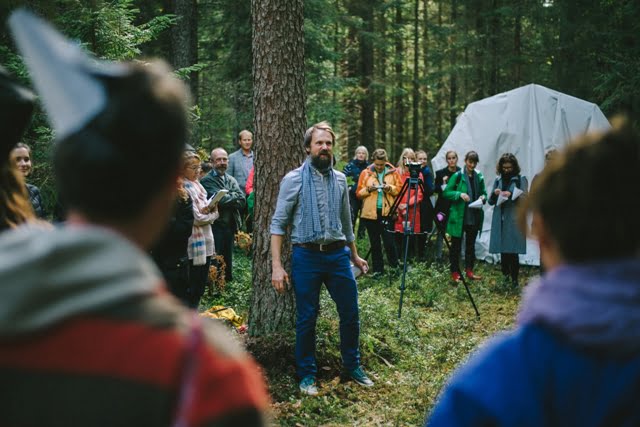
The idea for the “Forest Library” came from Estonian writer Valdur Mikita, famous for his interpretations of how modern man relates to wild nature and history. Birgitta’s proposal to create megaphones at the last stage of the project seemed like a very clear and beautiful continuation of the original idea. The reality is thisthat building a library without heating and security system in the Estonian climate seems a bit silly. Therefore, Birgitta’s clever idea saved the whole project: we changed the intelligible “reading in the forest” for the letter to “reading the forest soundtrack”.
HOW DO YOU ACHIEVE A NON-STANDARD SOLUTION?
Hannes Praks: The biggest challenge was choosing the best idea that was also realistic to install or build. We received at least a dozen “forest library” concepts.
I don’t know if Birgit herself realizes how she came up with this idea, but we, together with the Department of Architecture and Interiors of the Estonian Academy of Arts, believe that our awareness of nature and the problem-solving teaching methods we implement have also led to this. The whole group in mid-January I took a 5-day drawing course in the dense forest, in a remote forester’s hut. After a while, we sent students to London for 48 hours, with no money and no phone. for observation and survival training. We sincerely believe that such experiments and, I would say, even extreme tests lay the foundation for amazing solutions.
WHY THIS PROJECT IN THE FOREST?
Hannes Praks: The Department of Architecture and Interiors started a new curriculum a year and a half ago. Since its leadership is made up of young and ambitious people, we have thought a lot about who we are and what interesting things we can offer to the world as a design school. When we talk about technology, there is no hope of catching up with North America, in “old” Europe craft traditions are much stronger, and in Scandinavia minimalism and modernism are better mastered.
So if we condense everything from this program, we end up with drizzle, thickets and autumn darkness. And if it were a little more poetic – the dark thicket of the forest. That’s where we focused.
WHAT ARE SPECIAL FORESTS IN ESTONIA?
Hannes Praks: 51% of Estonia’s territory is covered by forests, but it seems to me that Estonians’ relationship with forests is not just practical. Maybe I’d call him too friendly relationship. Forests provided shelter and food during particularly difficult times. The last partisan who fled into the woods after the Second World War was captured only in the 1970s. Therefore, it is possible to survive in forests for up to three decades. What are we doing? Let’s translate partisan experience in modern language.
By the way, in our training program we call not only a simple grove of trees a forest, but also the entire technological environment.
HOW MANY PEOPLE CONTRIBUTE TO THE CREATION OF THE MEGAPHONES PROJECT?
Hannes Praks: There was a very large group of active local specialists who willingly contributed and helped the design studio, so the students constantly received professional support. In the group there were 12 students, 6 active teachers and 6-7 consultants. The number of people, of course, is impressive, but looking back, I think the project was worth all our investment.
Thank you, Hannes, for this interview.
It’s fun to see how a good idea with naked people can turn into objects that leave a big impression. Maybe you could even create wonderful things in your garden with your own hands, don’t limit yourself to what you saw from your neighbors. Imagine ordinary things in a new way: different size, different shape, different materials. Go ahead!
The first part of the article, in which there is an interview with student megaphone designer Birgit Oigus and her biggest challenge for this project: “Giant megaphones: listening to the sounds of the forest. Estonia”.
latest posts published
Tired of working in the garden? What can be done to reduce maintenance
How to successfully transplant a Christmas tree
Landscaping a new plot: where to start?
What grows in clay: This is what worked on Juste’s farm

Organic seeds: are they worth paying more for?

Preventive spraying of tomatoes with homemade remedies –
Environmental management: how to renovate a bored plot?

Designers answer what are the 3 best plants for the garden
Fruit trees online: how I ordered them and how I planted them