What is fruit tree tourism, you ask? I first heard this term from tree connoisseur Leonard Mekionis and was struck by how many interesting and impressive fruit trees can be seen in Lithuania. In the program “Plant Enthusiasts” of “Knowledge Radio”, Leonard talked in more detail about this unusual type of tourism and even suggested the route of the most interesting attractions. You can find the complete recording of the show by clicking hereand now read on and get ready for your trip!
Fruit tourism: what is it?
Trees as tourist attractions are a fairly common phenomenon. After all, we all know the Stelmužė oak well or have heard about the tallest Lithuanian spruce in the Norūnai forest. And it turns out that in Lithuania we also have particularly interesting fruit trees, which are:
- several centuries old and still bearing fruit;
- with particularly thick trunks;
- unusually tall, etc.
Therefore, fruit tree tourism is a trip whose purpose is to visit and learn more about exceptional fruit trees. According to Leonardo, it is worth taking such a trip at any time of the year, and preferably even several times a year, because each season allows you to see different characteristics and beauties of the trees:
- in winter, against the background of white snow, the majesty of tree trunks and interesting shapes of branches are perfectly revealed;
- clouds of fragrant flowers startle in spring;
- in summer the eyes shine bright green;
- in early autumn you can taste the ripe fruits and, later, admire the multicolored leaves of the fruit trees.
So, even if we can’t travel abroad much, fruit tree tourism can become a great reason to get out of the house, spend time in nature, take beautiful photos and discover unexpected and beautiful places in our country.
The oldest apple tree in Lithuania
Fruit tree tourism and its route can start in Kaunas. It grows here in Alexot Old Kaunas apple tree. You can find it easily using Google Maps. This is the only protected apple tree in Lithuania.
If we believe the inscription near the apple tree, it is even 360 years old! This fact is difficult to verify, because part of the trunk is already rotten. But even if the number of years is not entirely accurate, the fact is that this apple tree is the oldest in Lithuania. And the most amazing thing is that it is still bearing fruit! As Leonardas says, apples are quite small and not very tasty, but picking and tasting the fruit of the oldest apple tree in Lithuania is an amazing experience in itself.
The old mulberry trees of Kaunas
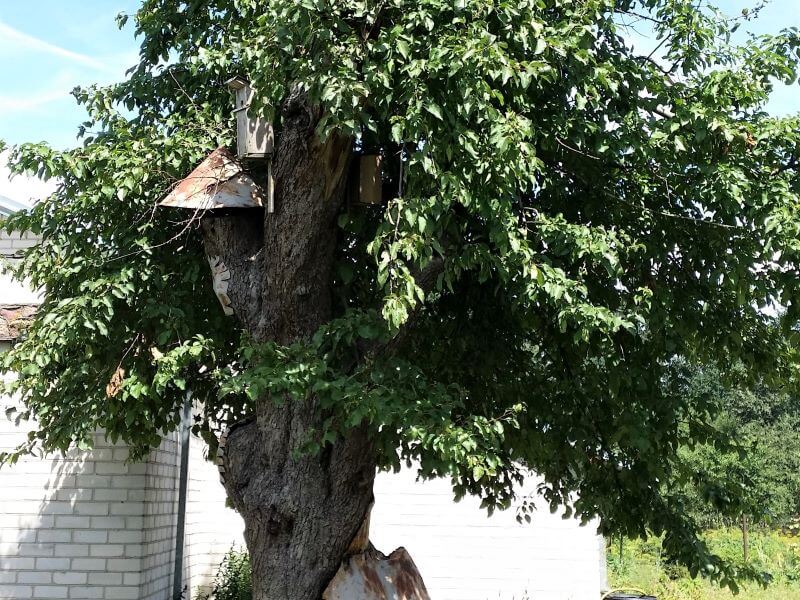
In another neighborhood of Kaunas, Zemeiši Šančiai, you can see another unexpected sight: mulberry trees. Near the kindergarten that is there now, along the fence, there is a row of mulberry trees that are more than a hundred years old! Leonard laughs that the mulberry trees growing in his yard look like only the grandchildren of these majestic trees.
It is true that the mulberry trees in Kaunas could be better arranged and pruned, but even so, they are really worth a visit. And if you come in June or July, you might even taste their berries.
Narrow-leaved gray bushes in Kaunas
In Kaunas you can also see the narrow-leaved elderberry (Elaeagnus angustifolia), or rather two such impressive fruit trees: the Karaliaus Mindaugos elderberry (Kaunas, Karaliaus Mindaugos pr. 43A) and the Savanorių elderberry (Kaunas, Savanorių pr. 306).
This fruit tree has an interesting trunk, spiky branches, blooms with fragrant yellow flowers and ripens as edible drupes that look like olives.
A special hazelnut in the Kaunas district
Fruit tree tourism in Lithuania is especially convenient for residents of Kaunas, because to see even some of the most impressive fruit trees in Lithuania, it is enough to go around the city of Kaunas and its surroundings. That is why even after visiting the “Obelynės” farm of the naturalist Tadas Ivanauskas, located in the Akademija locality in the Kaunas district, you can visit Turkish hazelnut (Corylus colurna). In most cases, we imagine the hazelnut as a small bush, so you will be surprised to see a tree with a thick and impressive trunk here. Leonard says it would take at least two people to hug his trunk. You will not see a similar second hazel anywhere else in Lithuania.
This turquoise hazelnut matures edible nuts. By the way, his nut bunches are also impressive: they seem to be covered with matted hairs. About eight nuts ripen in one bunch. The shell of this nut is thicker, and the nuts themselves are smaller than our common hazelnut – perhaps that is why it is not often grown in gardens.
Fruit tree tourism: visit the largest pear tree in Lithuania
In the Kaunas district, on an isolated farm in the village of Kupria, a three-chambered tree grows “Mieldažine” pear. (the name comes from the surname of the people who lived there). Its peculiarity is that its trunk is up to 5 meters and 70 centimeters long and its height reaches up to 17 meters! For comparison, an oak with a usually thick trunk is considered exceptional and can become a state-protected natural object when its trunk reaches 4.5 meters thick. And here – a “simple” pear thicker than an oak! It’s just incredible.
In addition, this pear is very beautiful and abundantly ripens fruits. If you visit in spring, you will be able to admire its beautiful flowers and, in autumn, taste pears. They may not be particularly tasty, but they are made not with just any pear, but with the largest pears from Lithuania!
Although this tree grows on private property, Leonard says its owners have graciously allowed him to look at the pear, take photos and taste the fruit. So, if you decide to see the thickest pear in Lithuania, here it is coordinates on Google Maps.
Unusual rowan
Fruit tree tourism is interesting because it allows us to discover unusual and unexpected variations of the fruit trees we know. For example, in Žagarė, in the old Jewish cemetery, the thickest one in Lithuania grows rowan. The volume of its trunk reaches up to 2.27 m. This is truly surprising, considering that rowans are usually small trees or shrubs with 30-40 cm trunks. Leonard says that he has not seen his berries because he has only visited this tree in winter, so go there in autumn and check whether the red berries are ripening or not.
Walnut tree in Laukuva
Another tree that breaks standards: it grows walnut tree (Juglans directed by L.). This tree immediately attracts attention and stands out in the environment due to its impressive size, thickness and height. This is a great example of how you can grow a breathtaking tree in your yard that will become the focal point of your property and captivate everyone around you.
Do you want to create a backyard with a beautiful orchard? Register for courses “Farm Landscape”in which you will learn to evaluate the advantages and disadvantages of your plot, to divide it into functional zones, to choose the best place for the plants and the orchard of your dreams. In the courses, Dr. Dr. Ingė Auželiene. Therefore, these courses are a great way to verify the vision of your farm that is maturing in your head and to refine the concrete steps to turn your dream into reality.
I thank Leonard Mekionis of the company Arborists of the Academywho explained what fruit tree tourism is, offered to visit many special objects and shared his photos. So let’s travel around Lithuania, discover interesting things, get inspiration, so when we return home we can create a beautiful environment in our backyard too.
latest posts published
Tired of working in the garden? What can be done to reduce maintenance
How to successfully transplant a Christmas tree
Landscaping a new plot: where to start?
What grows in clay: This is what worked on Juste’s farm
Organic seeds: are they worth paying more for?
Preventive spraying of tomatoes with homemade remedies –
Environmental management: how to renovate a bored plot?
Designers answer what are the 3 best plants for the garden
Fruit trees online: how I ordered them and how I planted them