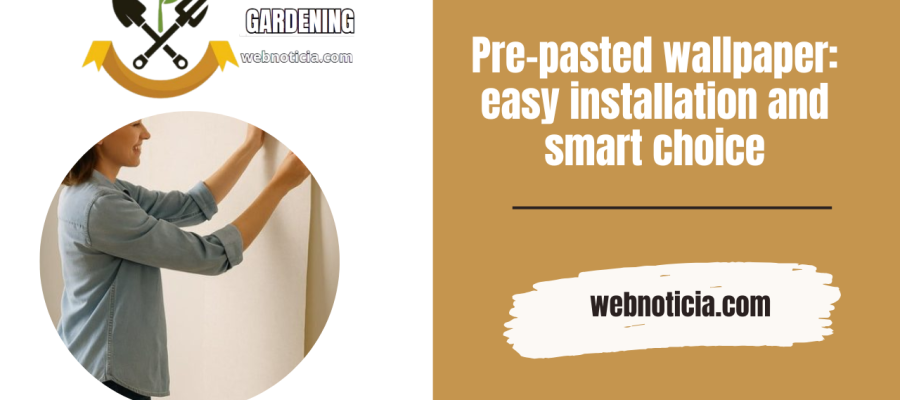
Pre-pasted wallpaper has it all: practical, quick to install, perfect for transforming a room in the blink of an eye. But what do you really need to know before you get started? If you are thinking of using it to dress up your walls, this guide is for you. Together we analyze the strengths, pitfalls to avoid, installation techniques, professional advice and the different models so that your choice is aesthetic, durable and intelligent.
What is pre-pasted wallpaper?
A technology designed to simplify installation
Unlike classic wallpapers, pre-pasted wallpaper is already coated with dry glue on the back. Simply immerse it in water for a few seconds to activate the glue, before placing it directly on the wall. This process makes for a cleaner installation, with no glue to prepare or brushes to clean. A real revolution for lovers of wall decoration!
What is the difference between classic and non-woven wallpaper?
Conventional wallpaper requires applying glue to the back or directly to the wall, which can be messy. Non-woven fabric is easier to install, but also more expensive. Pre-glued offers an ideal compromise: simplicity without adding too much cost. It is a very popular choice for smaller budgets or rental accommodation.
Why choose pre-pasted wallpaper?
The concrete advantages in use
The main advantage? Easy installation, of course. But that’s not all: pre-pasted wallpaper adheres quickly, does not leak and can be fixed for a few minutes before drying. It is also lightweight and therefore easier to handle alone. It is the ideal ally for rapid development projects.
Who is this type of wallpaper for?
Perfect for DIY beginners, but also for families who want to refresh their bedroom or living room without undertaking major work. It is also recommended for rental, because there are models that are repositionable and easy to remove. A practical, economical and safe choice.
The different types of pre-pasted wallpaper
Vinyl, foam, non-woven – how to choose based on your room
Pre-glued vinyl is moisture resistant – perfect for kitchens or bathrooms. The foam, with its relief effect, adds a warm touch to environments. The pre-glued non-woven fabric combines aesthetics and resistance: ideal for the living area. Adapt the material to your use for best results.
Pre-pasted or self-adhesive wallpaper – don’t get confused!
Many people confuse pre-glued and self-adhesive. The first must be moistened, while the second is applied directly like an adhesive. Self-adhesive wallpaper is faster to install, but less tolerant to errors. The pre-glued allows for a slight repositioning before definitive fixing.
How to correctly install pre-pasted wallpaper
Preparing the wall: the crucial step
A clean, dry and smooth wall is the basis for a successful installation. Remove any traces of peeling paint, loose plaster or previous wallpaper. Consider applying an undercoat if the surface is too porous.
Step by step installation, no bubbles or creases
- Measure and cut the strips.
- Soak a sheet of paper in water for 30 seconds.
- Apply to the top of the wall, smoothing down.
- Smooth from the center to the edges to eliminate bubbles.
- Repeat, checking the alignment of the pattern.
Maintenance, durability and removal of pre-glued wallpaper
How to clean without damaging?
Most pre-pasted wallpapers are washable. Use a damp sponge, without aggressive detergents. For stains, a little diluted Marseille soap works wonders.
Is it really reusable? What you need to know about withdrawal
Technically, pre-pasted wallpaper is not designed to be reused. However, some models can be removed without damage if the wall has been properly prepared. Warning: the more time passes, the more the glue penetrates. Ideal retirement within 3 years.
Mistakes to avoid with pre-pasted wallpaper: practical FAQs
Do you really need to soak the wallpaper?
Yes, absolutely. Soaking activates the pre-glued glue. If you skip this step or if the paper is not moistened enough, the glue will not work and the paper may peel off quickly or cause wrinkles.
How long to leave a strip soaking?
Typically 30 seconds in a tub of water is enough. Next, it is recommended to fold it like an accordion and let it rest for 1 to 2 minutes to fully activate the glue.
How to avoid misaligned models?
Take the time to make a vertical mark with a level before laying the first strip. This is your reference axis. Each subsequent strip must be perfectly edge-to-edge with the previous one, especially if the paper has coordinated patterns.
What to do if bubbles appear?
They are often due to poor plaster or a poorly prepared wall. Pass a marouflage from the center outwards to gently remove them. If the bubble persists, pierce it with a fine needle and smooth again.
Comparison: Pre-pasted wallpaper versus other wall solutions
How does it differ from non-woven wallpaper?
Non-woven fabric glues directly to the wall and comes off easily, but is often more expensive. Pre-glued is less expensive and can be installed without glue, but can be a little more difficult to remove.
Alternative to painting or covering walls?
Pre-pasted wallpaper is an ideal alternative for those who want to personalize a wall quickly, without undertaking major work. It allows you to change your vibe in a weekend.
Our advice for choosing the right one in store or online
Information to check on the packaging
Look at the words “pre-glued” or “pre-glued.” Make sure the paper is washable, cut straight (if patterned) and suitable for your intended use. A wall pictogram can indicate the recommended room type.
Furnishing advice: patterns and colors that last over time
Prefer neutral shades, vertical lines or material effects (polished concrete, linen, wood). These designs integrate easily into a durable, customizable wall decor with colorful furniture or curtains.
A wall covering project with pre-pasted wallpaper? It’s a great idea. With a little method, the right tools and a choice adapted to your needs, the result will be as aesthetic as it is long-lasting.
latest posts published

Tired of working in the garden? What can be done to reduce maintenance
How to successfully transplant a Christmas tree
Landscaping a new plot: where to start?

What grows in clay: This is what worked on Juste’s farm

Organic seeds: are they worth paying more for?
Preventive spraying of tomatoes with homemade remedies –

Environmental management: how to renovate a bored plot?

Designers answer what are the 3 best plants for the garden
Fruit trees online: how I ordered them and how I planted them