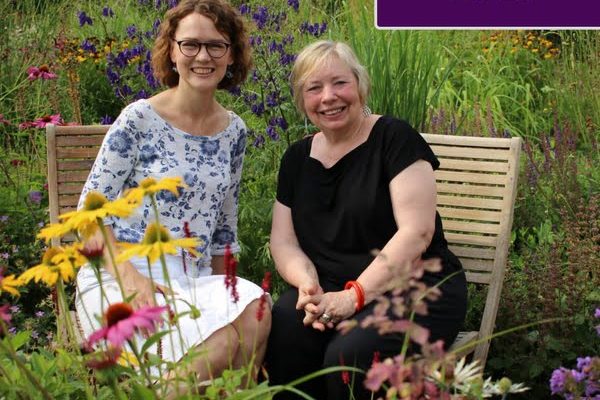
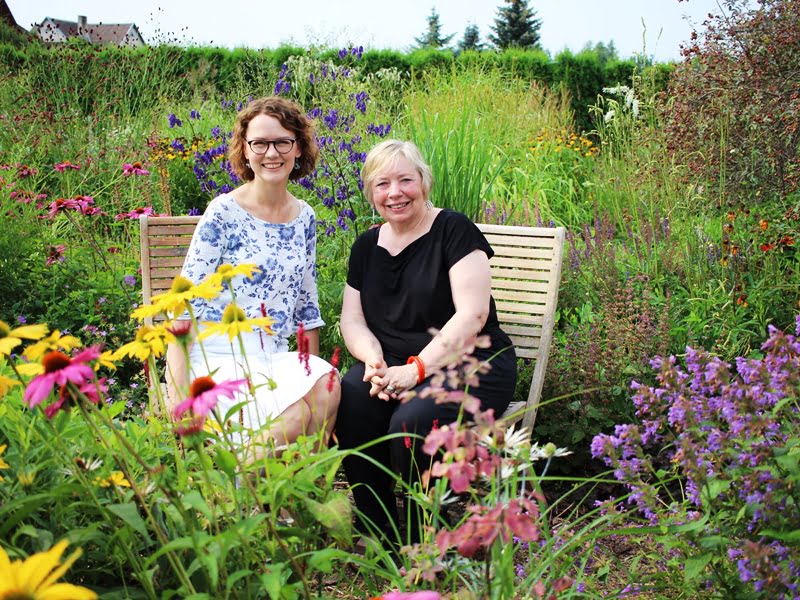
He visited Lithuania at the end of the summer landscape designer Carolyn Mullet (USA). He is a true celebrity in the field of garden design, not so much for the gardens he creates, but for his keen eye for spotting talented landscapers around the world. His Facebook account is followed by almost one and a half million people from all over the world, so his arrival in Lithuania really aroused curiosity. We met in the courtyard of designer and grower Rasa Laurinavičienė and talked about the map of the most beautiful gardens in the world and Lithuania’s potential in it. You can also watch the interview in a video report (press the “CC” button in the right corner of the screen for Lithuanian subtitles):
Lina Liubertaitė: Carolyn, how did the idea of presenting the wonderful gardens come about and how did it develop?
Carolyn Mullet: I was fascinated by the possibility of communicating with so many people from all over the world through social networks. I started my Facebook account because I felt like there are so many beautifully designed gardens that no one knows about, there are so many little spaces that no one has heard of. So I thought it would be really important to introduce these spaces and gardening ideas from around the world to garden designers.
The photos alone were not enough, we wanted to visit it. This is how my travel company was born. I gather small groups, mostly from the United States, although sometimes there are people from Australia, some European countries like Sweden, Greece, England. We all gather in a specific place and travel from garden to garden for seven or eight days.
Lina Liubertaitė: Which trip did you like the most? Was there a special release?
Carolyn Mullet: There’s been a lot of travel, so this is a really tough question. Personally I was very impressed Piet Oudolf work, a meeting with Piet himself in his garden and a visit to several projects he created in Europe. I saw his work at the Lurie Garden in Chicago and the High Line Garden in New York City, but I was most impressed by his work in Europe. He is truly a great person who sincerely shares his knowledge, so every time we visit his garden it is amazing.
However, we recently learned that its Hummel Garden will no longer be open to the public after 2018. So, next year will be its last. I’ll plan a trip or two. But we will always have wonderful memories. You know, as it grows, the family wants more privacy and other things to do besides keeping the garden open to visitors. Regarding the closure of the garden I fully agree with him, but it means that next year will be the last.
Lina Liubertaitė: You have visited many gardens. Was there a place that particularly surprised you?
Carolyn Mullet: Yes, there was one in England. This was a trip where we visited the Arts and Crafts Gardens, specially designed by Gertrude Jekyll. He lived in the 20th century. early on and was a famous garden designer of the time, wrote many books and worked with architect Edwin Lutyens. So as we explored those gardens, we stopped at a garden called Folly Farm. “Folly Farm” was a house built in the 20th century. pr., a garden designed by E. Lutyens, and plants selected by G. Jekyll. The mill owners decided to invite Dan Pearsonwho is an English designer who, among other things, I admire a lot.
I didn’t expect how good the 21st century was. the plants may seem 20th century. Ave. in the garden Thus, in the 20th century, the garden forms Ave. and its modern contribution. There is a sunken garden with a circular staircase from which you can descend. Maybe 1.80 m, maybe a little more. You find yourself in a completely enclosed space where Mr. Pearson has planted some incredibly interesting natural plants. I was simply carried away by the promise. I have never seen such an amazing sight.
Perhaps I admire these three designers even more because they are from the 20th century. The garden’s shapes and structures have remained as intact as the day they were created, whilst bringing the 21st century to them. natural plants. I hope many people can go there.
Lina Liubertaitė: Carolyn, you are from the United States, but you travel all over the world. What differences do you see between U.S. and European gardens?
Carolyn Mullet: I think that in the United States, as sad as it is to say, there is no deep horticultural tradition. In Europe there are very skilled homeowners who manage their gardens themselves, perhaps with a little help from trained professionals, but they live in gardens that are simply fascinating. It is thanks to their excellent skills that they are able to do this. They have a vision, they have talent. Although the United States also has the same people, for our culture this is not as important as it is for Europeans. It fascinates me. I was lucky enough to see those gardens and chat with the gardeners themselves.
Lina Liubertaitė: Here in Lithuania we like to grow plants that not only perform a decorative function, but also edible plants. What do you think?
Carolyn Mullet: It is definitely popular in the United States. For many years people did not grow fruits or vegetables, but now younger generations are more interested not in large farms that grow fruits and vegetables, but begin to grow them in their own garden. This is how they start gardening. They are less interested in flowers, but I’m sure they will start, but for now they just want to grow healthy food for their family. It’s really very trendy. The Millennial generation, as we call it, is very interested in gardening. This is truly a wonderful thing. Many garden in their homes in the city, on balconies, on roofs. This is a very inspiring fashion.
Lina Liubertaitė: Now we are in Lithuania, in Vilnius, in the Rasa Laurinavičienė nursery. There are many plants in naturalistic style here. This is not typical for Lithuania. We have our own traditions and are just starting to take our first steps in the global design community. What opportunities do you see for us?
Carolyn Mullet: What I saw was great. I saw several compositions in Vilnius, they were very beautiful and well planned. I also had the opportunity to see Rasa’s compositions for clients. They were breathtaking views. I think the potential is huge. Naturalistic fashion can be adapted to almost any style. You can have a very formal structure, you can have hedges, evergreens, then add some naturalistic perennials and grasses and the garden becomes richer.
People are just starting to get into this type of gardening, so they have many options. This direction brings wild life into your garden, the bees buzzing right behind us, the butterflies. If you have a body of water in your garden, you can raise frogs and you will have beautiful wildlife that we encourage all over the world. Therefore, this type of gardening is particularly suitable for this. I’m very happy to see what you are doing.
Lina Liubertaitė: We really put a lot of effort into it: we learn design principles, we learn gardening styles. In August we will also organize an environmental design conference called Garden Style.
Carolyn Mullet: Oh yeah, I’ve heard about it, it sounds great. I think it’s really cool to be at the beginning of a movement, which is exactly what’s happening here. I can only imagine that it will grow more and more, especially with a conference like this, with nurseries like Rasos and designers using these ideas in their designs that we see in public spaces, in cities. All of this helps people see what they can create in their own gardens.
latest posts published
Tired of working in the garden? What can be done to reduce maintenance
How to successfully transplant a Christmas tree
Landscaping a new plot: where to start?
What grows in clay: This is what worked on Juste’s farm

Organic seeds: are they worth paying more for?

Preventive spraying of tomatoes with homemade remedies –
Environmental management: how to renovate a bored plot?
Designers answer what are the 3 best plants for the garden
Fruit trees online: how I ordered them and how I planted them