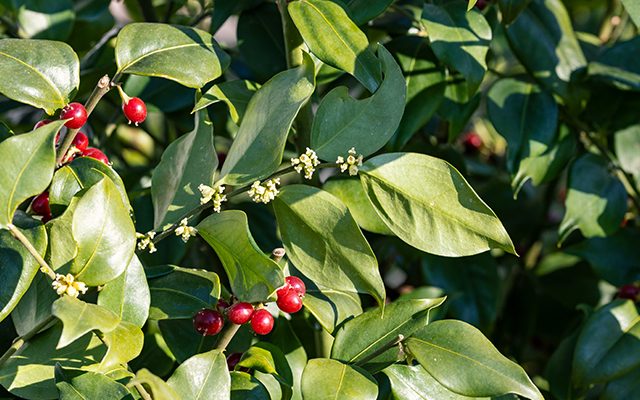
THE Sarcococcaalso known as Christmas box or Sweet boxit is a shrub compact evergreen much appreciated for its leathery and decorative foliage and for its extraordinary scent of winter flowers. The small light flowers, discreet but intensely aromatic, bloom between winter and spring and then leave room for ornamental berries brightly colored: purple, red or black.
In this period Sarcococca is at its most beautiful, so much so that it was impossible not to tell you about it! Let’s discover these little scented pearls of the garden together!
THE Sarcococca they are plants easy to growresistant and not very subject to diseases or parasites. They adapt well to many environmental conditions and are also ideal for those with little experience with plants. Let’s now look at them in detail main species and varieties of Sarcococcawith characteristics, uses and rusticity.
| Species / Varieties | Height x width | Bearing | Leaves | Flowering | Perfume | Berries | Rusticity | Ideal use |
| Sarcococca confusion | 1-1.5m x 1-1.5m (up to 2m) | Compact, bushy shrub | Ovate, shiny dark green | Winter (white) | ⭐⭐⭐⭐ | Red -> black | ⭐⭐⭐⭐ (Up to -15°C) |
Low hedges, stains, shade |
| Sarcococca hookeriana “Valle Perfumata” | 0.5-1m x 1-1.5m | Low, widened | bright green | Winter | ⭐⭐⭐⭐ | Red -> blue – black | ⭐⭐⭐⭐ (-15 / –10°C) |
Borders, ground cover, flower beds |
| Sarcococca hookeriana “Winter Gem” | 0.5-1m x 0.5-1m | Compact and dense | Dark green | Winter | ⭐⭐⭐⭐⭐ | Red -> black | ⭐⭐⭐⭐ (-15 / –10°C) |
Vase, small spaces, shadow |
| Sarcococca ruscifolia | 0.5-1m x 0.5-1m | Rounded | Ovate, shiny | Winter | ⭐⭐⭐⭐ | Red -> black | ⭐⭐⭐⭐ (-15 / –10°C) |
Borders, ground cover |
| Sarcococca ruscifolia var. chinensis “Dragon’s Gate” | 1-1.5 m x 1 m | Elegant, tidy | Elongated, very shiny | Winter | ⭐⭐⭐⭐⭐ | Red | ⭐⭐⭐ (-10 / –5°C) |
Vase, low hedges, terraces |
| Sarcococca saligna | 0.5-1m x 0.5-1m | Expanded | Narrow, lanceolate | Winter | ⭐⭐⭐ | Dark purple | ⭐⭐⭐ (-10 / –5°C) |
Borders, sheltered areas |
THE Sarcococca it is a fragrant evergreen shrub, perfect for shaded gardens, terraces and balconies. Easy to grow, resistant and not very prone to problems, it is an ideal choice even for those with little experience. Let’s find out together how to grow Sarcococcafrom position to pruning.
Where to place the Sarcococca
Sarcococca is a perfect plant for dimly lit areasas it grows very well in partial or full shade. It also adapts to brighter exposures, as long as the soil remains constantly moist, although in full sun the foliage may lose some chromatic intensity.
👉 Direct exposure to the sun is only possible in the cold months; during the summer it is better to avoid it.
Sarcococca: minimum temperature and cold resistance
Sarcococca is a plant very rustic and tolerates temperatures up to –10°C / –15°Cdepending on the variety.
If grown outdoors, it is advisable mulch the soil during the harshest winters to protect the root system from frost.
How often to wet the Sarcococca
Sarcococca requires moderate wateringalways taking seasonal rains into account.
- In vase or in the housecheck the humidity of the substrate with your finger: when the first centimeters are dry, it is time to water abundantly.
- Young plants tolerate short periods of drought, but maintaining soil is best for healthy growth slightly moist.
Which soil to use for Sarcococci
The ideal soil for Sarcococca must be:
- Moderately fertile
- Rich in humus
- Well draining
For pot cultivation, they are excellent substrates such as One and One+.
In open ground, if necessary, you can improve the soil by adding humus or peat.
How to fertilize Sarcococca
Fertilize the Sarcococca with a slow release fertilizer in March, June and September, so the plant will grow vigorously and even more fragrant!
How to propagate Sarcococca
Sarcococca can be propagated by seed or by cutting.
Propagation from seed
- Sowing outdoors in autumn or spring.
- At home you can start already late winter.
- Use fertile soil rich in organic matter.
- Maintain the substrate humid until germination.
Propagation from semi-woody cutting
- Take long cuttings 12–15 cm with more leaves.
- Remove the lower leaves and, if possible, use a rooting hormone.
- Place the cuttings in pots with a substrate rich and draining.
When to transplant Sarcococca
Sarcococca loves rich soil: this is why it is recommended repot it every 2 yearsso as to prevent stagnation, rot or the development of fungi. Be careful when changing from one pot size to a slightly larger one or you risk overpotting!
How to prune Sarcococca
Pruning is mainly useful for maintain shape and order.
The best time to prune is in springonce flowering has finished.
Sarcococca parasites
Sarcococca is a plant naturally resistant to parasites and diseases. Any problems are rare and almost always linked to excess water or poorly draining soil.
Description of Sarcococca
THE Sarcococca it is an evergreen shrub much appreciated for its decorative foliage and for his intensely scented flowers. It is a robust plant, characterized by leathery, shiny leaves and small creamy-white flowers that bloom in winter and early spring. In summer, the flowers give way to ornamental berries red, black or purple, extremely persistent: they often remain on the plant until the following winter.
The leaves are generally alternate (rarely opposite) and vary in shape from lanceolate All’ovate and ellipticalgiving the plant an elegant and tidy appearance.
Sarcococca flowers
Sarcococca flowers are small (approx 5 mm), scented, devoid of petals and variable in color from white to light green. They grow in small groups along the leaf axis.
- I male flowers they have evident anthers.
- I female flowers they develop under the male ones in the same inflorescence.
Despite being discreet from an aesthetic point of view, these flowers release a intense and sweet aromacapable of scenting entire areas of the garden, especially when the plants are grown in groups.
Habit and growth
Sarcococca is a shrub monoecious, evergreen and slow growingwhich it generally achieves 1–2 meters tall. The compact and tidy shape makes it ideal for borders, low hedges and shaded areas.
Taxonomic description of Sarcococca
The genre Sarcococca includes approx 11 species of evergreen shrubs, sometimes rhizomatous bushes.
Family: Buxaceae
Natural habitat of Sarcococca
Sarcococca originates fromEast and South-East Asia and the regions ofHimalayaswhere it grows spontaneously in forest environments, often shaded and cool.
Is Sarcococca pet friendly?
Yes, there Sarcococca is pet-friendlytherefore it can be grown safely even in gardens and terraces frequented by pets.
Curiosities about Sarcococca
The scientific name Sarcococca comes from Greek:
- “big house” = meat
- “messy” = berry
A direct reference to his fleshy and decorative berriesone of the most fascinating characteristics of this plant.
Thanks to its dense and compact foliage, Sarcococca is also often chosen for creating tidy green barrierslow hedges and scented shady spots.
latest posts published

Tired of working in the garden? What can be done to reduce maintenance
How to successfully transplant a Christmas tree
Landscaping a new plot: where to start?

What grows in clay: This is what worked on Juste’s farm
Organic seeds: are they worth paying more for?
Preventive spraying of tomatoes with homemade remedies –
Environmental management: how to renovate a bored plot?
Designers answer what are the 3 best plants for the garden
Fruit trees online: how I ordered them and how I planted them