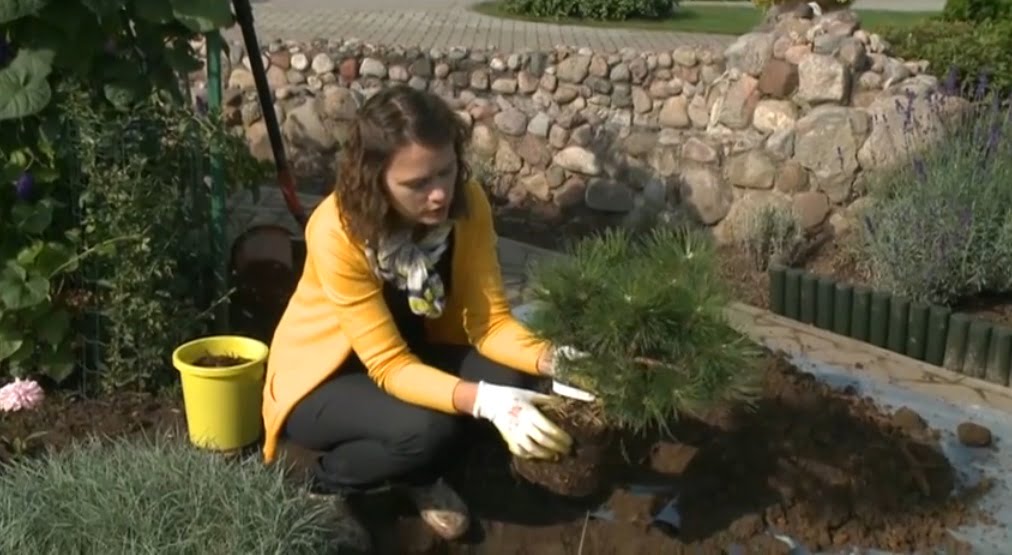
Soon we will show you how to plant a pine tree. Fall is a great time to plant conifers. September or later, while the “bob summer” sun is still warm, is a great time to do this. Planting conifers is easy, but you need to know some nuances. In this video report you can see how I managed to plant a ‘Nana’ pine tree, which has a closed root system:
And then the teacher of the “Yellow Wheelbarrow”. Ingė Auželiene tells how to evaluate a seedling, when to plant conifers and how to do it correctly.
WHEN TO PLANTING CONFLES
When transplanting plants, the roots are slightly damaged, their nutrition is disrupted and it depends on whether the plant will grow well and quickly. We can call the sleep period of plants winter, because in that period the roots cannot feed intensely, like in spring or summer. However, winter sun also affects the plant because it causes some of the moisture to evaporate. Here are the main reasons why they fall deciduous and coniferous trees should be planted at different times.
As long as deciduous trees have leaves, they need nutrients and moisture. After dropping their leaves in the fall (except for evergreens like rhododendrons), plants go into dormant mode, so they need a minimal amount of water. At the end of winter, when the sun is active, the plants evaporate little water because they have no leaves. So it’s worth it deciduous trees are planted with fallen leavesto winter quietly and take root when it’s warm in spring.
Conifers are green even in winter, so if the sun evaporates moisture through the needles, all the plant has to do is compensate for the lack of water by pumping it through the roots. Therefore the roots must already be strong, rooted, well watered before winter. AS planting conifers – in September or at the beginning of October to have time to take root and prepare for winter.
OPEN OR CLOSED ROOT SYSTEM
Seedlings are sold with an open or closed root system. What does it mean:
Open the root system – if grown directly in the ground, dug up and prepared for sowing. Since the roots are damaged during digging, the timing of transplanting is very important.
Closed root system – if grown specifically in pots (mainly in containers). When grown this way, the roots are not cut or pickled during moving, long-term storage or transportation. Therefore, plants with a closed root system can be planted practically at any time during the warm period.
How do you know if a plant is grown in a pot or simply dug up and moved there?
- If the root system is closed, after removing the plant, the entire mass of soil and roots removed together maintains the shape of the pot. If the roots are many, they are twisted and the soil is almost invisible, it means that it has been grown in the pot for too long, it should be moved to a larger one. In order for the soil to maintain the shape of the pot it is necessary to cultivate it inside it for at least a year;
- If, after removing the plant, the soil immediately crumbles and falls to the sides, it means that the plant was grown in soil and only potted for sale. Don’t keep it that long and plant it now.
ROOT EVALUATION
Examine the roots. The plant does not feed on large roots, but with small white roots (with root hairs). They are the ones who suck water and nutrients from the soil. If you find such roots, you have a very good chance of successfully transplanting the plant.
Plants are friends with various fungi, but we cannot always see them with the naked eye. But don’t be surprised to find pine trees, especially those with closed root systems, when you buy them root covered with mycelium. It’s not mold like you might think. This mycelium is a sign of a healthy pine.
Tip: when you buy plants with an open root system, evaluate not only the trunk, stem or branches, it is normal to ask the seller to also show the roots, take advantage of this.
HOW TO PLANT A PINE
Conifer pit a considerable amount is prepared: the height and width of the crown of an adult tree or bush corresponds to the volume occupied by the roots. Even if the plant is still small, prepare a hole large enough for the mature plant. Pine trees don’t need particularly fertile soil, so mixing the compost into the hole will be sufficient.
Find it root collar – thickening of the upper part of the root, which passes into the cortex. If you purchased a plant with a closed root system, you may also need to remove 3-5 cm of soil. Plant like this root collar it would be slightly above the groundlet’s say 2 cm. It’s better to plant a little too high than too deep, not just for pines, but for many other plants as well. If you have already planted and the plants are poor, check that they are not too deep root collar – perhaps you have already made this mistake. I. Auželiene in courses “Modern garden and vegetable patch” recommends throwing a board or just the handle of a spade through the hole, then you’ll see what height you’re planting the plant at and can make adjustments immediately.
FINAL WORKS
After planting a bush or other conifer:
- Trample the earth, not at the roots, but around;
- Water generously, if the soil is very dry, replenish it
- Mulch.
The final step, mulching, is necessary to retain moisture and create an environment suitable for the growth of beneficial microorganisms. Even if you are not planting forest plants, but ornamental trees or shrubs, such as mountain pine, black pine, thuja, juniper, ornamental Christmas tree, we must imitate the undergrowth so that the plant feels good and grows well. If you don’t mulch, plant a variety of groundcover plants
latest posts published
Tired of working in the garden? What can be done to reduce maintenance
How to successfully transplant a Christmas tree
Landscaping a new plot: where to start?

What grows in clay: This is what worked on Juste’s farm

Organic seeds: are they worth paying more for?

Preventive spraying of tomatoes with homemade remedies –
Environmental management: how to renovate a bored plot?
Designers answer what are the 3 best plants for the garden
Fruit trees online: how I ordered them and how I planted them