THE Jacaranda mimosifolia it is a plant for which one could use a lot of adjectives. Do you know those trees you see in Fantasy movies? Those that the protagonists encounter in the heart of an enchanted clearing enclosed in an ancient forest. Tested by their adventures, they arrive in front of the large tree and feel sheltered, free to rest and, if they are lucky, to find help from some woodland creature that has made that majestic tree its home.
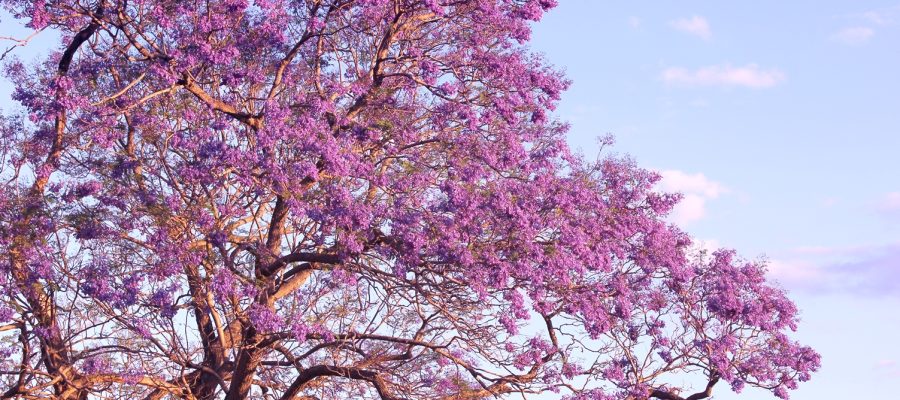
If that tree had to have a name, it would probably be Jacaranda mimosifolia, not only for the particular shape of this tree, slender and delicate, but above all for the color of the flowers, which dye its foliage violet, transforming the dense branches into sources of small purple waterfalls. Oh yes, this tree can only arouse a vein of poetry in everyone. Here are all ours advice to take treatment of this wonderful plant!
JACARANDA MIMOSYPHOLIA
The Jacaranda mimosifolia plant or Blue Jacaranda it is a tree native to Central and South Americavery fast growing, which can reach 10-12 meters in height. 49 species belong to the Jacaranda genus, always originating from the American tropical regions.
The name “Jacaranda” has Guarani origins (a language spoken in Paraguay and other South American states) and means “fragrant”.

Here you can buy your Jacaranda mimosifolia!
He has an upright posture and it has one hair very dense and almost as wide as the height of the tree.
It is a deciduous plant, so during the cold months it will lose some of its splendor, only to regain it when the first warm weather arrives. Furthermore, the flowers will bloom before the leaves appear.
His bark it’s a lot dark and smooth; its leaves I am bipinnatelike those of Acacia dealbata or Mimosa, with a bright green colour.
Your flowersthat bloom in spring, they are collected in many apical clusters and are trumpet-shaped, blue-violet in colour, up to 5-6 cm long. In fallthe plant produces long pods containing numerous dark, winged seeds.
The Jacaranda will also be able to see you and the next generations that follow grow, in fact it has a very long life, if grown in ideal conditions it can reach 150/200 years of age!
DOES JACARANDA HAVE INVASIVE ROOTS?
The root system of the jacaranda tree is quite vigorous. It occupies the top 60cm of the ground and can extend twice as wide as its canopy, so if the canopy reaches a 3m radius, the roots could extend up to 6m away from the tree. Its roots are often visible on the surface even several meters away from the trunk; although I have read that it rarely ruins nearby sidewalks and driveways, I have seen images that prove the opposite. It is therefore better to raise this tree 4-5 meters from structures and floors or, in the case of small gardens, opt for cultivation in pots: we will not get gigantic trees but we will still enjoy its blooms.
TAKING CARE OF YOUR JACARANDA
The magnificent Jacaranda, despite its graceful appearance, is not a particularly demanding or delicate plant. Let’s take into account that in its countries of origin it is used as street trees, precisely due to the lack of care it requires despite its very high decorative potential. Let’s go see what she needs!
EXPOSURE
The Jacaranda grows in any position, prefers sunny and well-ventilated places.
TEMPERATURE
It is a plant not suitable for frosts, its ideal temperature is in fact one that does not fall below 5-7°C. The adult Jacaranda it is however able to withstand temperatures of little below 0°Con the contrary, young plants must be sheltered at least in the first few years after planting, to prevent frost from compromising their growth.
No problems even with the heat, even 40°C won’t put her in difficulty.
WATERING
Young specimens must be watered regularlywhile the specimens adults do not require watering, except in long periods of drought. In the winter, watering should be suspended.
In any case, to know when it’s time to water the Jacaranda, just touch the ground: if the first 5-8cm are dry, then it’s time to intervene with a good wetting.
LAND
The Jacaranda It likes loose, sandy, well-drained and fertile soil and cannot tolerate damp and compact soils.
The ideal pH is generally basic or slightly acidic.
FERTILIZATION
It is advisable to administer some organic fertilizer in autumn and mineral fertilizer in spring to promote growth and provide the correct nutrition to the plant.
MULTIPLICATION
THE multiplication of the Jacaranda it can be done by seed or by cutting.
To obtain the best results with seed propagation, it is ideal to soak the seeds in water 24 hours before planting them. Spring is the ideal time to plant them, especially when temperatures range from 16°C to 21°C.
Generally the Jacaranda requires one regular pruning, especially in the first 10-15 years of life. This is because these are years in which the correct formation of a sort of skeleton is finalized which will then support its growth and stability. Even when the plant is adult it can be pruned, more or less annually, to help flowering and remove damaged branches.
CURIOSITY:
The Jacaranda as well as being cultivated as a decorative tree for its showy flowering it is exploited for wood that derives from it, improperly called rosewood (true rosewood comes from a fabacea, Dalbergia), very valuableused for furniture construction.
The city of Pretoria in South Africa it is also called “City of the Jacaranda“ for the enormous number of plants present in roadside avenues and in both public and private gardens.
In Brazil, wood of the Jacaranda It is used for the construction of some body parts of acoustic guitarsrecognizable by its bright, red colour.
Always in Brazilsome Jacaranda plants are used in traditional medicine for its antirheumatic, anti-inflammatory and analgesic properties.
PARASITES AND DISEASES
The Jacaranda it is rarely attacked by parasites and diseasesbut in the presence of signs of attack, it is necessary to act promptly with broad-spectrum products to protect it as best as possible.
The parasites you may be dealing with are aphids, whiteflies and red spider mites (mites). It is important to ensure that the soil is well draining or rot caused by fungal attacks could develop.
Jacaranda in pot
Jacaranda is not a plant suitable for growing in pots. We can make this choice but we will probably never be able to see its flowers as it will be impossible for it to flourish. Furthermore, as time goes by, it will be absolutely necessary to put it in open ground or it will not survive.
Jacaranda, symbolism
The Jacaranda is a symbol of wisdom, rebirth, wealth and good luck. In short, nothing is missing!
According to an Amazonian legend, a wonderful bird named Mitu landed on a Jacaranda tree, carrying on its wings an enchanting indigenous priestess. The priestess, called Daughter of the Moon, descended from the tree and lived among the villagers. He shared his knowledge, wisdom and ethics with them, showing them the difference between good and evil.
When he had completed his mission he returned to the tree, which in the meantime had adorned itself with flowers and ascended to the sky, joining the Son of the Sun who had carried out a similar mission in another area of the jungle.
Furthermore, particularly in Australia, There is a widespread rumor that if a Jacaranda petal falls on your head, then you will have luck (linked to the imagery of the Jacaranda as a wise plant), for this reason it is very widespread on university campuses.
What do you think? You needed ours advice for the treatment and the cultivation from the Jacaranda?
This magnificent plant hardly leaves you indifferent and, we are sure, it has already managed to conquer you too!
latest posts published
Tired of working in the garden? What can be done to reduce maintenance
How to successfully transplant a Christmas tree
Landscaping a new plot: where to start?
What grows in clay: This is what worked on Juste’s farm

Organic seeds: are they worth paying more for?
Preventive spraying of tomatoes with homemade remedies –
Environmental management: how to renovate a bored plot?
Designers answer what are the 3 best plants for the garden
Fruit trees online: how I ordered them and how I planted them