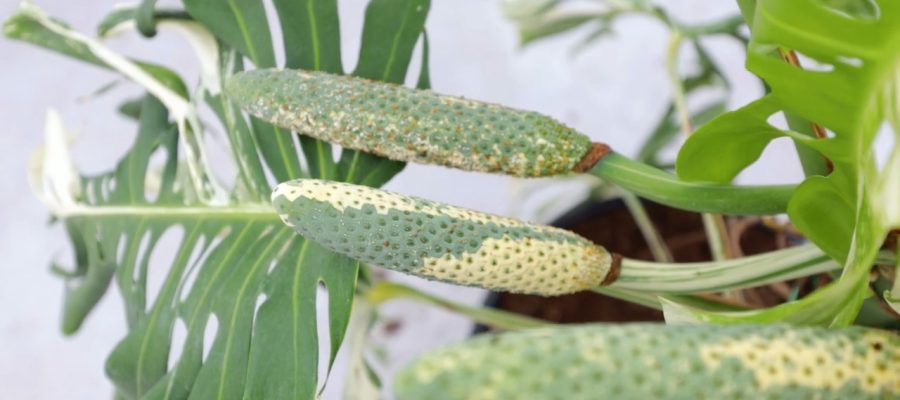
Something spectacular happened in the nursery: the Monstera deliciosa “Albo Variegata” bore fruit! But how does this type of plant bear fruit? And how does it reproduce? Let’s find out!
The Araceae family
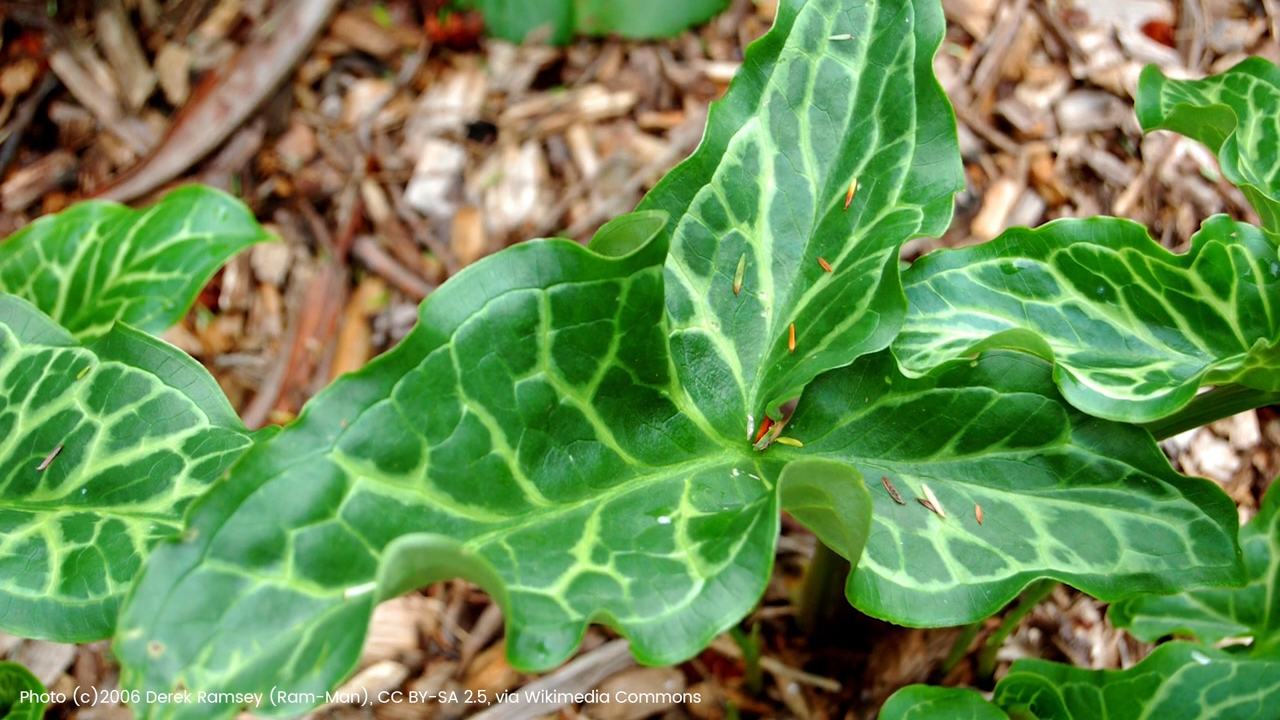
Most of the plants we have at home belong to the big family of the Araceae, which takes its name from the most representative genus, the Arum, like the Arum italicum, also native to Italy. But among the ranks of this family we find other well-known names: calla lilies, Photos, Philodendron, Anthurium, Caladium, Colocasia, Alocasia, Aglaonema, Spathiphyllum, Syngonium, Dieffenbachia, Zamioculcas.
In particular, the Monstera genus, together with the Rhaphidophora genus (to which the Monstera minima belongs), Epipremnum and Scindapsus, belongs to a subfamily of the Araceae called “Monsteroidee”, therefore today we have the rare possibility of seeing how the anthesis evolvesthat is, the evolution and development of the floral systems of the Monstera Albo Variegata.
The flowers of the Monstera Albo Variegata
The inflorescences typical of the Araceae are made up of one fallow (i.e. a central part that leads to the floral elements) and then one spadethen a transformed leaf that wraps the spadix and protects it, revealing it a little at a time. On the axis of the spadix, in the Monstera genus and in the Monsteroidea group, the flowers develop, which are hermaphrodites.
A hermaphrodite flower is a flower that bears both the female parts (pistils, with the ovules inside) and the male parts (anthers with pollen). This is not a common rule for the Araceae, in the Aroidea subfamily, for example, on the spadix we find very distinct unisexual flowers, the male flowers at the top and the female ones at the bottom, in the middle there is often an area of sterile flowers. It would seem that everything is designed to allow the pollen to fall and pollinate the female flowers, but in reality this is not even the case, because as we have seen more than once, plants don’t like to self-pollinatepreferring to have external contributions contribute to the new genome that will develop through the seed. For this reason, sometimes, ripening is staggered, causing the female flowers to bloom first, so that when the male flowers are ready to drop the pollen, the female flowers have already regressed.
The spadix is made up of many small hexagons, the color of which varies from white to green and it is from those hexagons that a powder comes out which is nothing other than pollen. These single hexagonal/pentagonal flowers that make up the inflorescence are composed of a female part which is that part similar to a small eye, inside which we find the stamens which can accommodate the pollen which will then fertilize the ovules which are contained in the underlying part, while the male parts emerge from the areas of conjunction between one flower and another and in fact, from there, the powdery anthers can be seen emerging.
In the lower part of the spadix, there are flowers slightly smaller than the others which secrete a rubbery resin-like material. These flowers do not participate in the pollination process, as they are not fertile, but it is thought that the “rubber” produced could be attractive to some kinds of bees who can use it to build their nests. Naturally, this mechanism was developed to ensure that when the insect goes to get the gum it is smeared with pollen and then carries it to other plants in order to complete the pollination.
Gummy material secreted by flowers
Even the production of rubber is not something that happens in all Monstera, for example, a 2007 study, in which the flowers of Monstera obliqua were studied, in this plant the pollination was done by beetles and the flowers were free of these secretions.
Another very curious phenomenon when talking about the blooms of the Araceae is the ability of many species belonging to this family to produce heat at the flower levelwith a process known as thermogenesis. We had already had the opportunity to talk about this phenomenon with Syngonium, but think that there are flowers of some Araceae capable of raising the temperature of the flowers by 45°C compared to the ambient temperature. This is not the case with the Monstera flower which can “only” increase by 5°C compared to the environmentwhich in any case already makes a big difference for an insect looking for refuge.
Canadian researchers, in this 2009 study, explained very well how anthesis evolves and how pollination works in the Monstera genus, plus they carry out a parallel study, in which they monitor temperatures to understand the incidence of thermogenesis within the process.
The first thing scientists noticed is one succession in the maturation and development of flowers on the same plantin fact the flowers do not develop all at once, but rather one by one. Here is an overview of the phases that we were also able to observe in the nursery:
Day 0, the spathe is completely closed
- Day 0: the anthesis has not yet begun, this can be seen from the spathe which completely envelops the spadix, making it completely inaccessible (or almost).
- Day 1: on the first day of flowering the anthesis begins around 6 in the morning. The stigmas (terminal part of the pistil, are responsible for landing the pollen grain which then enters deeply fertilizing the ovules contained in the ovary of the flower) are already receptive, the scent begins to spread and the spathe begins to open slightly (about 2 mm). The inflorescences will remain like this until the morning of the fourth day, thus showing a very narrow entrance to the floral chamber, where, if you enter, you can already start to perceive the heat, as there is already 2 or 3°C higher than the surrounding environment.
- Day 4: when the sun begins to rise, thus starting the photoperiod, the spathe begins to swell and unfold completely, revealing in its entirety the spadix that it had conquered up to that moment. Between 12 and 2 pm, a small amount of pollen begins to emerge from the male parts of the inflorescence. The first flowers to release pollen are those in the lower area, but always towards midday, the stigmas dry out quickly and become less receptive. Between the evening of the fourth day and the night of the fifth, the sterile flowers at the base of the spadix begin to secrete the gummy resin.
- Day 5: during the morning (from 6 to 8), the flowers begin to produce a large quantity of pollen which is dispersed, falling and being collected inside the spathe. At the same time, the flowers of Monstera deliciosa emit a very strong and very sweet scent. It is in this last male phase that the temperature rises the most, managing to increase up to 5°C higher than the environment.
Pollen starting to shed during the fourth day
This study served the Canadian researchers to compare with the previous study we mentioned before, where it was suggested that the pollination of the Monstera genus was mostly carried out by bees, especially because the gummy secretions could be used to build their nest. The 4 days with the spathe only slightly open also suggest a contribution from other insects, probably beetles, something very similar to beetles.
Also looking at the temperature trend, the idea is that even during the 4 days, as soon as the spathe begins to open slightly, the first beetles can enter and stay inside the flower to enjoy both its protection and the temperature. On the last day of anthesis, during the male phase, these beetles probably cover themselves with pollen and then when the spathe is completely open and the male phase also ends, these beetles will go and take refuge inside another spathe. They will be dirty with pollen and there they will find receptive female flowers, thus also avoiding self-pollination.
latest posts published

Tired of working in the garden? What can be done to reduce maintenance
How to successfully transplant a Christmas tree

Landscaping a new plot: where to start?

What grows in clay: This is what worked on Juste’s farm

Organic seeds: are they worth paying more for?
Preventive spraying of tomatoes with homemade remedies –
Environmental management: how to renovate a bored plot?
Designers answer what are the 3 best plants for the garden
Fruit trees online: how I ordered them and how I planted them